






Edwardian Floral Watercolour
These edwardian floral watercolour pieces bring the bright, domestic charm of British gardens straight to your walls.
Edwardian Floral Watercolour
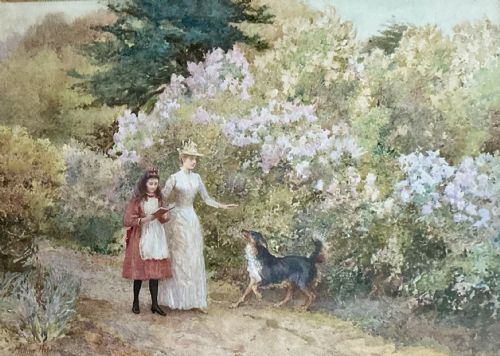
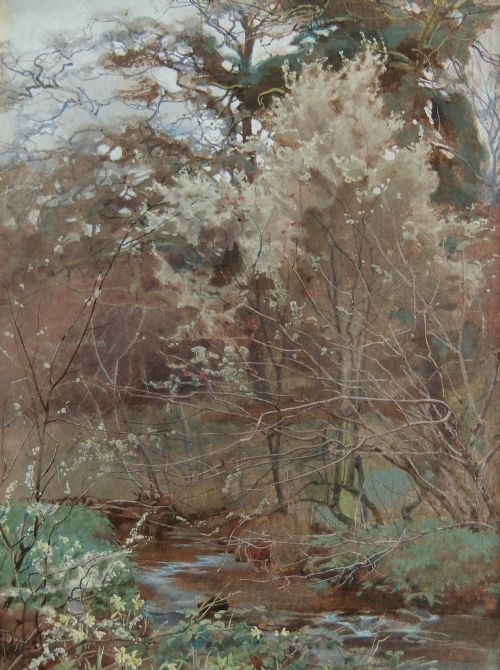
When you search for edwardian floral watercolour, you are looking at works on paper that capture gardens, blossoms, and still life arrangements from the late nineteenth and early twentieth centuries. These paintings record the horticulture and domestic scenery favoured during the Victorian, Edwardian, and British Impressionist periods.
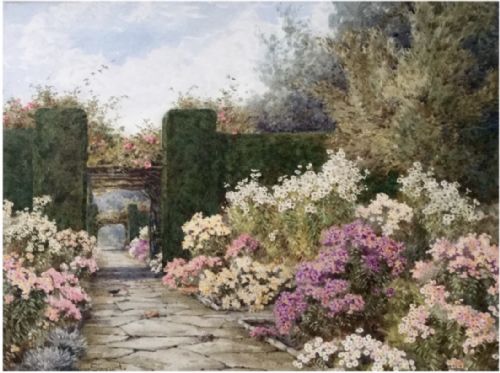
The pieces on this page mostly take the form of wall art and paintings, spanning dates from eighteen-eighty to nineteen-thirty. You will encounter cottage gardens, walled garden seats, and studies of anemones, polyanthus, and pelargoniums rendered on paper.
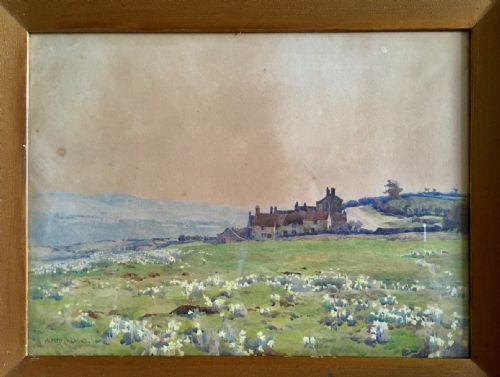
The selection ranges from detailed botanical observations to looser, impressionistic landscapes featuring blooms in London parks and country house settings. Each painting offers a distinct window into historical planting and the British countryside.
How they were made
These works rely primarily on watercolour pigment and watercolour paint applied directly to paper supports. Artists built up their compositions using transparent washes alongside more opaque gouache highlights to give depth to petals and foliage.
Many of these watercolours are housed behind glass within wooden and gilt frames, which helped protect the delicate pigments from moisture and fading over the decades. The combination of paper, pigment, and framing preserves the subtle tones of the original application.
Materials across these listings include paper, watercolour pigment, wood, glass, and gilt.
What varies in quality
The strength of an edwardian floral watercolour rests in the artist's handling of light and botanical accuracy. Superior works display a confident command of brushwork that brings movement to blossoms and foliage without relying on heavy outlines.
Condition also plays a significant role in determining the quality of a piece, particularly the preservation of pigment vibrancy against fading on the paper. Works that retain their original tonal contrast and sit within period wood and gilt frames offer a more complete historical presence.
Arthur Hopkins·Theresa Stannard·Lester Sutcliffe·Lilian Stannard·Alfred W. Parsons·David Woodlock·Alice Macallan Swan·Annie Mary Youngman·Edith Alice Andrews·Beatrice Parsons·George Frederick Nicholls·Arthur H Buckland·Alfred Parsons·Minnie Smythe
The Edwardian Floral Watercolour Glossary
- Watercolour
- A paint consisting of a pigment suspended in a water-based solution. It is traditionally applied to paper in transparent washes to create luminous effects.
- Gilt
- A thin layer of gold leaf or gold paint applied to surfaces such as picture frames. This finish adds a reflective border that enhances the colours within the painting.
- Botanical
- A style of illustration or painting focused on the accurate depiction of plant forms, structure, and colour. These studies served both scientific recording and decorative purposes.
- Impressionism
- An art movement characterised by relatively small, thin yet visible brush strokes and an open composition. British practitioners applied these principles to native landscapes and domestic gardens.
- Support
- The physical material upon which the painting is executed. In this collection, the support is invariably paper.
Edwardian Floral Watercolour: Frequently Asked Questions
Are these watercolours original period works?
The pieces listed date from the late Victorian period through the Edwardian era up to nineteen-thirty.
They are original watercolours executed on paper by named British artists of those periods.
How should I frame and hang them?
These paintings on paper need protection from direct sunlight to prevent the watercolour pigments from fading.
Keep them behind glass and hang them on interior walls away from damp spaces and direct heat sources.
What subjects do these paintings feature?
The works primarily depict domestic gardens, country houses, and detailed studies of spring and summer flowers.
You will also find scenes set in London parks alongside still life arrangements of potted plants.
How do I identify an Edwardian watercolour?
Look for the characteristic soft palette, naturalistic garden subjects, and traditional paper supports typical of the early twentieth century.
Signatures from artists active during the Edwardian and late Victorian periods often accompany these paintings.