


Edwardian Dessert Set
An edwardian dessert set brings fruit, cakes and sweets to the table in fitted boxes with mother of pearl and silver.
Edwardian Dessert Set
When you search for an edwardian dessert set, you are looking at matched table services and cased cutlery designed for serving fruit, cakes and small sweets after a meal. The pieces on this page span the late Victorian, Edwardian and George V periods, stretching from the late nineteenth century into the nineteen-twenties.
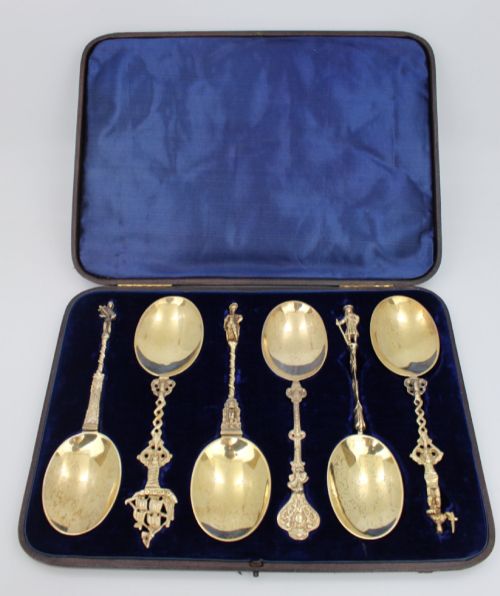
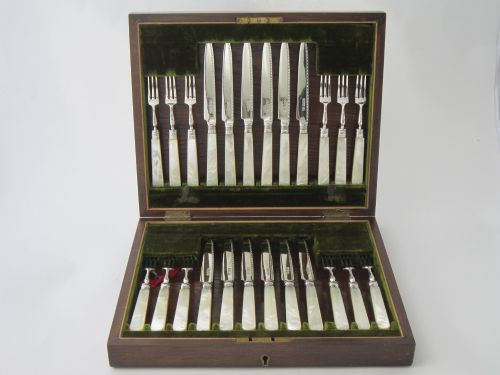
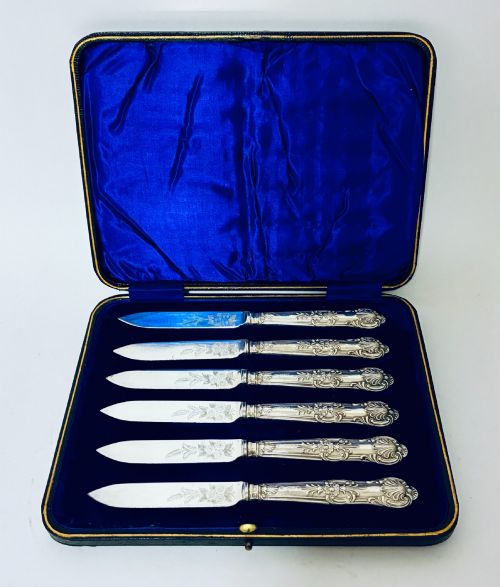
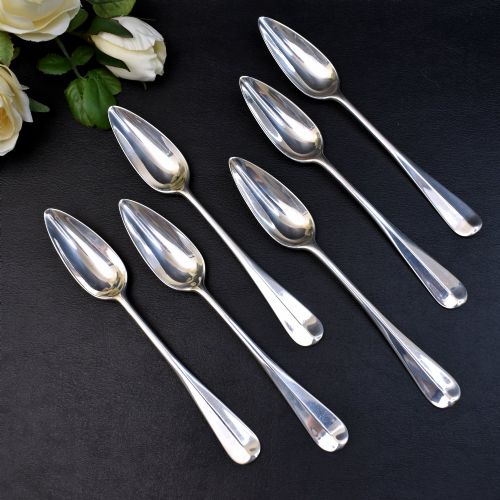
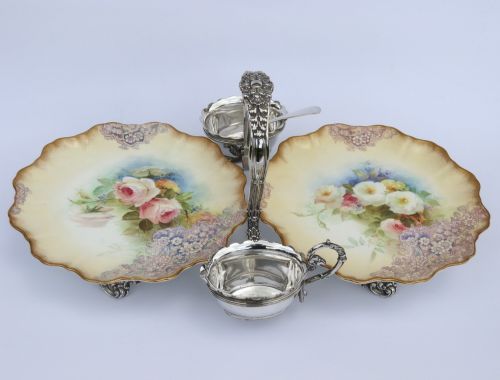
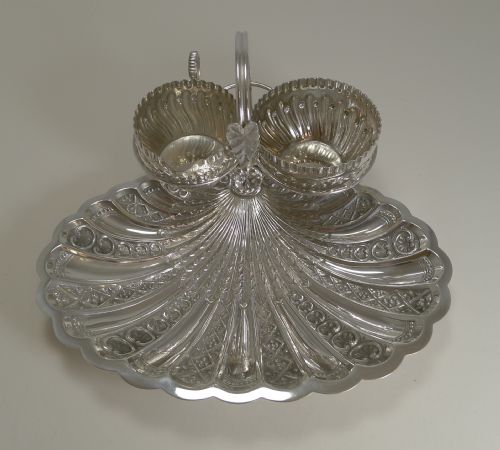
Most examples take the form of boxed cutlery, including fruit knives with mother of pearl handles, cake forks, apostle spoons, grapefruit spoons and serving forks. Alongside these cased flatware sets, you will occasionally find broader dining services featuring ceramic plates paired with silver plated strawberry dishes and finger bowls.
Makers working in Birmingham, Sheffield and Edinburgh produced these fitted sets in polished wooden canteens lined with velvet. They reflect formal dining habits of the period, where specific utensils were required for distinct courses rather than general use.
Materials and construction
Cutlery handles rely heavily on mother of pearl, carved into slender grips and pinned to steel or sterling silver blades. Sterling silver and silver-gilt provide the metalwork for spoons and forks, while silver plate offers a durable alternative over base metals for larger serving dishes and strawberry sets.
Wooden canteens utilise oak or other cabinet timbers fitted with interior slots to secure each piece safely during storage. Linings of velvet protect the polished metal and mother of pearl from friction inside their fitted presentation boxes.
Ceramic elements, such as plates found within strawberry sets, use hand painted earthenware produced by potteries like Doulton Burslem and Royal Crown Derby. Engraving decorates the bowls of spoons and the blades of fruit knives, often featuring floral or geometric patterns.
Listings feature items from the Edwardian, Victorian, late Victorian, George V and Art Deco periods, spanning the years from 1880 to 1930.
Factors of quality
The distinction between standard sets and finer examples lies in the material purity and the completeness of the original fitted case. Sterling silver blades and handles command higher regard than silver plated alternatives, while complete sets with every original fork and knife intact outvalue partial collections.
Maker attribution also elevates a set, with pieces bearing hallmarks from established silversmiths such as Deakin & Francis, Walker and Hall, Hamilton & Inches, or Roberts and Belk showing superior finishing. The quality of the hand painting on associated ceramic plates and the precision of the engraving on metal surfaces further separate standard production from high craftsmanship.
Deakin & Francis·Hamilton & Inches·Walker and Hall·Roberts and Belk·Doulton Burslem·Royal Crown Derby
The Edwardian Dessert Set Glossary
- Sterling silver
- A silver alloy containing 92.5 percent pure silver and 7.5 percent other metals, usually copper, used extensively for quality cutlery.
- Silver-gilt
- Sterling silver that has been coated with a thin layer of gold on the surface, often seen on decorative apostle spoons.
- Mother of pearl
- The iridescent inner layer of pearl oyster shells, shaped and polished to form the handle grips on fruit knives and forks.
- Finger bowl
- A small bowl filled with water, placed on the table after a meal for diners to rinse their fingers.
- Canteen
- A fitted wooden box or chest lined with velvet, designed to store a complete set of cutlery securely.
Edwardian Dessert Set: Frequently Asked Questions
What is an edwardian dessert set used for?
These sets were created specifically for serving post-dinner courses such as fresh fruit, cakes, pastries and grapefruit.
Specific utensils like fruit knives with mother of pearl handles prevented acidic fruit juices from corroding standard steel blades.
How do I know if the cutlery is silver or plated?
Sterling silver pieces carry clear hallmarking stamps indicating the assay office, standard mark and date letter.
Silver-plated items generally lack these official sterling marks and may show base metal underneath where the plating has worn thin.
Are these sets safe to use for dining?
Most cased cutlery sets remain entirely functional for occasional modern dining use when cleaned by hand.
Mother of pearl handles and vintage silver plate require careful hand washing rather than dishwasher cleaning to preserve their condition.
How are different periods distinguished in these sets?
Hallmarks stamped onto the metal provide exact dates and assay office locations for silver items.
Stylistic cues, such as the heavy ornamentation of late Victorian pieces compared to the cleaner lines of later Edwardian and Art Deco designs, also help date the sets.