
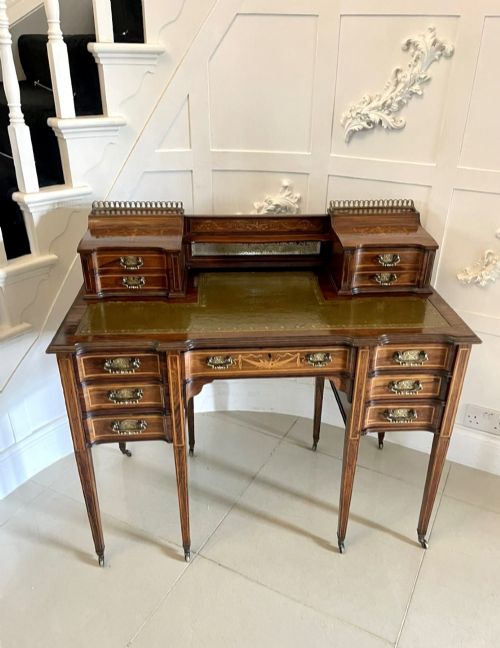
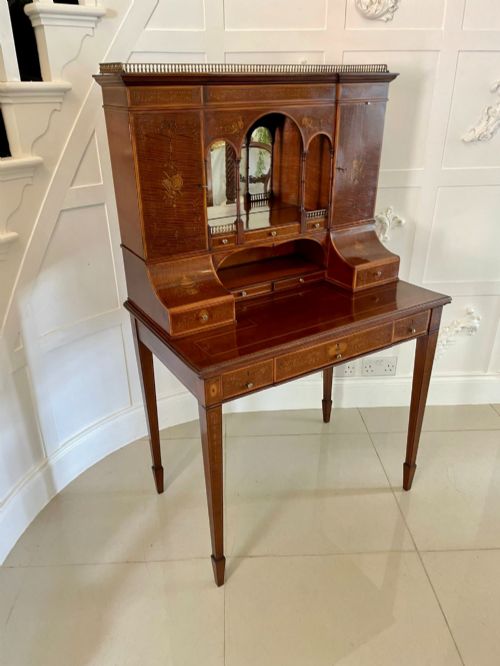
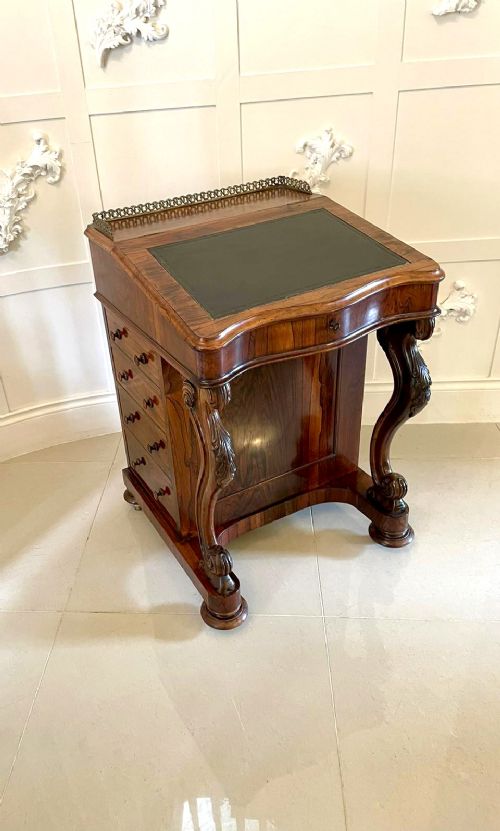
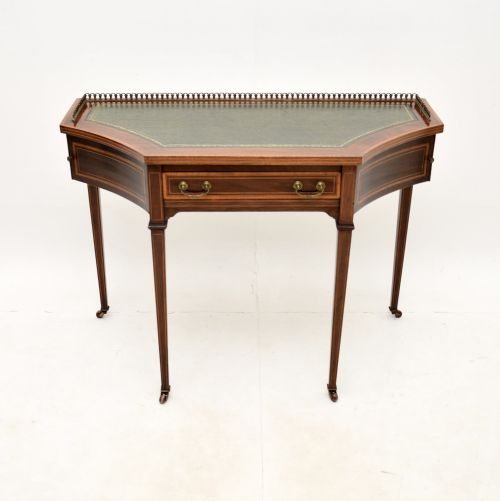
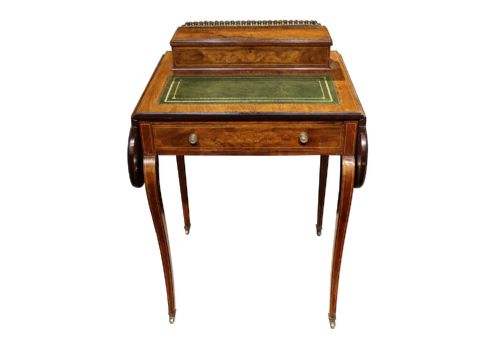
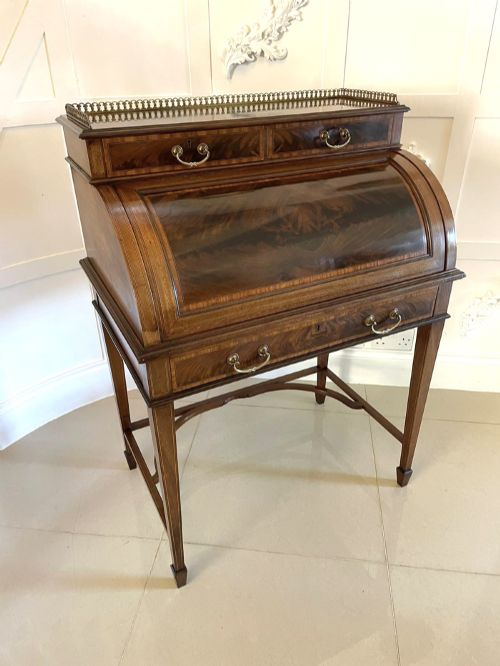

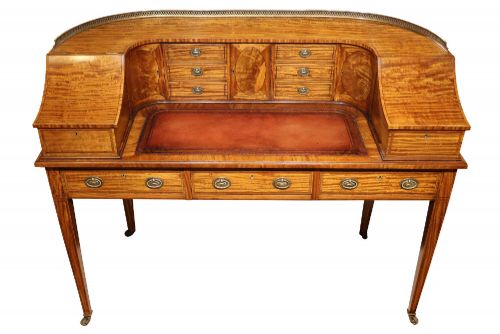

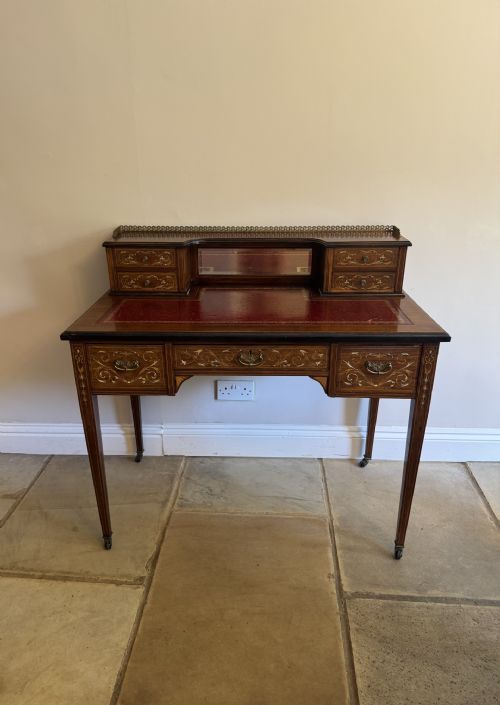
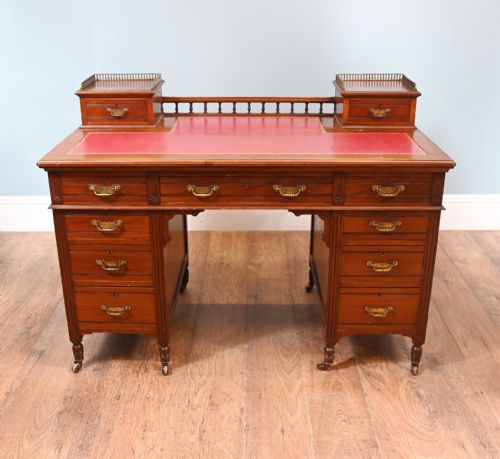


Edwardian Desk Brass Gallery
An Edwardian desk brass gallery secures loose papers whilst framing a refined workspace in polished timber.
Edwardian Desk Brass Gallery
An edwardian desk brass gallery brings together compact writing tables, elegant Carlton House desks, and refined cylinder forms primarily dating from the Edwardian period and late Victorian era. These pieces frequently feature satinwood, mahogany, and rosewood timbers enhanced by detailed inlay and crossbanding.
Buyers encounter writing tables and pedestal desks equipped with a delicate metal rail running along the upper rear edge or superstructure. This protective rail keeps stationery and inkwells secure during daily correspondence.
The selection ranges from simple lady's writing desks to elaborate marquetry-adorned Carlton House desks and fitted bureau models. Many examples display Sheraton Revival influences with balanced proportions and classical stringing.
Materials and construction methods
Cabinetmakers utilised dense hardwoods such as mahogany, rosewood, and satinwood, often applying contrasting veneers, satinwood inlay, and kingswood crossbanding across the writing surfaces and drawer fronts. Oak frequently appears within drawer linings, providing sturdy interior construction for smaller compartments.
Metalwork forms an integral structural and decorative element, incorporating cast brass galleries, original drop handles, and fitted hinges. Fine marquetry work and delicate stringing decorate the primary timber panels, requiring skilled hand-cutting and assembly.
Indicators of superior craftsmanship
The refinement of a piece rests upon the precision of its marquetry, the crispness of the brass gallery fixings, and the choice of cabinet timbers. Superior examples display seamless veneer matching, finely figured grain, and intact original hardware without replacement mounts.
Internal joinery reveals the standard of execution, demonstrated by dovetailed oak drawer boxes and carefully fitted stationery interiors. Pieces bearing maker stamps or attributed to notable workshops command particular attention for their elevated standard of finish.
Maple and Co·Edwards and Roberts
The Edwardian Desk Brass Gallery Glossary
- Brass gallery
- A low metal rail fitted around the upper edge of a desk to prevent items from sliding off the surface. This feature appears frequently on Davenport and Carlton House writing desks.
- Carlton House desk
- A distinctive writing desk featuring a fitted superstructure of small drawers and pigeonholes arranged in a horseshoe shape around the back and sides. These sophisticated desks often incorporate a leather inset writing surface.
- Cylinder desk
- A writing desk featuring a curved wooden cylinder that rolls backward to reveal a pull-out writing slide and pigeonholes. This mechanical roll-top design conceals correspondence when closed.
- Crossbanding
- A narrow strip of veneer applied perpendicularly to the grain of the main surface around the borders of a drawer or tabletop. This decorative technique creates a neat framing effect.
- Marquetry
- Elaborate decorative inlay using various tinted woods, shells, or ivories to form pictorial or geometric patterns on furniture surfaces. It appears prominently on Sheraton Revival pieces.
Edwardian Desk Brass Gallery: Frequently Asked Questions
What is an edwardian desk brass gallery?
An edwardian desk brass gallery is a writing table or bureau featuring a decorative metal rail along the top ledge. This rail stops small items from falling behind the workspace.
Such desks date predominantly from the early twentieth century and late nineteenth century. They combine practical writing surfaces with refined decorative framing.
Are these desks suitable for daily use?
These antique writing desks accommodate modern laptops and paperwork while offering traditional storage compartments. Their solid timber construction provides durable workspaces for daily tasks.
Careful placement away from direct heat sources protects the polished wood finishes and delicate veneer work. Leather writing surfaces benefit from occasional conditioning to maintain their supple texture.
How do I distinguish Edwardian from Victorian desks?
Victorian desks tend to display heavier proportions, darker rosewood or mahogany timbers, and deeper carved details. They often embrace exuberant revival styles.
Edwardian pieces generally exhibit lighter satinwood or mahogany veneers, simpler neoclassical lines, and brighter Sheraton Revival influences. The overall aesthetic feels more restrained and luminous.