



Edwardian Bookcase on Castors
These edwardian bookcase on castors selections combine practical utility with mobility, offering accessible shelving in warm mahogany or oak.
Edwardian Bookcase on Castors
An edwardian bookcase on castors brings useful compartmentalised storage into domestic spaces while remaining light enough to move about the room. The selection spans the Edwardian period, late Victorian years, and the wider nineteenth century, capturing a time of versatile furniture design.
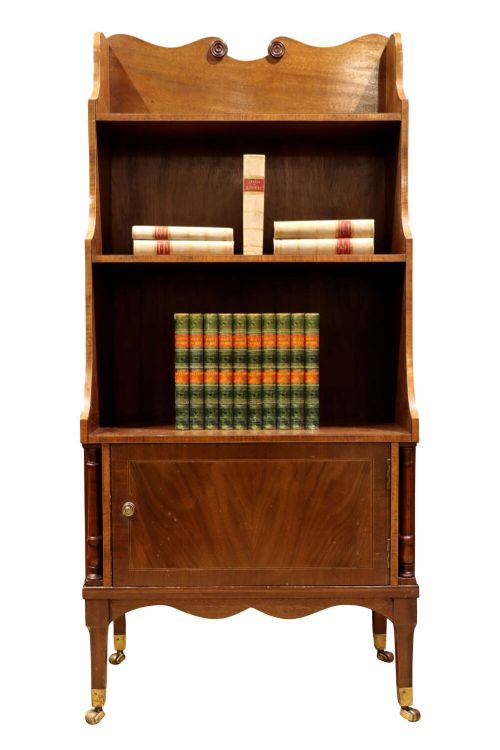
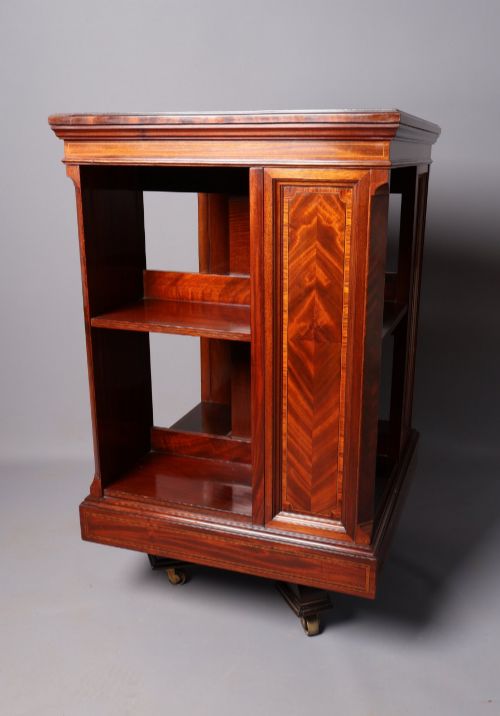
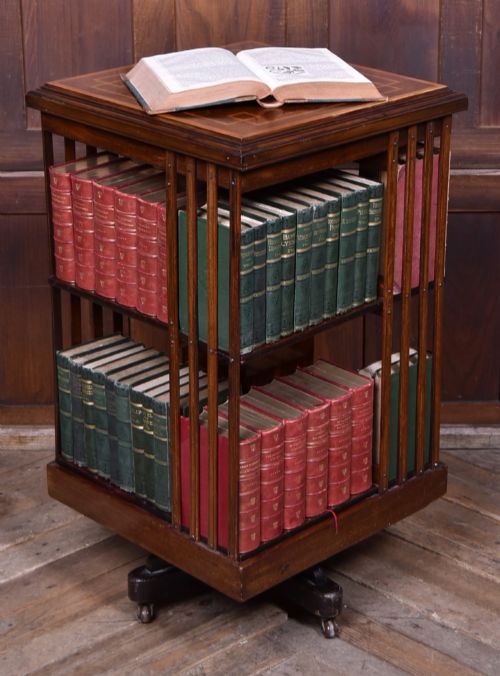
Most examples found here are revolving bookcases or waterfall bookcase cabinets, alongside bookstands and shelving units. Mahogany dominates the offerings, often accented with satinwood inlay, though oak pieces also appear.
The integration of castors allows these pieces to serve active studies and living rooms rather than remaining fixed against a wall. Buyers frequently encounter revolving designs that give rapid access to a desk-side library from a seated position.
Materials and Construction
Cabinet makers relied primarily on mahogany and oak for the structural carcass and shelves, occasionally deploying satinwood inlay for decorative contrast on tabletops and friezes. Timber selection determined both the weight and the visual richness of the finished piece.
Mobility relied on brass and cast iron castors affixed to the feet or bases, allowing heavy loaded volumes to glide smoothly across floor surfaces. Joinery techniques from the period ensured stability under the rotational stress of revolving tiers.
Edwardian Bookcase on Castors Retail Price Guide 2026
Typical asking prices for edwardian bookcase on castors among the pieces listed under this phrase on Sellingantiques today, from the lower quarter to the upper quarter. They describe what is for sale here now, not the wider market.
This site's listings feature mahogany, oak, and brass materials across Edwardian and Victorian periods.
Assessing Quality
Distinction across these pieces rests on the crispness of the satinwood inlay and the selection of timber grain in the primary mahogany or oak boards. Finer examples display meticulous attention to the revolving mechanism, ensuring smooth rotation without wobble.
The presence of original brass castors adds notable character and authenticity compared to later replacements. Proportion and decorative restraint further separate standard utilitarian pieces from finer cabinet work.
Maple and Co
The Edwardian Bookcase on Castors Glossary
- Revolving bookcase
- A tiered wooden shelving unit mounted on a concealed central pivot allowing it to spin freely. This design gave readers access to multiple volumes without needing to change seats.
- Waterfall bookcase
- A standing shelving unit where each successive shelf is slightly deeper than the one above, creating a stepped profile resembling a cascade. They often feature enclosed cabinet space at the base.
- Satinwood inlay
- A decorative technique where contrasting light-coloured satinwood veneers are embedded into the primary mahogany surface. It created delicate floral or geometric borders typical of the period.
- Castor
- A small wheel mounted on a swivel assembly attached to the base of the furniture. They permitted heavy book cabinets to be repositioned easily upon carpets and wooden floors.
Edwardian Bookcase on Castors: Frequently Asked Questions
What rooms suit an edwardian bookcase on castors?
These pieces fit naturally beside armchairs in studies, libraries, or living rooms where quick access to reference books is valued. Their mobility allows them to be shifted easily when rearranging a room.
Because many rotation models occupy a modest footprint, they work well in corners or tight spaces where traditional rectangular bookcases would prove cumbersome.
How do revolving bookcases function mechanically?
A concealed internal pivot and bearing system supports the stacked tiers, allowing the entire wooden structure to turn smoothly by hand. This engineering lets readers browse multiple directions of volumes from one stationary spot.
Quality in these mechanisms shows through steady rotation without sagging or scraping against the lower base.
Are mahogany and oak the only woods used?
Mahogany forms the vast majority of the pieces here, frequently paired with satinwood inlay for decorative contrast. Oak also appears in sturdier, simpler pieces suited to heavier daily use.
Both timbers were selected by makers for their strength and ability to bear the substantial weight of bound books.
How do I distinguish Edwardian pieces from Victorian ones?
Edwardian furniture tends to display lighter proportions and brighter mahogany finishes compared to the heavier, darker tones often found in earlier Victorian items. Inlay work became particularly refined during the Edwardian years.
Both eras overlap in stylistic evolution, making construction methods and secondary woods key indicators of precise age.