


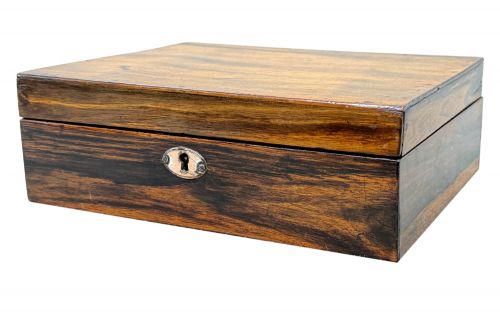


Ebony Storage Box
An ebony storage box brings dark tropical timbers and dense craftsmanship into the room, offering a heavy, tactile vessel for small treasures.
Ebony Storage Box
When you search for an ebony storage box, you enter a field of dark, dense vessels designed to hold tea, trinkets, jewellery, and documents. These pieces range from small trinket boxes and tea caddies to larger coffers, trunks, and table cabinets.
The versions most commonly met on this page date from the nineteenth century, including Regency and Victorian examples. Many bear the marks of colonial trade, arriving from Dutch East Indies, Ceylonese, and Anglo-Indian workshops.
Alongside solid ebony constructions, you will find lighter carcasses faced or inlaid with the dark wood, paired with contrasting materials like mahogany, coromandel, and padouk. Each form serves a domestic function, from desktop organisation to securing valuables.
How they were made
Maker's workshops utilised heavy tropical hardwoods, building carcasses in solid ebony, camphor wood, teak, and padouk, or applying ebony veneers over secondary timbers like mahogany and walnut. This dense wood often forms a stark ground for lighter inlay.
Metalwork played a structural and decorative role, with brass mounts, strapwork, and handles securing the heavy corners of trunks and strong boxes. Bone and mother-of-pearl provide contrasting white geometric or figurative inlays, particularly on Italian Renaissance revival and colonial caskets.
Ebony Storage Box Retail Price Guide 2026
Typical asking prices for ebony storage box among the pieces listed under this phrase on Sellingantiques today, from the lower quarter to the upper quarter. They describe what is for sale here now, not the wider market.
What varies in quality
The standard of a box rests upon the selection of the timber and the precision of its construction. Solid ebony and finely figured coromandel or burr yew command attention through grain depth and natural lustre, whereas secondary timbers rely entirely on the quality of their veneer.
Mounts and hardware also distinguish the work, as heavy cast brass hinges and flush-fitting handles demonstrate a higher order of maker than thin, stamped plate. Similarly, the tight registration of bone or mother-of-pearl inlay reveals the hand of a skilled artisan.
The Ebony Storage Box Glossary
- Caddy
- A small box or chest originally made for storing tea leaves. These containers often featured internal compartments and secure locks.
- Cofer
- A large strong box or chest used for storing valuables and documents. They frequently feature robust brass mountings and carrying handles.
- Coromandel
- A dense, heavily grained cabinet wood from South East Asia and India. It displays dark brown stripes against a lighter background.
- Padouk
- A heavy tropical hardwood showing reddish-orange tones that darken with age. It appears frequently in Dutch East Indies pieces.
- Veneer
- A thin layer of fine wood applied to a secondary timber carcass. This technique allowed makers to utilise expensive dark timbers efficiently.
Ebony Storage Box: Frequently Asked Questions
What did they store inside?
These vessels held a variety of precious domestic items depending on their specific form. Tea caddies preserved loose leaf tea, while trinket boxes and jewellery caskets safeguarded personal ornaments.
Larger coffers, chests, and trunks accommodated heavier documents, textiles, and valuables. Their sturdy construction and locks ensured the contents remained private and secure.
How do I date a piece?
Dating relies on observing the combination of timbers, construction methods, and stylistic cues present in the piece. Regency and nineteenth-century examples often incorporate brass stringing and specific proportions, while seventeenth-century Flemish pieces show heavier architectural mouldings.
Secondary woods visible inside the carcass and the style of the hinges or lock plates also offer clear indicators of age. Comparing the joinery against known period pieces helps confirm the era of manufacture.
Where were they made?
Production spanned British workshops, European centres, and colonial outposts across the globe. Many items reflect trade and craftsmanship from Dutch East Indies, Ceylonese, and Anglo-Indian makers.
European makers in Italy and Flanders also utilised ebony alongside native fruitwoods and walnut. This geographic spread results in diverse regional styles meeting on the same page.
How do I care for ebony?
Keep these pieces away from direct sunlight and sudden temperature shifts to prevent the dense wood and any veneers from splitting. A light dusting with a dry, soft cloth is usually sufficient for daily maintenance.
Avoid heavy liquid polishes and commercial waxes that can build up on the surface or seep into inlaid bone and brass. Occasional treatment with a suitable specialist wood balm preserves the natural sheen of the dark timber.