





Ebonised Walnut Writing Table
An ebonised walnut writing table brings dark elegance and refined utility to a room, offering a striking surface for correspondence and study.
Ebonised Walnut Writing Table
When searching for an ebonised walnut writing table, a buyer encounters dark, polished pieces originating predominantly in the nineteenth century, including the Victorian era and the year 1880. These items encompass varied forms such as French Napoleon III, Louis XV Revival, Louis XVI Revival, and the Aesthetic Movement.
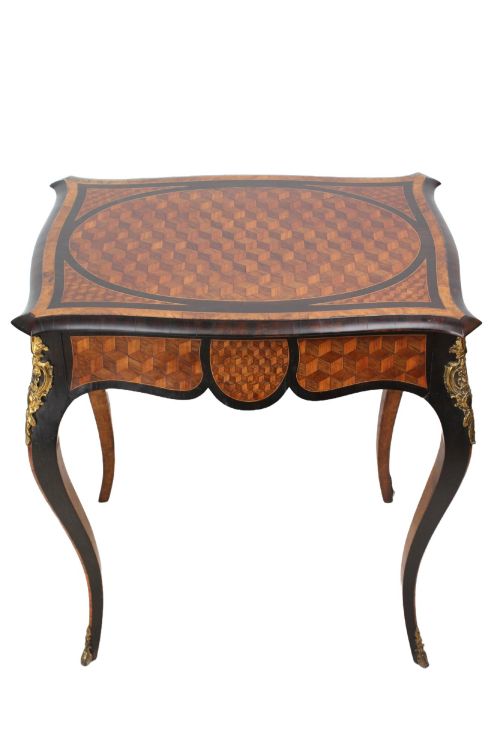
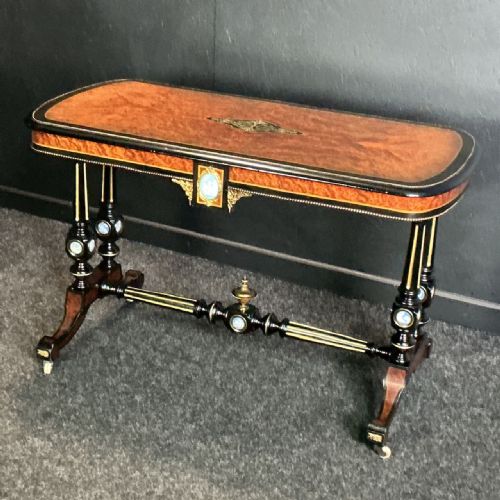
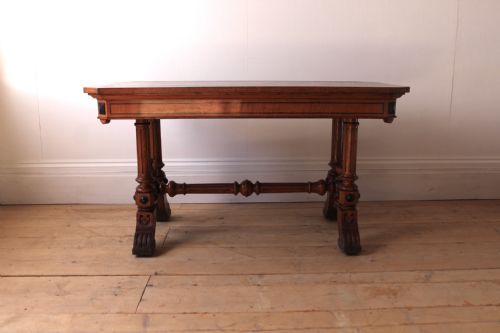
The versions met most frequently on this page span writing desks, centre tables, games tables, and pedestal desks, alongside sophisticated variations like the bonheur du jour and bureau de dame. Such pieces often combine utilitarian workspace with decorative marquetry, parquetry, and gilt mounts.
Origins stretch across English workshops and French ateliers, reflecting diverse revival styles that dominated nineteenth-century interior furnishing. A buyer might find a compact ladies morning room desk or a larger centre table suited to a grander reception space.
Materials and construction methods
Maker workshops built these tables using walnut and burr walnut as foundational timbers, frequently applying a dense ebonised finish to simulate more costly exotic woods or to satisfy contemporary taste for dark furniture. Contrasting veneers like amboyna and rosewood appear alongside inlaid parquetry and marquetry patterns.
Metalwork and ceramics played a significant role in embellishment, with ormolu mounts and brass detailing framing the timber. Selected French examples incorporate Sevres porcelain plaques into the superstructure, demonstrating advanced cabinet-making techniques of the period.
Ebonised Walnut Writing Table Retail Price Guide 2026
Typical asking prices for ebonised walnut writing table among the pieces listed under this phrase on Sellingantiques today, from the lower quarter to the upper quarter. They describe what is for sale here now, not the wider market.
Listings feature nineteen-century pieces spanning the Victorian era and the year 1880, encompassing French and English revival styles alongside the Aesthetic Movement.
Factors of distinction
The hierarchy of these tables rests upon the crispness of the parquetry inlay, the depth of the ebonised polish, and the fidelity of the revival style employed. Superior examples exhibit precise marquetry and harmonious integration of contrasting timbers such as amboyna and walnut.
Hardware and secondary decorative elements dictate the upper tier of the range, visible in the quality of ormolu mounts, cast brass details, and incorporated porcelain plaques. Maker attribution also elevates a piece, distinguishing standard workshop production from signed atelier output.
JAS Shoolbred·Edward’s And Robert’s·Paul Sormani
The Ebonised Walnut Writing Table Glossary
- Ebonised
- Timber treated to resemble ebony through staining or painting. This dark finish was widely favoured during the nineteenth century for furniture styling.
- Ormolu
- Gilded bronze applied as decorative mounts to furniture. It provides bright metallic contrast against dark ebonised wood and walnut surfaces.
- Marquetry
- Inlaid wood veneers arranged in decorative pictorial or geometric patterns. Skilled makers used contrasting timbers to create elaborate surface designs on writing tables.
- Parquetry
- Geometric wood inlay forming patterned surfaces such as cubes or herringbones. This technique frequently decorates the tops of nineteenth-century games and writing tables.
- Bonheur du jour
- A light ladies writing desk featuring an enclosed superstructure with drawers and shelves. These compact desks gained popularity in nineteenth-century French and English interiors.
Ebonised Walnut Writing Table: Frequently Asked Questions
What is an ebonised walnut writing table?
An ebonised walnut writing table is a nineteenth-century desk or centre table featuring dark stained wood over a walnut base, often enriched with marquetry and metal mounts.
These pieces were designed for correspondence and light study, frequently incorporating drawers or elevated superstructures.
How do I style an ebonised walnut writing table?
The dark ebonised finish allows these tables to serve as strong focal points in both traditional and contemporary interiors. They pair well with lighter walls where the silhouette can stand out clearly.
Use the surface for practical writing tasks or display small decorative objects alongside desk accessories suited to the period.
What periods do these writing tables come from?
The pieces listed belong to the nineteenth century, encompassing the Victorian era and the year 1880. Styles include French and English revivals alongside the Aesthetic Movement.
Design motifs draw inspiration from earlier Louis periods adapted to nineteenth-century manufacturing standards.
What materials are used besides ebonised wood?
Construction relies heavily on walnut and burr walnut beneath the ebonised surface. Secondary timbers such as rosewood and amboyna appear in veneers and inlay work.
Decoration frequently includes brass, ormolu mounts, and porcelain elements on more elaborate French examples.