




Eastern Accent Table
An eastern accent table brings intricate geometry and rich surface craft into a room, offering a distinct focal point through carved woodwork and metal inlay.
Eastern Accent Table
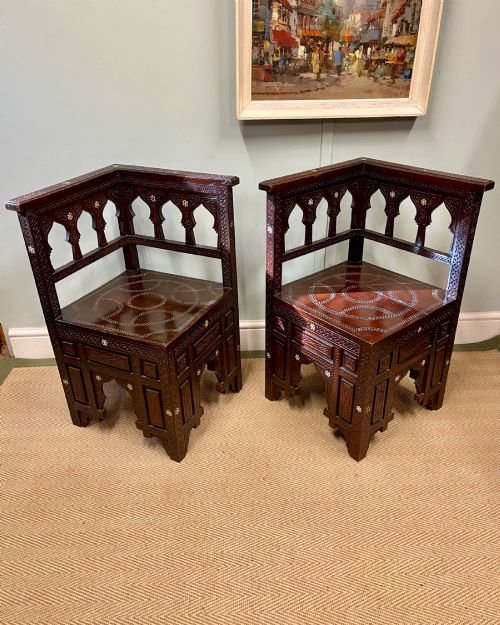
An eastern accent table encompasses diverse low and occasional tables rooted in Moorish, Syrian, Persian, and Anglo-Indian traditions. These pieces include hexagonal and octagonal side tables, two-tier tables, and corner pieces designed for compact display.
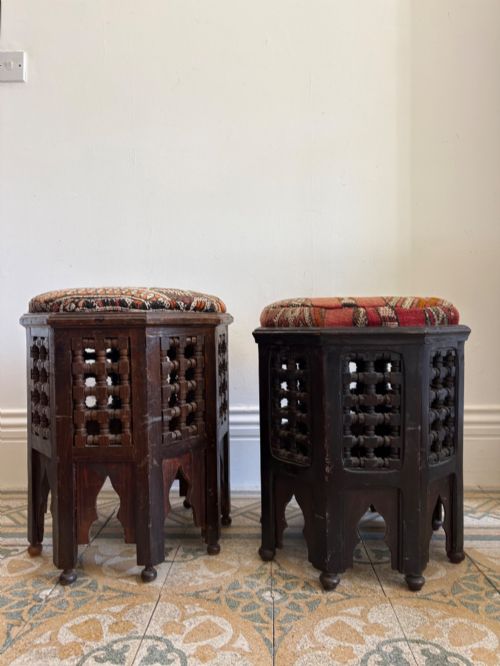
Most examples found here date from the nineteenth and early twentieth centuries, spanning Victorian interpretations and revival periods. Makers utilised rich regional vocabularies, producing forms such as octagonal occasional tables and low stools topped with kilim tapestry.
Buyers will encounter distinct regional sub-types, notably Syrian tables featuring extensive inlay work and Moorish tables defined by geometric lattice and openwork. The selection balances functional side tables with decorative centre tables.
Materials and construction methods
Construction relies on dense hardwoods such as walnut and rosewood, carved by hand into complex geometric frames and folding supports. Joinery often incorporates intricate interlocking panels that form hexagonal or octagonal footprints without standard nails.
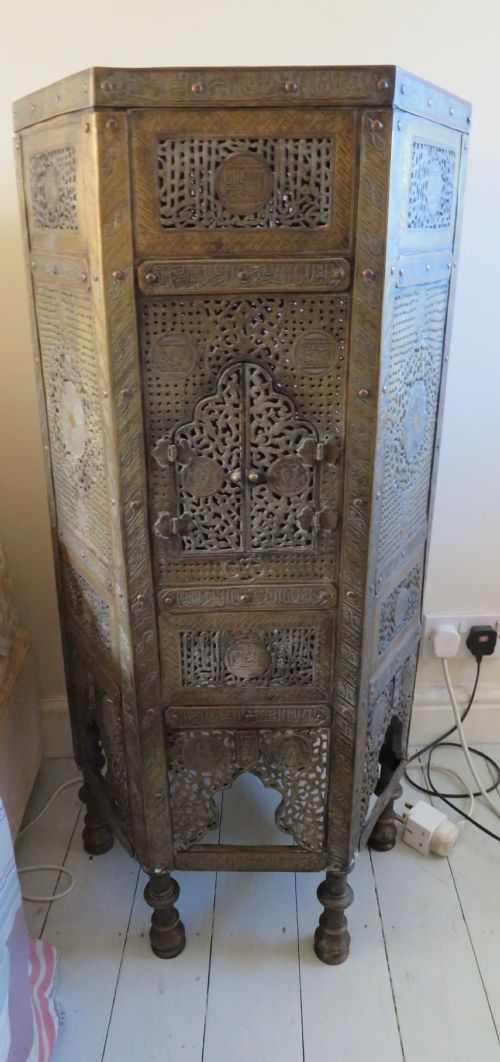
Surface ornamentation defines these tables, utilising contrasting materials pressed directly into the timber or metal core. Artisans inlaid mother-of-pearl, bone, white-metal, copper, and brass into carved recesses to create elaborate geometric and floral motifs.
Metalwork forms an alternative to carved wood, seen in brass and copper tables featuring chased or engraved surfaces. Some items integrate textiles, pairing carved wooden bases with woven kilim tapestry seat covers or upholstery.
Eastern Accent Table Retail Price Guide 2026
Typical asking prices for eastern accent table among the pieces listed under this phrase on Sellingantiques today, from the lower quarter to the upper quarter. They describe what is for sale here now, not the wider market.
Materials documented across the inventory include walnut, hardwood, brass, copper, bone, mother-of-pearl, and kilim tapestry.
Judging the quality of craftsmanship
Quality rests primarily on the precision and density of the surface decoration, whether hand-carved woodwork or inlaid metal and shell. Superior examples display tight, uniform geometry in the inlay work without gaps around the mother-of-pearl or bone elements.
The integrity of the timber and the stability of the frame indicate higher execution standards, especially in octagonal and multi-tiered forms. Pieces retain their structural firmness when joints remain true and the carved lattice work shows crisp edges.
Liberty and Co
The Eastern Accent Table Glossary
- Moorish Revival
- A nineteenth-century architectural and decorative style drawing on Islamic design principles, characterised by horseshoe arches and intricate geometric lattice work. This aesthetic heavily influenced the creation of European-market occasional tables.
- Kursi
- A traditional low table or stool originating in the Middle East, often hexagonal or octagonal in shape. These pieces serve as functional coffee or side tables in modern interiors.
- Mother-of-Pearl
- The iridescent inner layer of certain mollusc shells, harvested and shaped into delicate geometric tiles for surface inlay. It creates striking contrast when set against dark walnut or hardwood.
- Kilim Tapestry
- A flat-woven carpet or textile utilising traditional tribal motifs from the Middle East and Central Asia. In furniture, these textiles are occasionally repurposed as upholstery for low stools.
- Anglo-Indian
- A descriptive term for decorative arts produced in India during the British colonial period, combining traditional local craftsmanship with European furniture forms. These items frequently employ dense hand-carving and exotic hardwoods.
Eastern Accent Table: Frequently Asked Questions
What is an eastern accent table?
An eastern accent table is a decorative occasional piece drawing on design traditions from the Middle East, India, and North Africa. These tables typically feature intricate hand-carved woodwork or detailed metal inlay.
Common forms include octagonal side tables, low stools, and corner tables produced during the nineteenth and early twentieth centuries. They add textural contrast and geometric pattern to domestic interiors.
How do I style a Syrian side table?
A Syrian side table works well as a standalone bedside piece or paired beside a neutral sofa where its inlaid details can stand out. The intricate surface patterns complement both traditional period rooms and minimalist modern spaces.
Keep decorative objects placed on top minimal to allow the mother-of-pearl or metal inlay work to remain visible. Position the table near a light source to highlight the depth of the carved woodwork.
Are these tables sturdy enough for daily use?
Most antique accent tables are structurally stable for supporting lamps, books, or small decorative items during everyday use. Their traditional interlocking construction distributes weight effectively across the frame.
Avoid placing excessively heavy objects on pieces with delicate folding bases or intricate lattice work. Regular gentle dusting preserves the detailed woodcarving and inlaid elements.
How do I tell Moorish from Anglo-Indian tables?
Moorish tables usually rely on dense geometric lattice work, arches, and mother-of-pearl inlay within octagonal silhouettes. They reflect North African and Middle Eastern architectural motifs adapted for European homes.
Anglo-Indian pieces tend to feature deep, naturalistic floral carvings executed in rosewood or teak, reflecting traditional South Asian woodcarving techniques. Examining the specific motifs and timber types helps clarify the regional origin.