
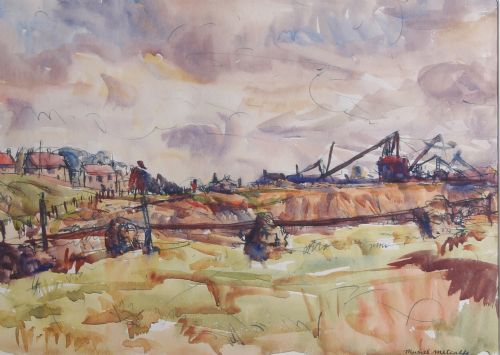


Earth Tone Countryside Watercolour
An earth tone countryside watercolour captures rural landscapes through muted pigments and subtle washes.
Earth Tone Countryside Watercolour
An earth tone countryside watercolour depicts rural scenes using muted, natural palettes ranging from soft ochres to deep browns and muted greens. These works portray valleys, harbours, rivers, and historic architecture across Britain.
Most examples on this page date from the Victorian period through to the mid-twentieth century, encompassing Edwardian and early twentieth century fine art movements. Painters utilised subdued colour harmonies to render the atmospheric conditions of the British countryside.
Original fine art paintings in this category include signed landscapes by named British artists such as Fred Lawson and Sidney James Beer. Buyers encounter framed and mounted works on paper that reflect distinct regional topography from Yorkshire to Surrey and County Wicklow.
How they were made
Artists applied watercolour pigment and watercolour paint directly onto paper support, frequently establishing foundational compositions with graphite underdrawing. The interaction between fluid washes and absorbent paper grounds creates the characteristic transparency of these landscape paintings.
Many works incorporate card mount surrounds to frame the painted surface, protecting the delicate pigments from direct contact with glass. The handling of watercolour ranges from swift, impressionistic strokes to controlled, detailed topographical rendering.
Listings span from the Victorian era through Edwardian times into the 1940s, executed primarily in watercolour on paper with graphite.
What varies in quality
The sophistication of atmospheric perspective and tonal control separates exceptional watercolours from standard topographical records. Superior hands manipulate earth pigments to convey genuine depth, moisture in the air, and shifting light across fields and hills.
The strength of the composition and the confidence of the brushwork determine the artistic merit of each painting. Works that balance detailed architectural elements with fluid, spontaneous washes of colour demonstrate higher levels of draughtsmanship.
Muriel Metcalfe·Alfred George Morgan·Fred Lawson·Sidney James Beer·John Edward Bale·JOHN SOWDEN·THOMAS PYNE·JOHN ABERNETHY LYNAS-GRAY·CHARLES JAMES ADAMS·Yeend King·Sir Ernest Albert Waterlow
The Earth Tone Countryside Watercolour Glossary
- Watercolour paint
- A medium consisting of colour pigments suspended in a water-soluble vehicle. It is applied in translucent washes to paper to create luminous effects.
- Card mount
- A protective paperboard border placed around a painting within a frame. It prevents the artwork from touching the glass and visually separates the image.
- Graphite
- A form of crystalline carbon used for initial sketching beneath watercolour paint. Artists rely on it to map out perspective and composition before applying wet pigment.
- Victorian Naturalism
- An art movement focusing on the detailed, realistic depiction of the natural world. Works in this style observe rural scenery with botanical and topographical accuracy.
- Modern British
- An umbrella term for art produced in Britain during the twentieth century that absorbed continental modernist influences while retaining national landscape traditions.
Earth Tone Countryside Watercolour: Frequently Asked Questions
How should I display a watercolour?
Watercolours require protection from direct sunlight to prevent the pigments from fading over time. Conservation framing with UV-filtering glass helps preserve the paper and delicate earth tones.
Keep them away from damp environments like unheated rooms or kitchens to safeguard the paper support against mould and foxing.
How do I identify the period of a painting?
Stylistic clues such as Victorian academic precision, Edwardian softness, or early twentieth-century modernism provide initial date markers. Signatures, artist biographies, and framing methods also help establish the era of creation.
Period inscriptions on the reverse or mount often record specific locations and dates from the nineteenth and twentieth centuries.
Are these works original paintings?
Every piece listed here is a unique, hand-painted original work on paper rather than a reproduction or print. Artists applied wet paint and pigment directly by hand.
Brushstrokes, pencil underdrawings, and the texture of the paper surface confirm the handmade nature of each painting.