
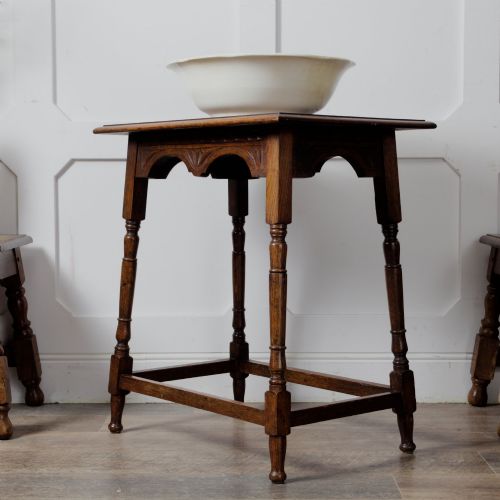


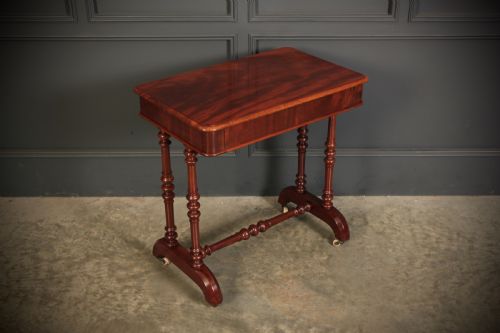


Early Victorian Tea Table
An early victorian tea table is a fold-over surface designed for evening hospitality, offering rich timbers and clever folding mechanisms that transform a console into a dining board.
Early Victorian Tea Table
An early victorian tea table bridges the gap between formal dining and domestic parlor life, serving primarily as a fold-over surface for hospitality and games. The selection centres heavily on mahogany and rosewood forms, alongside occasional oak and marble variants.
Buyers encounter numerous variations on this page, including pillar tables, swivel-top gaming formats, and Pembroke designs. These pieces date from the nineteenth century, spanning decades from the eighteen-forties to the late Victorian era.
The core utility of these items lies in their dual nature, operating as compact side or console tables against a wall before opening out on hinges or pivots. The surviving examples demonstrate how households adapted their living spaces for evening entertaining without permanently sacrificing room.
Materials and Construction
Cabinetmakers relied heavily on solid and veneered mahogany and rosewood, often selecting timber with pronounced grain patterns and flamed figures. These hardwoods provided the structural stability needed for the heavy hinged tops and substantial central pillars.
Brass castors and hinges frequently appeared on the feet and mechanisms, allowing these heavy timber tables to move across carpets with ease. Carved pedestals and pillars added sculptural weight to the base, anchoring the pivoting or folding upper sections securely.
The inventory records card tables, Pembroke tables, pillar tables, and games tables.
Assessing Quality and Craftsmanship
Quality reveals itself in the crispness of carved pedestals and the depth of the timber figure, where flamed mahogany and richly grained rosewood command greater visual presence. Cabinetmakers who spent time selecting matching veneers for the fold-over top produced a more harmonious surface when opened.
The engineering of the swivel and folding mechanism dictates daily utility, with superior examples operating smoothly without sagging or rocking on their central pillars. Heavy, stable bases and tight joinery separate standard utility pieces from workshop items bearing attribution to makers such as Heal & Son.
Heal & Son
The Early Victorian Tea Table Glossary
- Pembroke table
- A drop-leaf table with hinged flaps on two opposing sides, offering adjustable surface area for tea or writing. These often feature a single drawer beneath the top.
- Fold-over top
- A hinged wooden surface that doubles the footprint of the table when opened out for tea or games. The stationary leaf rests on a rotating pivot or a swing leg.
- Pillar table
- A freestanding small table supported by a single central column rising from a platform base or branching feet. This design allows maximum legroom for seated occupants.
- Swivel-top
- A tabletop construction that rotates ninety degrees on its base to reveal a concealed well or to lock the fold-over leaves into a rigid position. It provides secure support for cards and tea services.
- Occasional table
- A small, portable piece intended for specific, intermittent domestic tasks rather than permanent placement. These items include marble-topped and side variants seen across the period.
Early Victorian Tea Table: Frequently Asked Questions
What is an early victorian tea table?
An early victorian tea table is a nineteenth-century timber furnishing featuring a hinged top that folds open to double its surface area. These pieces functioned as sideboards or console tables during the day before being pulled out for evening hospitality.
The form accommodates both tea service and card playing, reflecting the social habits of the period. Mahogany and rosewood are the dominant timbers found in these adaptable items.
How do you use a fold over table?
To use the table, the upper leaf is lifted and pivoted or swung on its hinges to rest upon the expanded frame or a swing leg. This action reveals a finished surface, occasionally with a hidden compartment or green baize lining.
When the evening concludes, the top folds back against itself and the whole unit returns to its position against the wall. The operation relies on sturdy brass hinges and central pivot pins built into the pillar.
Where should I place a tea table?
These tables sit comfortably against a hallway wall, in a drawing room, or behind a sofa when in their closed position. Their narrow footprint makes them practical for circulation in spaces where a full dining table would obstruct movement.
Opening the table requires clear floor space on at least two sides so the leaf can swing freely. Positioning them away from direct sunlight protects the rosewood and mahogany veneers from fading.
How do I tell mahogany from rosewood?
Mahogany generally displays a warm reddish-brown hue with straight or flamed grain patterns that catch the light smoothly. It tends to be lighter in weight than dense tropical hardwoods.
Rosewood presents a darker, heavier appearance with distinct purple-brown streaks and an oily lustre. The natural grain contrast is sharper and more dramatic than that found in standard mahogany pieces.