





Early Victorian Office Desk
An early victorian office desk brings solid mahogany timber, tooled leather inserts and honest proportions to a working room.
Early Victorian Office Desk
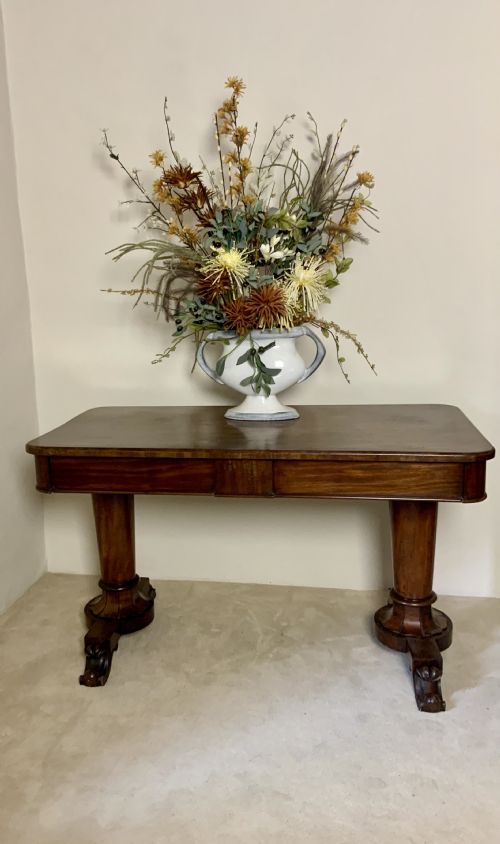
An early victorian office desk encompasses traditional writing tables, kneehole desks and partners desks constructed during the nineteenth century. These pieces serve as practical workspaces while displaying the heavier, structural timber work typical of the period.
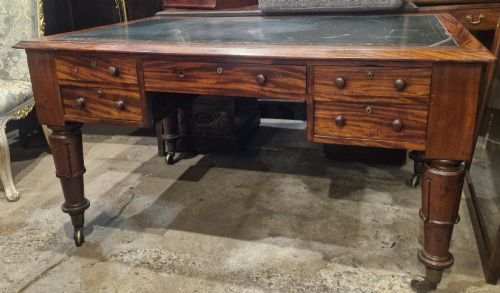
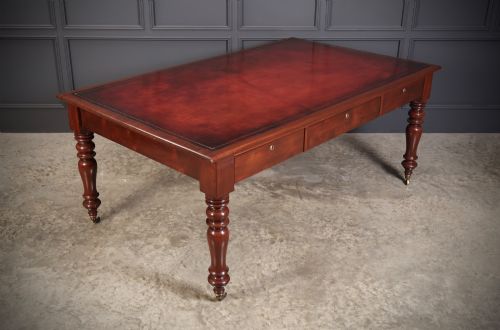
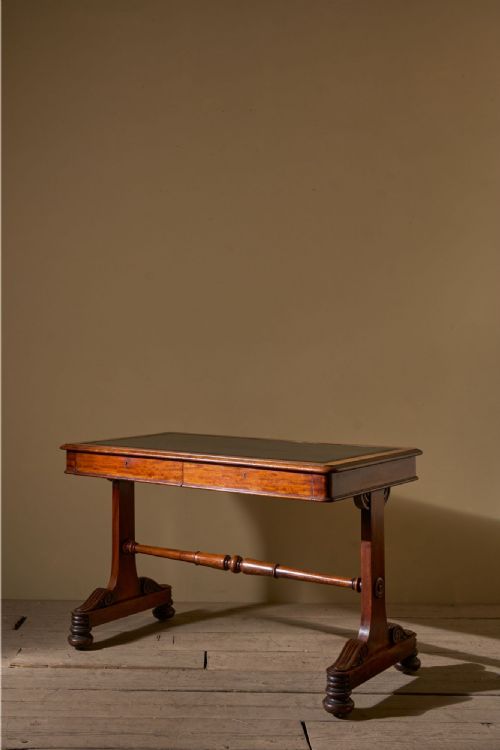
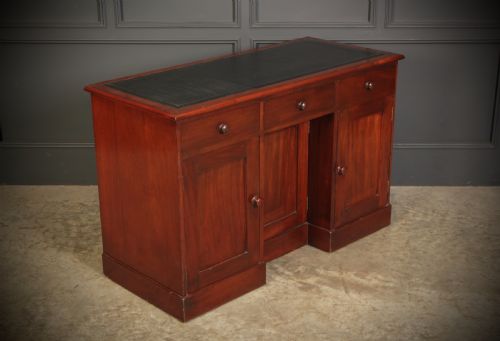
The most common form on this page is the freestanding writing table or pedestal desk, often fitted with drawers beneath the writing surface and finished with a leather insert. Mahogany remains the dominant timber across these examples.
Makers produced these desks to function in libraries, studies and estate offices, employing sturdy carcases designed to withstand daily use.
Materials and construction
Cabinet makers relied primarily on solid mahogany and figured walnut, selecting dense timber for both structural stability and rich grain pattern. Secondary woods were utilised for drawer linings and internal framing.
Surfaces were frequently inset with tooled black or dark leather, providing a smooth writing plane that contrasted with the polished timber surrounds. Brass handles, castors and occasionally locks were fitted to drawers for utility and movement.
Early Victorian Office Desk Retail Price Guide 2026
Typical asking prices for early victorian office desk among the pieces listed under this phrase on Sellingantiques today, from the lower quarter to the upper quarter. They describe what is for sale here now, not the wider market.
Form variations on this page include partners writing tables, kneehole desks, and standard writing tables.
Judgements of quality
The distinction between standard pieces and finer examples rests on timber selection, such as the use of highly figured walnut or faded mahogany with natural patination. Superior desks display careful attention to drawer dovetailing and proportion.
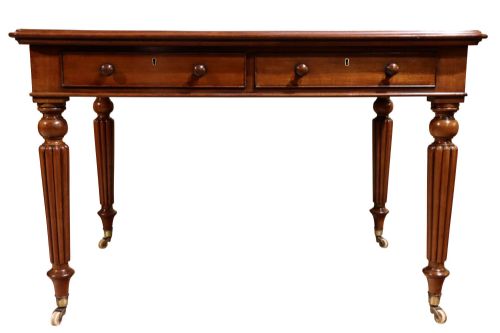
Desks with finished backs, such as partners tables that allow access from both sides, represent a more complex construction than single-sided writing tables. The crispness of the reeded legs or turned details further separates workshop output.
Johnstone & Jeanes
The Early Victorian Office Desk Glossary
- Partners desk
- A large double-sided desk designed for two people to work opposite one another, featuring drawers on both faces. These pieces were standard in institutional or large domestic offices.
- Kneehole desk
- A pedestal desk featuring a central recess for the user's legs, flanked by banks of drawers. This form allows a compact footprint while maintaining substantial storage capacity.
- Writing table
- A freestanding table with one or more drawers beneath the top, intended primarily for correspondence rather than heavy storage. They often feature finished backs so they can sit away from a wall.
- Reeded legs
- Cylindrical furniture legs carved with parallel convex mouldings running vertically. This decorative treatment appears frequently on nineteenth-century table supports.
- Tooled leather
- Leather hide impressed with a decorative gold or blind-stamped border around the perimeter of the writing surface. This traditional finish protected the paper and provided a tactile writing plane.
Early Victorian Office Desk: Frequently Asked Questions
How were these desks used originally?
Originally, these desks served clerks, professionals and landowners for writing letters, managing accounts and organising documents.
Partners desks allowed two individuals to sit facing each other and work at the same time in libraries or estate offices.
How do I fit one into a modern room?
An early victorian office desk works well as a central study table or placed against a wall, depending on whether the back is finished for display.
Pairing the desk with a simple chair allows the wood grain and leather top to function as the focal point of the room.
How do I identify the period?
Period identification relies on timber choice, construction methods such as hand-cut dovetails, and stylistic markers like reeded legs or brass castors.
Desks from this era often bridge late Regency heaviness and mid-Victorian proportions.