



Early Firearms
Early firearms bring tangible martial history to a collection, offering steel, walnut and brass mechanisms from centuries past.
Early Firearms
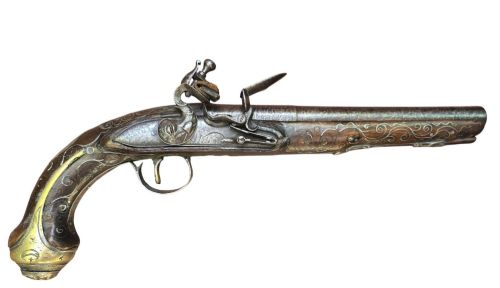
When you search for early firearms, you encounter functional military arms and pocket pistols spanning the eighteenth and nineteenth centuries. These pieces cross domestic British production and wider global workshops, including Ottoman, North African and Indo-Persian examples.
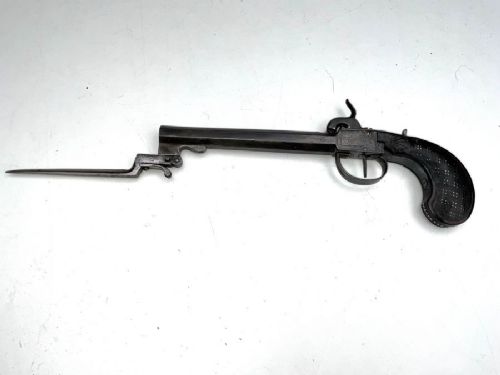
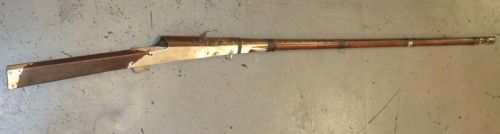
The most common versions on this page are flintlock and percussion pistols alongside matchlock and toe-lock long guns. You find everything from Birmingham proofed pepperboxes to heavy cavalry service arms and ornate holster pistols.
Originating primarily from the Georgian and early Victorian eras, these objects capture the evolution of personal defence and military technology. Regional decorative traditions shape the stocks as much as strict tactical utility does.
Materials and construction
Makers built these pieces primarily using forged steel and iron for the barrels and lock mechanisms, paired with stocks shaped from walnut and assorted hardwoods. Brass and silver appear frequently for furniture, trigger guards, and butt caps.
Decoration relied on skilled handcraft, utilising silver-wire inlay, bone plaques and embossed brass cladding to adorn the wooden grips and long gun stocks. Metal components bore proof marks and sometimes martial motifs cast or engraved directly onto the surface.
Early Firearms Retail Price Guide 2026
Typical asking prices for early firearms among the pieces listed under this phrase on Sellingantiques today, from the lower quarter to the upper quarter. They describe what is for sale here now, not the wider market.
The inventory records pieces originating from British, Ottoman, North Indian and North African workshops.
Judging the quality
Quality rests heavily on the crispness of the metalwork engraving, the intricacy of wire or bone inlay, and the retention of original finish across the steel and brass. Finer workshop production displays tighter wood-to-metal-fit and marked locks by known makers.
The presence of specialised mechanical variants, such as functional revolving clusters or integrated spring bayonets, elevates the sophistication of a piece. Regional decorative depth, from embossed Balkan brass to silver grotesque butt caps, distinguishes standard military issue from bespoke officer or presentation grade items.
J.R. Cooper·R. Willoughby·John Manton·Wilson
The Early Firearms Glossary
- Flintlock
- An ignition mechanism utilising a piece of flint held in a cock to strike a steel frizzen, creating sparks to ignite the priming powder.
- Percussion cap
- A small metal cup containing fulminate of mercury placed on a nipple, detonated by the hammer fall to fire the charge after about 1820.
- Matchlock
- An early ignition system where a slow-burning cord match is levered into contact with the priming powder in the flash pan.
- Pepperbox
- A multi-barrelled firearm where the entire cluster of barrels rotates with each shot, common in the percussion era.
- Miquelet
- A form of snaplock ignition featuring an external mainspring widely used in the Mediterranean, Ottoman regions and Spain.
- Bore
- The interior diameter of the barrel, historically measured by the number of round lead balls of that diameter weighing a pound.
Early Firearms: Frequently Asked Questions
How do flintlock and percussion pistols differ?
Flintlocks rely on a flint striking a steel frizzen to generate sparks for ignition, whereas percussion arms use an external hammer striking a primed metal cap placed on a hollow nipple.
Percussion systems generally offered faster, more reliable ignition in damp weather and largely superseded flint mechanisms during the nineteenth century.
Where were most of these arms made?
Production spans domestic British centres such as Birmingham and London, alongside extensive international workshops across the Ottoman Empire, North Africa and India.
English pieces typically reflect military regulation or civilian trade standards, while regional overseas examples display distinct local decorative metalwork and lock types.
How should I display or store them?
Keep metal components lightly oiled and store the pieces in stable, dry environments away from direct heat sources to preserve the original wood and metal surfaces.
Wall mounting requires secure brackets that support the full weight without stressing the lock plates or stock wrist.
How do I identify the period?
Dating relies on mechanical formats, proof marks, stylistic furniture motifs, and occasional maker signatures inscribed on the lock plates or barrel ribs.
Georgian and early Victorian styling cues, alongside transitional mechanism types like early revolvers and pepperboxes, help narrow down the decade of manufacture.