




Eagle Girandole Mirror
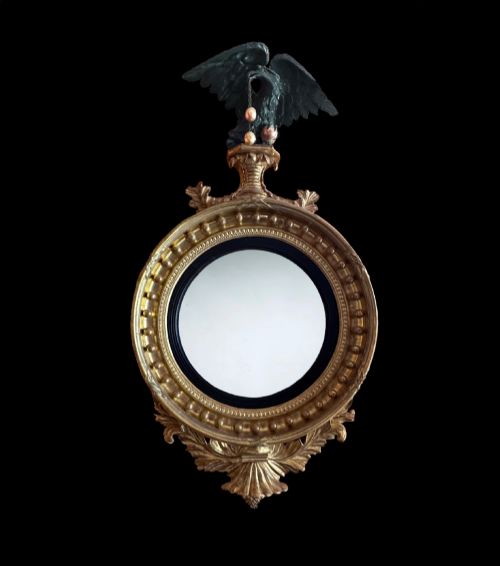
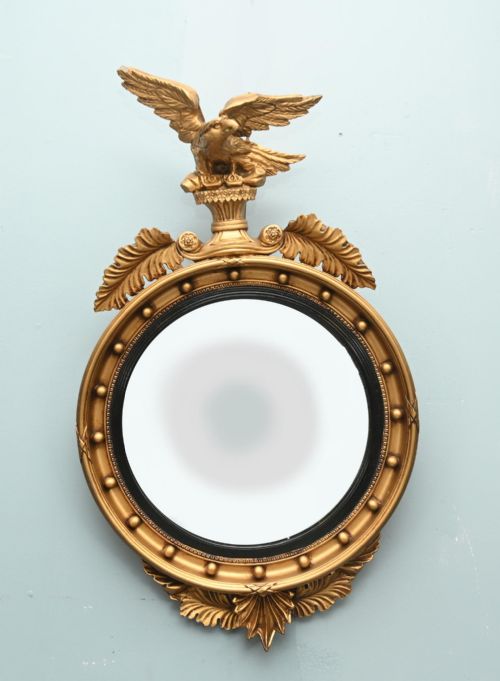
An eagle girandole mirror draws the eye with its carved bird and convex glass, bringing light and dramatic presence to any room.
Eagle Girandole Mirror
An eagle girandole mirror is a round wall hanging designed to reflect and scatter light across a space. When searching for an eagle girandole mirror, buyers will find pieces predominantly from the Regency period, alongside later revivals from the nineteenth and early twentieth centuries.
The defining characteristic of these wall mirrors is the convex glass plate held within a round frame, frequently surmounted by a carved eagle. Most examples encountered here adhere to the Regency style, though occasional Georgian and Victorian interpretations appear.
These convex wall mirrors function primarily as decorative centrepieces rather than functional looking glasses. Their curved surfaces distort perspective playfully, creating a wide-angle reflection of the interior.
Materials and construction
Makers constructed these frames predominantly from timber, applying layers of gesso to build up the intricate surface details before applying gold leaf. Giltwood provides the brilliant metallic lustre seen across the majority of these pieces, though ebonised wood and mahogany also occur.
Mirror glass is set deeply into the round frame, often surrounded by moulded balls or reeded bezels. Crystal elements and brass candle arms complete the girandole form on selected wall mirrors.
Eagle Girandole Mirror Retail Price Guide 2026
Typical asking prices for eagle girandole mirror among the pieces listed under this phrase on Sellingantiques today, from the lower quarter to the upper quarter. They describe what is for sale here now, not the wider market.
Materials recorded on this page include giltwood, ebonised wood, mahogany, brass, gesso, crystal, and mirror glass.
Assessing quality and craftsmanship
Quality in an eagle girandole mirror rests upon the crispness of the carving, particularly around the wings and beak of the perched bird. Superior examples exhibit deep, confident chisel work in the gesso and wood rather than soft or moulded details.
The condition of the gilding and the clarity of the original mirror plate heavily influence the desirability of a piece. Finer mirrors retain their historic convex glass with minimal foxing, while expertly applied giltwood catches the light evenly across the moulded frame.
The Eagle Girandole Mirror Glossary
- Girandole
- A branched wall bracket for candles, often attached to a mirror to multiply the effect of candlelight. This term describes wall mirrors equipped with candle arms.
- Convex glass
- Curved mirror glass that bulges outward towards the viewer. It creates a panoramic reflection of the entire room.
- Giltwood
- Timber that has been coated with gold leaf or gold paint. It provides a bright, reflective finish popular in traditional mirror frames.
- Gesso
- A plaster mixture applied to wood frames to create a smooth surface for carving and gilding. It allows for intricate decorative mouldings.
- Regency
- An English design period spanning the early nineteenth century. Pieces from this era often feature classical motifs and bold decorative forms.
Eagle Girandole Mirror: Frequently Asked Questions
What is an eagle girandole mirror?
An eagle girandole mirror is a round wall mirror featuring convex glass and a carved eagle emblem at the top. These pieces originated primarily during the Regency period and served to brighten rooms by reflecting ambient light.
Their distinctive curved glass creates a wide-angle view of the interior while adding a strong decorative focal point to the wall.
Where should I hang a convex mirror?
These mirrors suit principal living spaces, hallways, or dining rooms where they can command attention as a central wall ornament. Because their convex glass reflects a broad area, placing them opposite a window maximises the distribution of natural light.
Ensure the wall can support the weight of the timber and gesso frame before hanging.
How do I date an antique mirror?
Dating involves examining the construction methods, the composition of the timber and gesso, and the characteristics of the mirror plate. Regency and Georgian examples display hand-carved details and period-specific proportions.
Later nineteenth and twentieth-century revivals often replicate these early styles while utilising slightly different backing materials and assembly techniques.
How do I care for giltwood frames?
Giltwood surfaces require gentle dusting with a dry, soft cloth to prevent the accumulation of dirt without disturbing the gold leaf. Avoid using liquid cleaners, polishes, or abrasive cloths that can damage the delicate gesso underneath.
Keep the mirror away from direct sources of heat and dampness to preserve both the timber frame and the silvering on the glass.