



Dutch Winter Landscape
A dutch winter landscape brings frozen canals, skaters, and low frost-lit skies directly into a room with quiet 19th century authority.
Dutch Winter Landscape
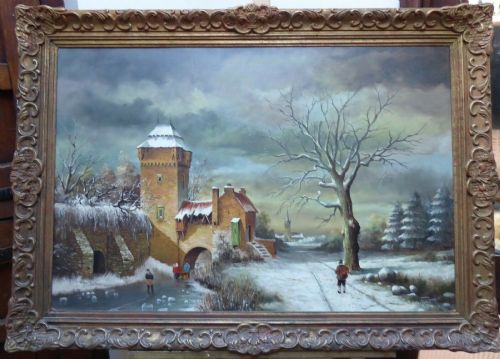
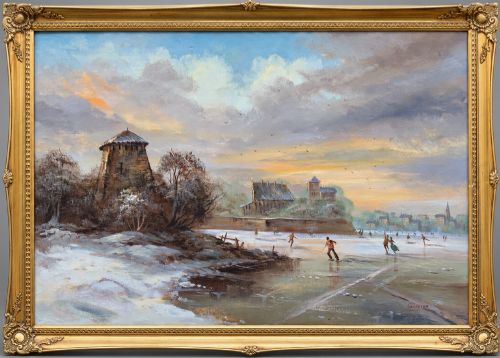
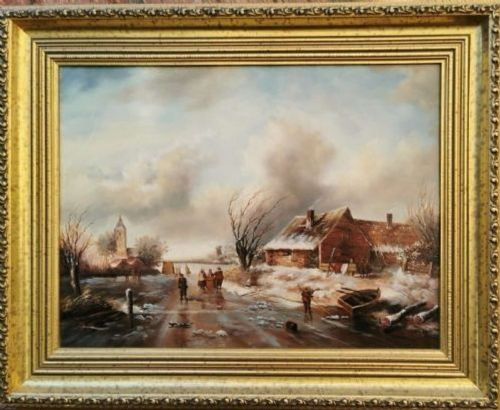
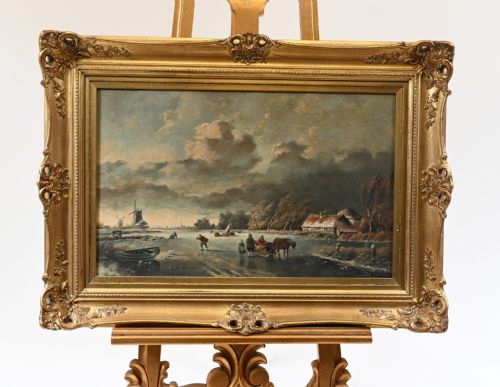
A dutch winter landscape captures frozen waterways, snow-laden townscapes, and figures skating or collecting firewood under crisp seasonal skies. These works span the nineteenth century and mid-twentieth century, drawing on established Dutch School traditions and Hague School sensibilities.
Buyers will most frequently encounter oil paintings on canvas or wood panel, often housed in decorative giltwood frames. The compositions range from expansive river scenes featuring castles and windmills to intimate town views and nocturnal country settings.
Materials and Technique
Artists built these scenes using oil paint applied to prepared canvas or solid wood panels. The medium allowed for subtle blending of pale greys, whites, and icy blues to evoke winter light.
Many of the surviving works sit within ornate giltwood frames that complement the tonal restraint of the painted surface. Panel supports frequently reveal traditional joinery and grain patterns characteristic of nineteenth-century studio practice.
Dutch Winter Landscape Retail Price Guide 2026
Typical asking prices for dutch winter landscape among the pieces listed under this phrase on Sellingantiques today, from the lower quarter to the upper quarter. They describe what is for sale here now, not the wider market.
The selection includes traditional landscape styles alongside Hague School and nineteenth-century realist interpretations.
Factors of Quality
Quality rests in the handling of atmospheric light and the precision of figurative detail on the ice. Masterful brushwork distinguishes works with genuine depth from more formulaic studio repetitions.
The integrity of the canvas or wood panel support and the preservation of the original paint layer determine lasting value. Original giltwood framing that matches the period of the artwork adds further distinction.
Pieter Cornelis Steenhouwer·Alexis De Leeuw·Ludwig Hermann·Louis Smets·Anthonij Anton Mauve·Thomas Heeremans
The Dutch Winter Landscape Glossary
- Oil Paint
- A slow-drying medium composed of pigments suspended in a drying oil, typically linseed. This allowed artists to achieve rich tonal gradations in winter skies.
- Giltwood
- Wood carved and coated with a thin layer of gold leaf or gilt powder. These frames often accompany traditional landscape paintings.
- Wood Panel
- A rigid flat support made from timber used by painters instead of canvas. Panels provide a stable ground for detailed nineteenth-century brushwork.
- Dutch School
- A regional classification for artists working in the manner of traditional Netherlands painting. The style emphasises naturalistic light and domestic realism.
Dutch Winter Landscape: Frequently Asked Questions
How should I care for an oil painting on panel?
Keep the artwork away from direct sunlight and sudden changes in room temperature to protect the wood and paint layer.
Dust the surface gently with a soft dry brush and avoid using liquid cleaners on either the painting or the frame.
Are these paintings signed by the artist?
Many examples feature artist signatures or monograms either directly on the canvas or noted within historical gallery records.
Unsigned works often reflect the broader output of the nineteenth-century Dutch School traditions.
What subjects typically appear in these winter scenes?
Common motifs include figures skating on frozen canals, horse-drawn carts on ice, and travellers near windmills or town walls.
Scenes frequently incorporate quiet riverbanks, quay sides, and snow-covered cottages under muted daylight.
How do I identify a nineteenth-century work?
Examine the construction of the canvas stretcher or wood panel, alongside the ageing of the oil paint and varnish layers.
Period framing and stretcher markings often provide reliable clues to the exact era of creation.