

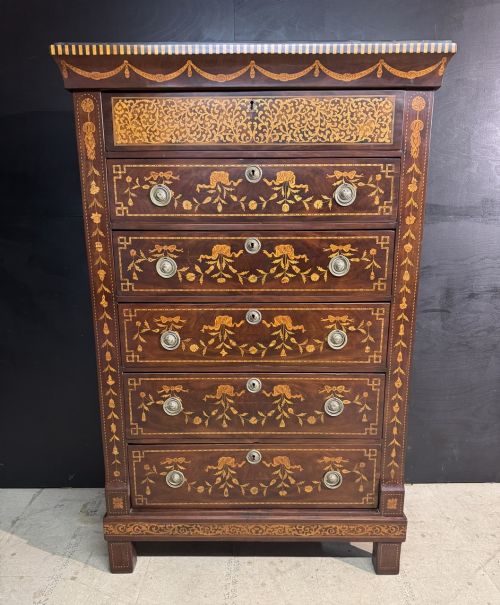
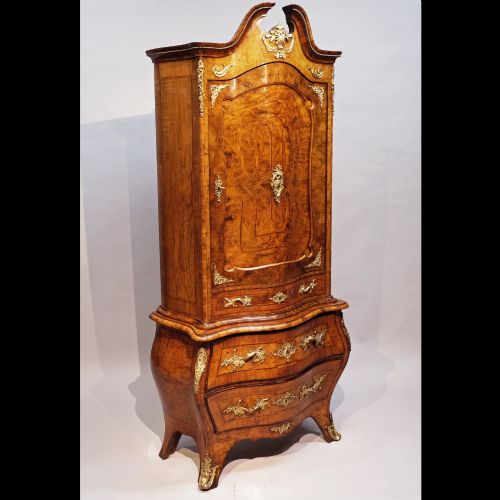


Dutch Marquetry Tallboy
A dutch marquetry tallboy brings exceptional floral inlay and imposing vertical storage into a room, uniting utility with decorative mastery.
Dutch Marquetry Tallboy
A dutch marquetry tallboy provides high-capacity storage through a series of stacked drawers, linen presses, or cabinets. These pieces combine practical domestic storage with elaborate pictorial woodwork.
The pieces appearing here span from the 17th century through the 19th century. Buyers frequently encounter forms designated as chests of drawers, secretaire cabinets, and linen presses.
Stylistic influences range across Dutch Baroque, Rococo Revival, William and Mary, and Dutch Neo-Classical periods. Walnut and mahogany serve as the primary foundational timbers for these towering carcases.
How they were made
Craftsmen built these carcases primarily using walnut, mahogany, and burr walnut as the main structural timbers. Fruitwood, boxwood, and assorted fruitwood inlay were then meticulously fitted into the surfaces to create detailed floral and botanical patterns.
Metalwork details such as brass handles and ormolu mounts were applied to complement the timber work. The creation of these surfaces demanded precise hand-cutting of veneers to secure the intricate marquetry designs across tall facades.
What varies in quality
The refinement of the marquetry design and the complexity of the floral inlay determine the visual standing of each cabinet. Finer examples display meticulous control of fruitwood and boxwood contrasts against the walnut or mahogany background.
The architectural integration of brass hardware and ormolu mounts relative to the scale of the tall chest dictates the piece's overall harmony. Structural integrity within the carcase and drawer construction further separates standard production from superior cabinet-making.
The Dutch Marquetry Tallboy Glossary
- Marquetry
- Decorative veneer work arranged in pictorial patterns. Craftsmen apply thin slices of wood like fruitwood and boxwood to form floral designs across the furniture surface.
- Tallboy
- A tall chest of drawers or cabinet built in vertical sections. This form maximises storage capacity while occupying a compact floor footprint.
- Ormolu
- Gilt bronze mounts used for decorative enrichment on furniture. These metallic elements highlight key architectural sections of the cabinet.
- Linen Press
- A large cabinet designed specifically for storing folded garments and household linens. The upper section typically encloses shelves behind doors above lower drawers.
- Secretaire Cabinet
- A tall furniture form incorporating a fitted writing drawer with a drop-front desk. This combines general storage with a dedicated writing surface.
Dutch Marquetry Tallboy: Frequently Asked Questions
How were these cabinets used historically?
These tall cabinets served as primary storage units for valuable clothing, household textiles, and personal documents within wealthy homes. Secretaire variants offered a private writing space alongside drawer storage.
The vertical construction allowed households to store extensive wardrobes without sacrificing excessive floor space in domestic chambers.
How do I date a dutch marquetry tallboy?
Dating relies on identifying the underlying structural timber, stylistic vocabulary, and marquetry technique. Pieces range from 17th century Walnut examples to 19th century mahogany or fruitwood veneered pieces.
Stylistic shifts between Dutch Baroque, William and Mary, and Neo-Classical periods provide clear chronological markers for the cabinetwork.
Where should I place a tallboy in a room?
A tallboy requires a stable wall position where its vertical proportions and decorative marquetry can be fully appreciated. Adequate clearance is necessary for opening drawers and cabinet doors safely.
Placing the piece away from direct sunlight protects the delicate fruitwood inlay and walnut veneers from fading.