

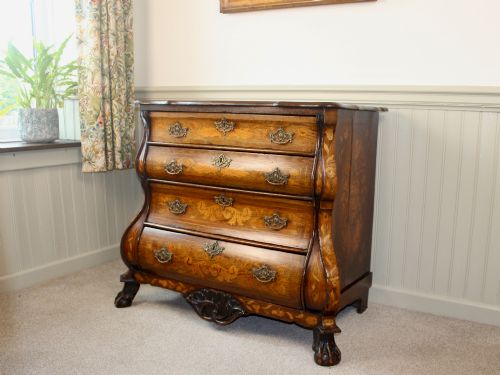


Dutch Floral Commode
These dutch floral commode pieces bring together elaborate marquetry and robust timber forms from across several centuries.
Dutch Floral Commode
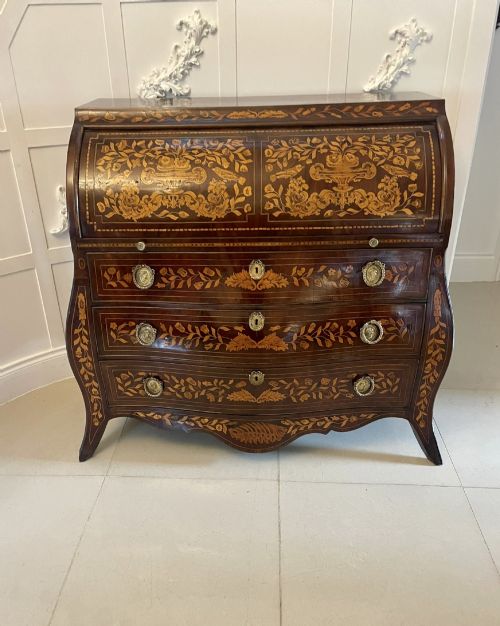
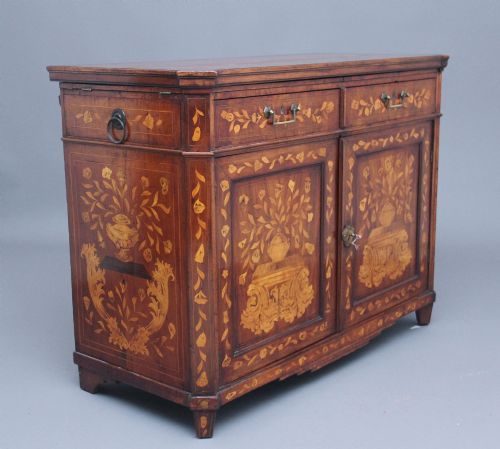
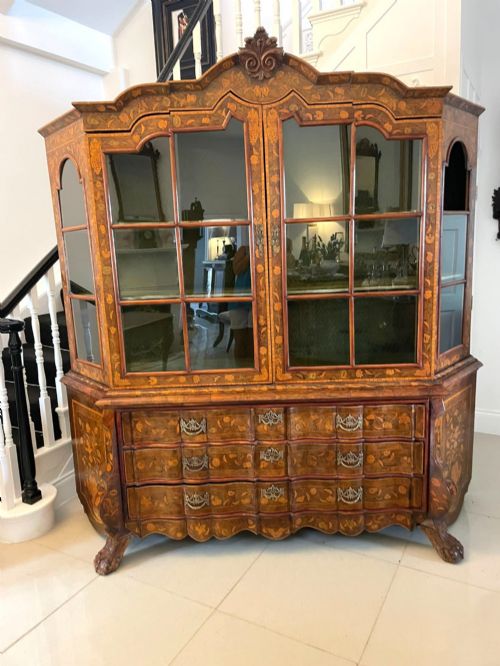
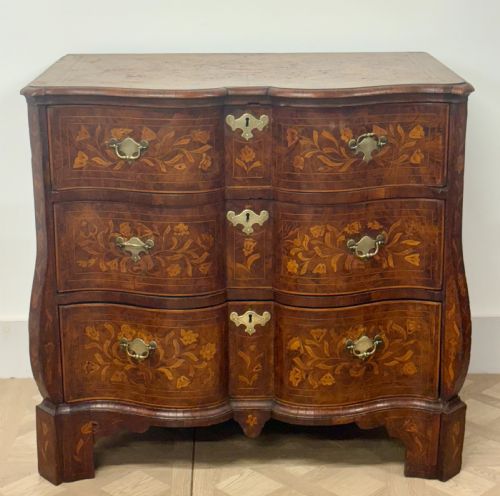
A dutch floral commode primarily manifests as a chest of drawers, bombe chest, or bureau created within the Dutch decorative tradition. The versions most commonly encountered on this page span the 17th, 18th, and 19th centuries, appearing in forms ranging from serpentine chests to tallboys and display cabinets.
Makers and cabinetmakers constructed these items using substantial structural woods like oak, walnut, and mahogany as a foundation. They then covered surfaces with intricate floral marquetry and fruitwood inlay, often shaping the profile into distinct bombe curves.
How they were made
Craftsmen built the carcase and drawer structures using solid timbers such as oak, walnut, mahogany, and pine. They reinforced these sturdy frames to support the extensive decorative veneer work applied to the exterior.
The characteristic floral decoration relies on fruitwood inlay and marquetry techniques, contrasting lighter woods against darker walnut or mahogany grounds. Metal mounts in brass frequently accent the drawers and key escutcheons.
Dutch Floral Commode Retail Price Guide 2026
Typical asking prices for dutch floral commode among the pieces listed under this phrase on Sellingantiques today, from the lower quarter to the upper quarter. They describe what is for sale here now, not the wider market.
Listings feature walnut, mahogany, oak, and fruitwood inlay across 17th, 18th, and 19th-century periods.
What varies in quality
The standard of a piece rests largely on the precision and complexity of the floral marquetry across the facade and sides. Finer examples display meticulous cutting of fruitwood inlay with a high level of botanical detail.
Structural execution also dictates worth, particularly the skill involved in shaping bombe profiles and ensuring drawers operate smoothly within curved carcases. The choice of primary timber, such as burr walnut or figured mahogany, further defines the grade.
The Dutch Floral Commode Glossary
- Marquetry
- A technique of patterning veneer applied to a wood structure to form decorative pictures or designs. In these pieces, it typically depicts elaborate floral arrangements.
- Bombe
- A swollen or bulging out-curved contour characteristic of certain continental furniture forms. This shaped profile requires advanced woodworking skill to execute properly.
- Burr walnut
- Timber taken from a growth on a walnut tree, yielding a swirling and highly figured grain pattern. It provides a rich visual texture for high-status cabinet work.
- Serpentine
- A line or surface that curves outward and then inward in a horizontal wave. This undulating front shape appears frequently on chests from the period.
Dutch Floral Commode: Frequently Asked Questions
How do I clean marquetry?
Marquetry surfaces require gentle dusting with a dry, soft cloth to prevent moisture damage to the delicate fruitwood inlay. Avoid modern chemical polishes that can degrade historical finishes.
Maintaining stable room humidity protects the wood veneers from lifting or cracking over time.
Where were these made?
These pieces originated in the Netherlands during periods spanning from the 17th to the 19th centuries. Dutch workshops developed distinct regional styles including baroque and neoclassical designs.
Master craftsmen in these centres specialised in floral marquetry and shaped furniture forms.
What woods were utilised?
Primary timbers include oak, walnut, mahogany, and fruitwood. Burr walnut and various inlaid woods form the decorative exterior surfaces.
Pine also appears in regional cupboards and carcase construction.