


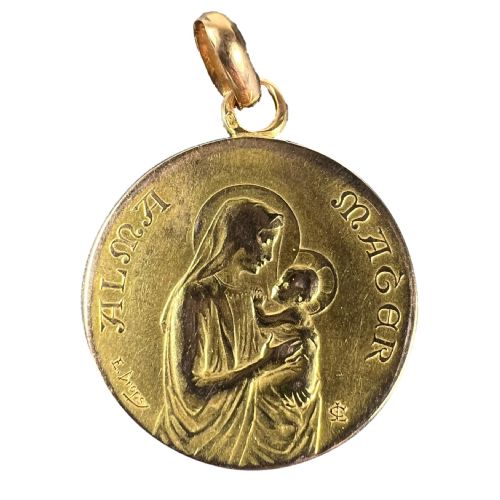


Dropsy Religious Medal
These dropsy religious medal pendants are French devotional works in gold carrying portraits of the Virgin Mary and Jesus Christ.
Dropsy Religious Medal
A dropsy religious medal is a devotional pendant created by the French medalist Emile Dropsy, featuring sacred imagery such as the Madonna and Child or the Virgin Mary. These pieces span the late nineteenth century into the mid-twentieth century, specifically drawing from periods between eighteen ninety and nineteen fifty. Collectors encounter these works primarily as pendants and charms designed for daily wear or personal devotion.
The assortment on this page concentrates on French devotional forms, including Alma Mater, Ave Maria, and Virgo Gloriosa inscriptions. Alongside standard portrait medals, variations incorporate pierced metalwork and enamel details. Each piece functions as both wearable jewellery and a tangible record of early twentieth-century religious craftsmanship.
Materials and technique
The construction frequently includes pierced metalwork, where the background surrounding the holy figure is cut away to create an openwork frame. This technique requires careful piercing by hand to ensure the structural integrity of the gold pendant remains intact. The combination of stamped metal relief and delicate pierced borders defines the physical character of these works.
Dropsy Religious Medal Retail Price Guide 2026
Typical asking prices for dropsy religious medal among the pieces listed under this phrase on Sellingantiques today, from the lower quarter to the upper quarter. They describe what is for sale here now, not the wider market.
Emile Dropsy signed his medals so securely into history that people now search his surname as if it were a medical condition.
Quality variations
The standard of a dropsy religious medal rests upon the crispness of the stamped relief and the depth of detail in the facial expressions of the Madonna or Christ. Superior examples exhibit sharp contours in the hair, garments, and lettering such as Ave Maria, whereas simpler pieces show softer definition from worn dies. The clarity of the maker's artistic hand dictates the overall distinction of the pendant.
Additional craftsmanship in enamel work or intricate pierced borders elevates certain pieces above standard production medals. Plique-à-jour enamel requires immense skill to execute without flaws in the translucent panels, marking out exceptional items. The presence of these refined decorative elements distinguishes standard devotional tokens from finer art medals.
Emile Dropsy
The Dropsy Religious Medal Glossary
- Plique-à-jour
- An enamelling technique where enamel is applied in cells without a backing, resembling miniature stained glass. This lets light shine directly through the translucent colour.
- Devotional medal
- A small metal pendant worn for religious protection, prayer, or commemoration of a sacred figure. These objects serve both spiritual and ornamental purposes.
- Medalist
- An artist or sculptor who designs and produces medals, coins, and medallions. Emile Dropsy is a notable figure in this tradition.
- Pierced work
- Metal ornamentation created by cutting or sawing openings through the plate to form a decorative pattern. This lightens the piece and adds visual depth.
- Alma Mater
- A Latin phrase meaning nourishing mother, frequently inscribed on devotional medals dedicated to the Virgin Mary. It appears alongside Marian imagery.
Dropsy Religious Medal: Frequently Asked Questions
What is a dropsy religious medal?
A dropsy religious medal is a French devotional pendant designed by the medalist Emile Dropsy, featuring sacred figures like the Virgin Mary or Jesus Christ.
These pieces were produced from the late nineteenth century through the mid-twentieth century, primarily cast in yellow and rose gold.
How were these medals worn?
These items functioned as pendants and charms, suspended from chains around the neck or attached to bracelets.
They served as personal objects of faith, often marked with inscriptions such as Ave Maria or Virgo Gloriosa.
What materials are used?
The listings consist entirely of gold constructions, predominantly eighteen karat yellow gold alongside occasional rose gold variations.
Certain examples incorporate vitreous enamel and plique-à-jour techniques to add colour around the central figures.
How do I identify the period?
Dating relies on the stylistic markers of the periods represented, which stretch from eighteen ninety through nineteen fifty.
Art Nouveau influences appear in pieces from the early nineteen hundreds, visible in the flowing lines and organic borders surrounding the medals.