
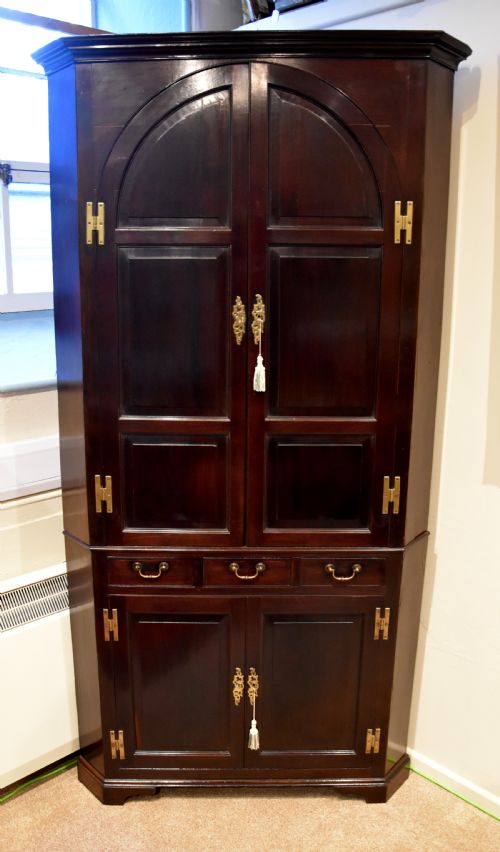


Double Corner Cupboard
A double corner cupboard solves the perennial dilemma of awkward room junctions by turning empty angles into display space.
Double Corner Cupboard
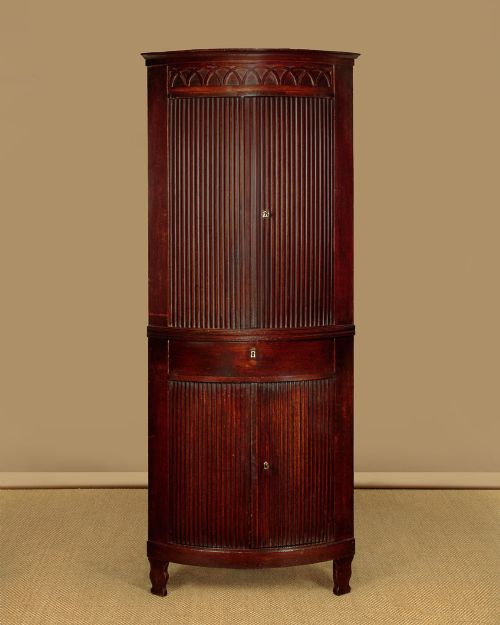
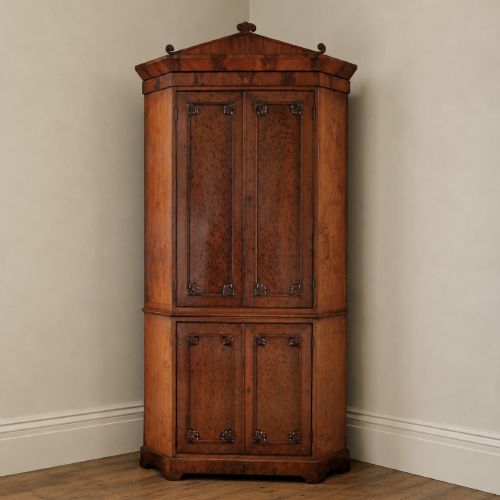
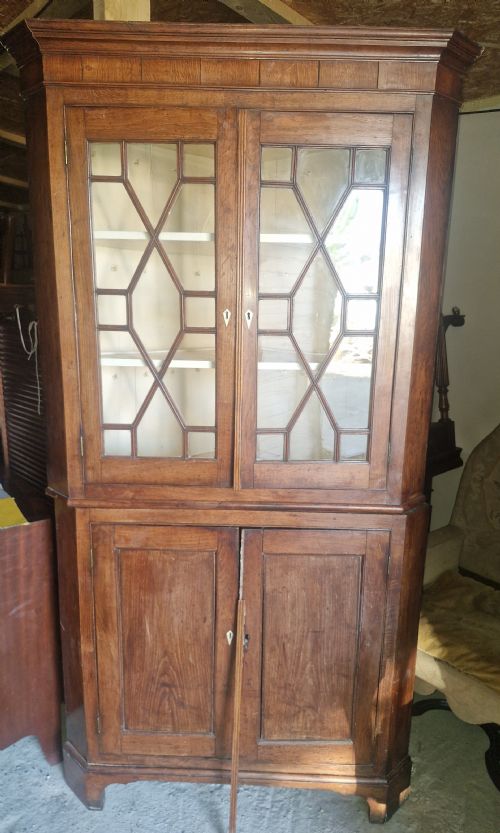
A double corner cupboard is a large piece of furniture designed to fit squarely into the 90-degree angle of a room, utilising vertical space efficiently. Most examples encountered here are two-part standing pieces or double-height cabinets, combining a shelved upper section with a lower cupboard base.
Makers constructed these cabinets to bridge practical storage requirements with decorative ambition. They suit dining rooms and sitting rooms where perimeter wall space is at a premium.
How they were made
Cabinet makers relied primarily on native oak and imported mahogany, frequently selecting Cuban varieties for dense grain and deep colour. Secondary timbers such as elm and walnut appear in structural elements, whilst satinwood inlay and brass hardware provide decorative contrast.
Construction methods involve joining timber carefully to withstand the seasonal movement inherent in large corner units. Glazing bars divide the upper doors into geometric panes, and marquetry details ornament the more decorative Edwardian and Georgian surfaces.
Listings feature oak, mahogany, walnut, and satinwood across Georgian, Regency, and Edwardian periods.
What varies in quality
Quality rests on the selection of timber and the precision of the cabinet work. The figuring of the mahogany or the choice of quarter-sawn oak sets finer pieces apart from utilitarian versions.
Proportion and decorative restraint dictate the visual success of the piece. Crisp marquetry inlay, well-proportioned glazing bars, and original brass fittings elevate the standing of a cabinet within its period.
Edwards And Roberts
The Double Corner Cupboard Glossary
- Double height
- A cabinet built in two distinct vertical sections, typically with an upper display case resting on a lower cupboard base.
- Bow front
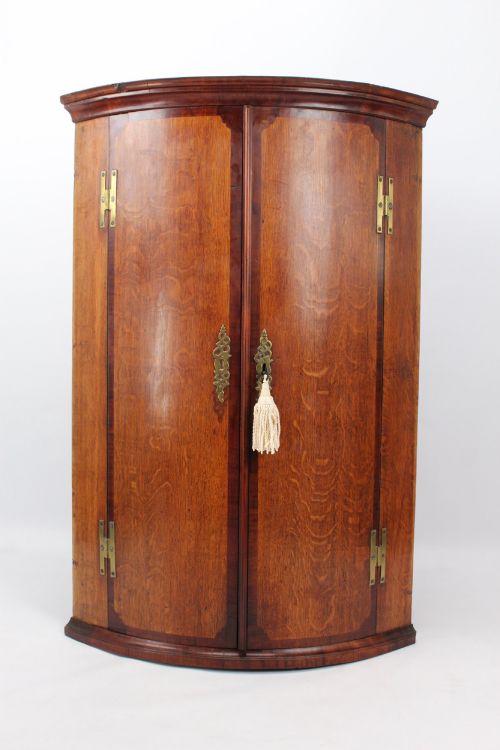
- A convex curved cabinet front that projects outward from the corner angles.
- Marquetry
- Decorative patterns formed by inserting pieces of contrasting veneer into wood panels.
- Glazing bars
- The wooden strips that hold individual panes of glass within a cabinet door.
- Serpentine
- A front shape curving inward centrally and outward at the sides in a continuous sweep.
Double Corner Cupboard: Frequently Asked Questions
How do I fit a double corner cupboard into a modern room?
Measure the wall depth and angle carefully before placement, as these tall two-part pieces require stable contact with both adjacent walls. Their footprint fits neatly into unused corners, freeing up linear wall space for other furniture.
Position the cabinet away from direct heat sources to protect the polished timber surfaces and historical veneers from drying out.
What is the difference between hanging and standing models?
Hanging versions are smaller single-unit cupboards designed to be mounted directly onto wall studs at eye level. Standing models are substantial two-part floor pieces that rest entirely on the ground.
Standing double corner cupboards offer significantly more storage capacity and architectural presence than wall-mounted variants.
How can I tell the Georgian period pieces apart from Edwardian revivals?
Georgian pieces rely on structural proportion, timber figuring, and traditional joinery such as hand-cut dovetails. Edwardian revivals often incorporate lighter satinwood inlay work and machine-assisted precision alongside older stylistic cues.
Examine the secondary woods inside the cupboard carcase to help clarify the period of manufacture.
Were these cupboards used exclusively in dining rooms?
Historically, these cabinets stood in parlours, dining rooms, and hallways to store and display ceramic tableware, glassware, and silver. Their vertical design made them ideal for keeping valuable household goods secure and dust-free.
Today, they serve similar display and storage functions in sitting rooms and studies.