


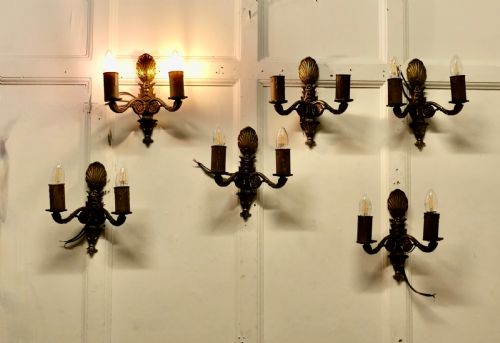

Double Branch Wall Lights
Double branch wall lights bring balanced illumination and architectural symmetry to a room, drawing the eye with paired arms.
Double Branch Wall Lights
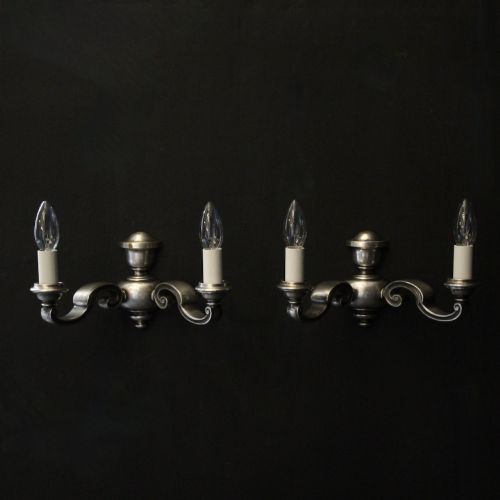
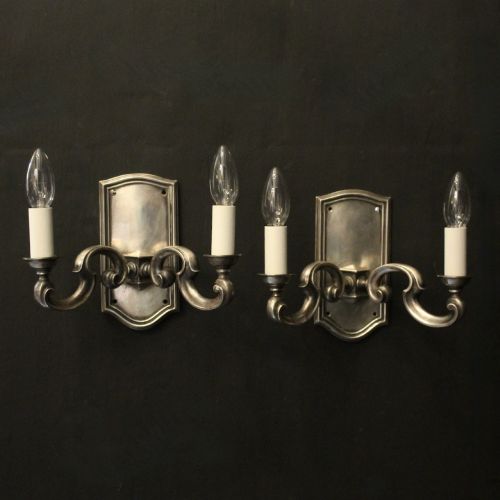
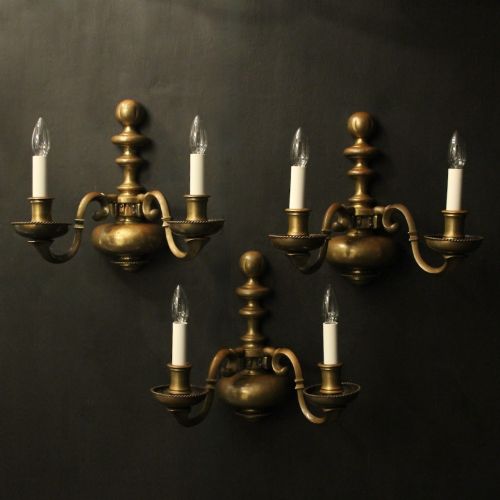
Double branch wall lights provide paired illumination mounted directly to a vertical surface, projecting light outward through two distinct arms. These fixtures appear frequently in pairs or sets, spanning the Victorian and Edwardian eras as well as the 1920s and 1930s.
The physical forms include wall lights and wall sconces fashioned with twin branches, twin arms, or twin lights. French and English origins predominate among the surviving examples.
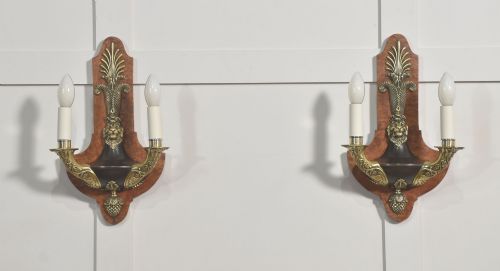
Design influences range from Neoclassical, Georgian Revival, and Adam Revival to French Rococo, Louis XVI Revival, and Empire Style. Giltwood, burr walnut, and various metals shape the silhouettes seen on this page.
Materials and construction
Metalwork forms the structural foundation of most pieces, utilising cast bronze, gilt bronze, brass, gilded brass, and silver plating over base metal. These metallic elements provide the rigidity required for projecting twin arms.
Carved wooden elements appear in specific pieces, utilising giltwood and gesso to build elaborate ornamental backplates and frames. Gilding techniques applied to wood and metal create unified reflective surfaces.
Design vocabularies represented here draw heavily from Neoclassical, Adam Revival, Empire, and French Rococo traditions.
Distinctions in craftsmanship
The refinement of the casting and carving dictates the visual depth of the backplate and the crispness of the foliage or architectural moulding. Pieces with sharp, well-defined chased details stand apart from softer, simpler castings.
The weight and gauge of the metal used for the backplate and arms determine the structural integrity of the fixture. Substantial metalwork supports the dual branches securely against the wall without flex.
F. & C. Osler
The Double Branch Wall Lights Glossary
- Ormolu
- Gilded bronze, where a layer of gold amalgam is applied to a bronze base through heat processing. This technique gives the metal a warm, enduring golden lustre.
- Giltwood
- Wood that has been coated with a thin layer of gold leaf or gold paint. It provides a brilliant reflective surface for ornate carved wall fixtures.
- Sconce
- A wall-mounted lighting fixture designed to hold candles or electric lamps. The term is often used interchangeably with wall light.
- Gesso
- A plaster-like mixture applied to wood surfaces to create a smooth base for gilding or painting. It allows craftsmen to sculpt crisp ornamental details before finishing.
Double Branch Wall Lights: Frequently Asked Questions
How were double branch wall lights originally illuminated?
These fixtures initially held candles positioned in drip pans along each branch to catch melting wax. The twin arms maximised the spread of candlelight across wood-panelled or papered walls.
Many surviving examples have since been converted to electricity for modern domestic use. This rewiring allows them to function as primary or accent lighting while retaining their historical framework.
How do I identify French revival styles?
French revival styles such as Louis XVI and Rococo display characteristic motifs like acanthus leaves, scrolling cartouches, and classical urns. These decorative elements reflect the courtly aesthetics of earlier centuries reinterpreted by later makers.
Ormolu finishes and gilt bronze further distinguish French production from simpler English brass work. The casting quality often reveals the atelier's adherence to historical precedent.
Are these lights compatible with modern wiring?
Most antique wall lights require professional rewiring to meet current electrical standards and safety codes. Many pieces arrive already converted or rewired for standard wall circuits.
Consulting a qualified electrician ensures the heavy brass or bronze backplates anchor securely to wall studs. Modern internal components fit discreetly behind the original historical housing.