


Double Branch Sconces
Double branch sconces bring paired illumination to a wall, offering balanced light through twin arms.
Double Branch Sconces
Double branch sconces are wall-mounted light fixtures featuring two arms designed to hold candles or electric lamps, appearing frequently in pairs across this selection. These pieces span from the nineteenth century through the Edwardian era and into the nineteen-thirties, reflecting diverse historical revivals.
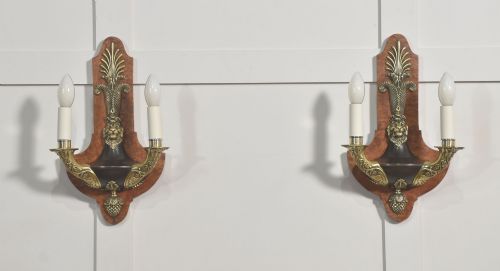
The assortment includes English and French pieces taking the form of wall lights, candelabra, and candlesticks. Makers and designers drew upon Neoclassical, Georgian Revival, French Rococo, Empire Style, and Louis XVI Revival vocabularies to shape these dual-armed fixtures.
Buyers encounter forms constructed for specific domestic settings, ranging from small wall lights to large carved giltwood appliqués. The selection demonstrates how makers adapted twin-branch lighting across different decades using varied metallic and wooden mediums.
Materials and Construction
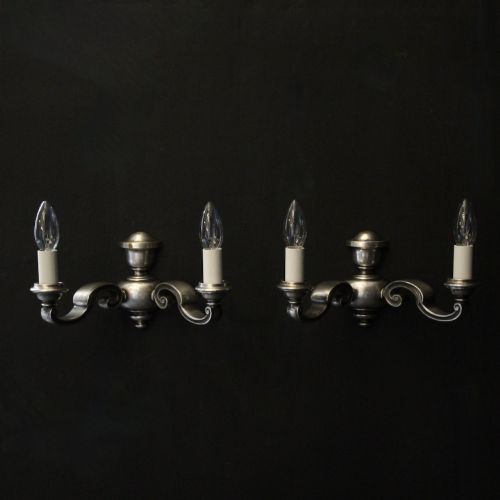
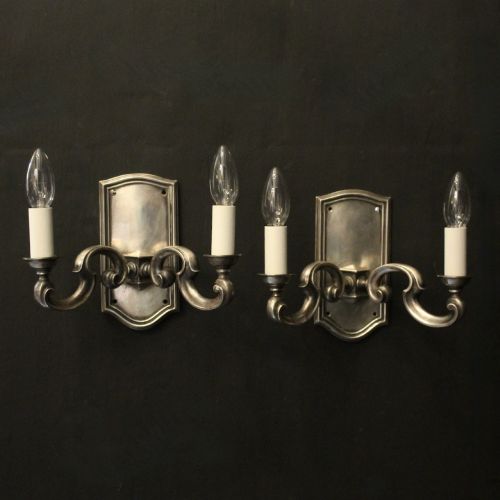
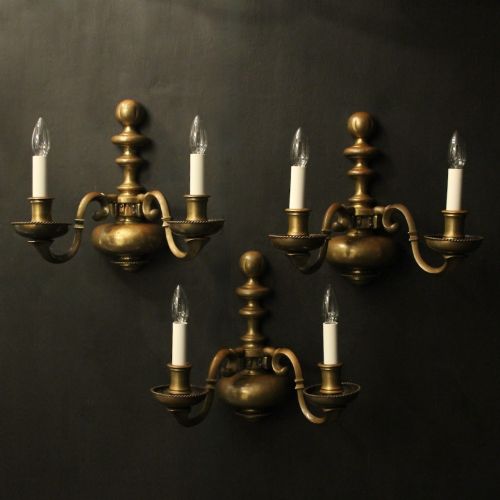
Metals form the core of these pieces, utilising brass, gilt bronze, bronze, silver plate, and gilded brass to construct the twin arms and backplates. These metallic surfaces are often cast and chased, yielding structured forms in styles from Empire to Art Nouveau.
Materials range from solid bronze and gilt brass to carved giltwood, burr walnut, and silver-plated metal.
Evaluating Quality
Quality rests upon the crispness of the casting in metal pieces and the depth of the hand-carving in wooden examples. Finer pieces display sharply defined ornamentation and coherent adherence to historical styles such as French Rococo or Neoclassical.
The choice of primary material alters the character of each piece, distinguishing solid cast bronzes and carved giltwood from silver-plated or simpler brass iterations. Proportion between the backplate and the twin branches dictates the visual balance of the fixture upon the wall.
F. and C. Osler
The Double Branch Sconces Glossary
- Appliqué
- A wall-mounted decorative light fixture or sconce, often carved from giltwood or cast in metal. The term frequently appears in descriptions of continental wall lights.
- Ormolu
- Gilded bronze, where a finely ground gold-mercury amalgam is applied to a bronze base. This technique creates a rich golden surface seen on nineteenth-century French pieces.
- Gesso
- A plaster-like mixture applied to wood surfaces as a base for gilding. It allows craftsmen to carve intricate relief details before applying gold leaf.
- Candelabra
- A multi-branched lighting fixture designed to hold multiple candles or bulbs. Twin-branch versions function as wall lights or table pieces.
Double Branch Sconces: Frequently Asked Questions
How are double branch sconces mounted on walls?
These fixtures typically secure to a wall via a backplate designed to anchor the weight of the twin arms and any attached ornamentation.
Wiring or candle placement follows the specific configuration of the individual wall light or appliqué.
What periods do these sconces represent?
The pieces span the nineteenth century, Victorian and Edwardian periods, and extend into the nineteen-thirties.
Stylistic influences reach back further into seventeenth-century Louis XIV manners and eighteenth-century neoclassical revivals.
Which materials are most common?
Metals predominate, including brass, bronze, gilt bronze, and silver-plated copper alloy over various core structures.
Wood also appears, notably in carved giltwood and burr walnut constructions from French and English workshops.
Are these fixtures suitable for modern electric lighting?
Many examples arrive rewired for electrical use, adapting historical candle-form arms into functional wall lights.
Original configurations often began as purely candle-lit sconces before subsequent adaptation.