


Dolphin Carving Table
A dolphin carving table brings monumental maritime form and classical grandeur directly into a grand interior.
Dolphin Carving Table
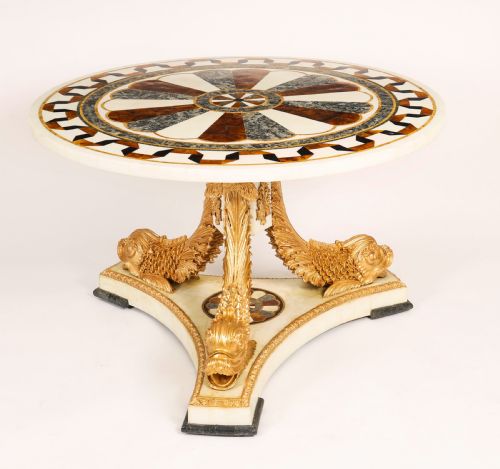
A dolphin carving table incorporates marine motifs into supports, pedestals, or console legs, drawing on classical antiquity and revival movements. These tables appear across centre, console, games, and coffee formats, often paired with heavy stone or timber tops.
The versions most frequently met on this page span the nineteenth and twentieth centuries, reflecting Neoclassical, Regency, and Venetian tastes. Makers utilised walnut, rosewood, and giltwood to render powerful sea-creature pedestals that anchor the room.
Origins stretch from English Regency workshops to Italian studios, uniting maritime mythology with functional furniture. Each piece balances sculptural ambition with the practical demands of a surface for lamps, cards, or display.
How they were made
Carvers shaped dense hardwoods like rosewood, walnut, and mahogany by hand to form the sinuous bodies and tails of dolphins. These wooden supports often received a gilt finish or were left with a polished dark grain to contrast against pale tops.
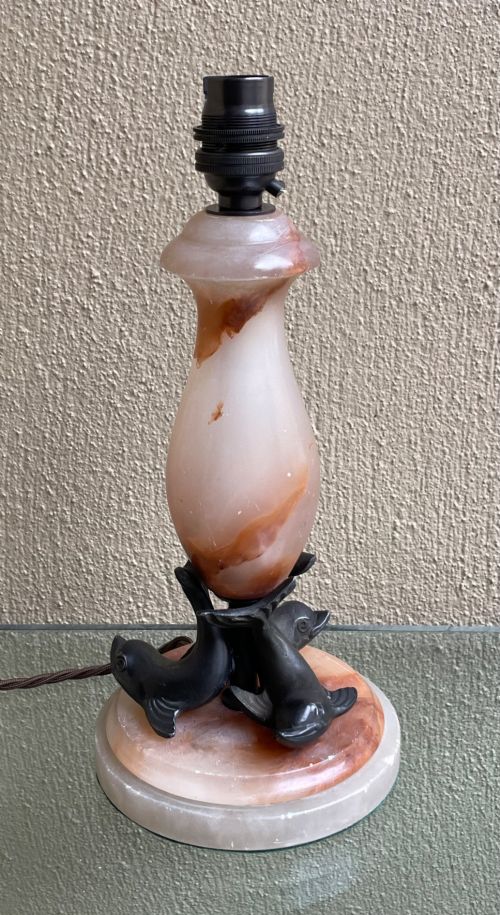
Pebbled marble, white onyx, and alabaster served as heavy plate tops, demanding precise stone-cutting and levelling to sit securely upon carved wooden pedestals. Gilt metal and brass components further integrated metalwork into mid-century variations.
The object forms range widely from heavy centre and console tables to delicate side tables, table lamps, and card tables.
What varies in quality
The depth and animation of the wood carving dictate the distinction of the piece, separating static blocks from fluid, muscular forms. Anatomical precision in the dolphin tails, scales, and fins reveals the hand of a skilled artisan rather than routine production.
The choice of top material elevates the work, with specimen marble or deeply figured flame mahogany marking superior commissions. Proportion and balance between the heavy top and the sculpted base determine whether the table commands the room successfully.
Pauly et Cie
The Dolphin Carving Table Glossary
- Giltwood
- Timber coated with gold leaf or gold paint to create a brilliant reflective surface. This finish frequently highlights carved classical motifs on nineteenth-century frames.
- Pedestal base
- A central support structure that replaces four corner legs to hold up the table top. Dolphin carvings often form this central pillar.
- Specimen marble
- A composite top made from various distinct types of coloured marble arranged in geometric or mosaic patterns. It provides a luxurious surface for grand centre tables.
- Console table
- A table designed to stand flat against a wall, often secured with brackets. Dolphin console tables utilise front marine supports while relying on the wall for balance.
- Regency style
- An English design aesthetic spanning the early nineteenth century defined by classical restraint and archaeological motifs. Dolphin supports became popular during this period.
Dolphin Carving Table: Frequently Asked Questions
Where should I place a dolphin carving table?
These tables suit grand entrance halls, formal living rooms, or centre spaces where the carved base can be viewed from all sides. Console variants anchor neatly against a flat wall beneath a mirror or painting.
Ensure the room has sufficient floor space so the sculptural dolphin supports remain unobstructed and serve as a natural focal point.
How do I care for marble and wood tops?
Dust timber surfaces regularly with a soft cloth and avoid placing them in direct sunlight to protect the polished grain. Marble and onyx require gentle cleaning with mild soap and water, avoiding acidic substances that etch the stone.
Use coasters under glasses and pads under decorative objects to protect both the polished stone and the underlying wooden structure from moisture.
What periods do these tables represent?
The pieces span the nineteenth century through the mid-twentieth century, capturing revivals of classical, Regency, and Venetian aesthetics. Earlier examples lean into heavy timber and detailed hand-carving.
Later mid-century iterations combine stone tops with gilt metal elements, demonstrating how the marine motif evolved across different design eras.
Can these tables be used for games?
Certain variations function specifically as games or card tables, featuring folding tops that open to reveal specialised surfaces. These were historically used for evening entertainment in drawing rooms.
When closed, they occupy less space while still displaying the characteristic dolphin pedestal beneath.