



Diamond Crescent Jewellery
Diamond crescent jewellery brings the night sky to your lapel, offering celestial elegance in gold and gems.
Diamond Crescent Jewellery
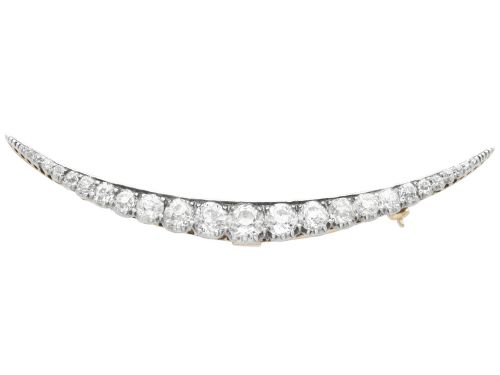
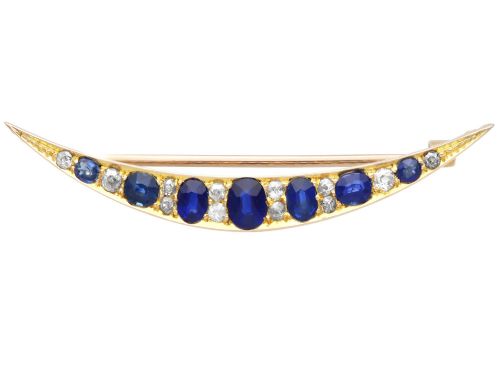
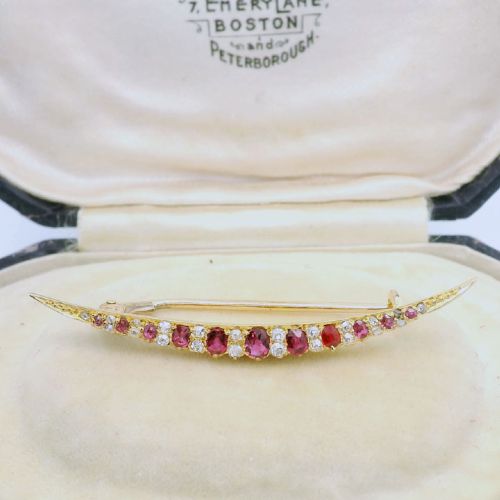
Diamond crescent jewellery takes the form of celestial brooches and pendants shaped like the moon, a motif capturing the late nineteenth and early twentieth century fascination with astronomy and naturalism. You will most frequently encounter antique crescent brooches on this page, alongside occasional convertible pendants.
The pieces span the Victorian, late Victorian, and Edwardian eras, with dates clustering around eighteen eighty through to nineteen ten. Formations range from pure graduated diamond sweeps to combinations set with rubies, sapphires, turquoise, and pearls.
Makers fashioned these ornaments in yellow gold, rose gold, silver-topped gold, and platinum-set gold. They served primarily as daytime fastenings or evening adornments, pinning securely to lapels, bodices, and scarves.
How they were made
Goldsmiths constructed the foundational frames using fifteen carat gold, nine carat yellow and rose gold, or eighteen carat yellow gold. They frequently backed the front surfaces with silver or platinum to provide a whiter setting that enhanced the sparkle of the mounted stones.
Craftsmen set diamonds alongside rubies, sapphires, turquoise, and pearls in tight graduating curves. Stones were secured using early claw settings, grain settings, or gypsy mounts tailored to the narrow crescent silhouette.
Diamond Crescent Jewellery Retail Price Guide 2026
Typical asking prices for diamond crescent jewellery among the pieces listed under this phrase on Sellingantiques today, from the lower quarter to the upper quarter. They describe what is for sale here now, not the wider market.
Listings feature items from the Victorian, late Victorian, and Edwardian periods, spanning eighteen eighty to nineteen ten.
What varies in quality
The distinction between standard examples and finer pieces lies in the total carat weight of the diamonds and the saturation of accompanying coloured gemstones such as rubies and sapphires. Heavier gem weights and carefully matched stone sizes elevate the visual impact of the crescent.
Construction methods also set pieces apart, particularly the transition from solid gold backs to platinum or silver-topped mounts that demonstrate greater refinement in metalwork and gem-securing techniques.
The Diamond Crescent Jewellery Glossary
- Crescent brooch
- A curved ornament shaped like a moon, pinned to garments using a pin stem and catch. This form dominates the selection of diamond crescent jewellery.
- Silver-topped gold
- A dual-metal technique where a thin layer of silver is soldered to the front of a gold mount. It provided a bright white surface for diamond settings while retaining the strength of gold underneath.
- Graduated stones
- Gemstones arranged in a sequence from largest at the centre to smallest at the tips. This technique creates a balanced, harmonious curve along the crescent body.
- Platinum
- A dense, durable white metal utilised in later pieces for fine settings. It allowed goldsmiths to use minimal metal claws around diamonds.
Diamond Crescent Jewellery: Frequently Asked Questions
What is diamond crescent jewellery?
Diamond crescent jewellery consists of antique brooches and pendants shaped like the moon, set with diamonds and often coloured stones. These pieces date from the Victorian and Edwardian eras.
They were designed as decorative dress ornaments to be pinned onto heavy fabrics, bodices, or lapels during the late nineteenth and early twentieth centuries.
How do I wear a crescent brooch?
Crescent brooches attach to garments using a traditional pin and C-clasp or tubular hinge mechanism. They sit well on jacket lapels, heavy scarves, or pinned near the neckline.
Because antique pins can be delicate, ensure the catch fastens securely before wearing your piece throughout the day.
How do I date a crescent brooch?
Dating relies on the gold carat marks, gemstone combinations, and overall mounting style recorded in the piece details. Victorian items often feature fifteen carat gold or silver-topped mounts.
Edwardian examples frequently incorporate platinum or lighter nine carat alloys combined with delicate millegrain edges and bright diamond arrangements.
Can a crescent brooch be a pendant?
Certain crescent designs function as both brooches and pendants through the inclusion of a hidden or folding loop. This allowed Victorian and Edwardian wearers to pin the piece to clothing or suspend it from a chain.
Checking the reverse of the ornament reveals whether a pendant loop or bail is present alongside the pin mechanism.