





Desert Landscape Art
Desert landscape art captures vast horizons and arid vistas, offering evocative depictions of distant terrain through traditional painting and printmaking.
Desert Landscape Art
Desert landscape art comprises paintings, watercolours, and framed prints capturing arid scenes, Middle Eastern vistas, and canyons from the nineteenth and twentieth centuries. These works span Victorian Orientalism, Mid-Century Modern, and Post-Impressionism, reflecting varied global topographies.
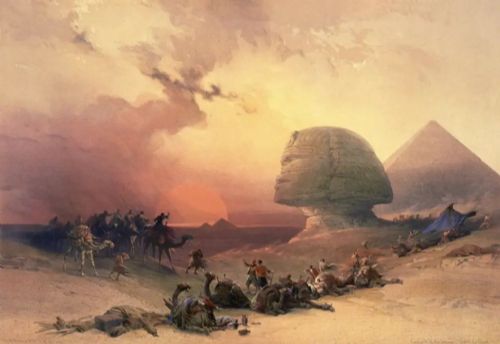
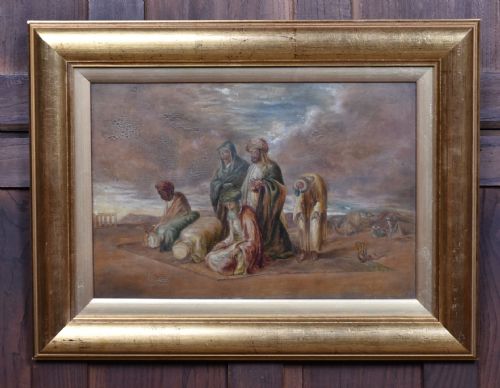
Buyers will encounter watercolours, oil paintings on canvas, and prints depicting subjects such as Bedouin tribesmen, the Nile, the Pyramids, and Arizona canyons. The selection ranges from early Victorian depictions to mid-century modern interpretations.
Originating across different global regions, these works incorporate distinct regional viewpoints, from British and American interpretations to modern Iraqi art and European Orientalism.
Materials and techniques
Artists utilised oil paint on canvas and wood panels alongside watercolours and gouache on paper and board to render these arid scenes. Ink was also employed for detailed graphic work within prints.
Framed works often incorporate glass to protect delicate watercolours and paper prints, while canvas supports provide robust foundations for heavier oil applications.
Desert Landscape Art Retail Price Guide 2026
Typical asking prices for desert landscape art among the pieces listed under this phrase on Sellingantiques today, from the lower quarter to the upper quarter. They describe what is for sale here now, not the wider market.
Camels feature frequently enough in these distant vistas to serve as an unofficial unit of desert distance.
Determinants of quality
Execution and handling of medium set individual works apart, where confident brushwork in oil or precise control in watercolour defines the success of the composition. The depth of atmospheric perspective and tonal balance across the arid palette further distinguish superior examples.
The historical significance of the artist and the documentation of the specific location contribute strongly to the standing of a piece within the genre.
David Roberts·Edwin Lord Weeks·Anne Dorrien Smith·Nora Cundell·Cecil Rochfort Doyly John·William James Muller·Yves Brayer·Otto Pilny·Hugo Vogel·Abdul Kadir Al Rassam·Earl Haig
The Desert Landscape Art Glossary
- Orientalism
- A cultural and artistic movement depicting scenes of the Middle East and North Africa, often produced by Western artists travelling abroad. This style frequently highlights local architecture, dress, and desert topographies.
- Gouche
- An opaque water-based medium containing pigment and a binding agent, offering a heavier consistency than traditional watercolour. It provides flat areas of bright colour useful for intense desert light.
- Post-Impressionism
- An art movement extending beyond Impressionism while rejecting its limitations, focusing on symbolic motifs and expressive use of paint. Works in this style prioritize distinct personal vision over strict naturalism.
- Provenance
- The documented history of ownership of a work of art, establishing its authenticity and origin. A clear record enhances the historical value of older pieces.
Desert Landscape Art: Frequently Asked Questions
What subjects appear in desert landscape art?
These works primarily feature arid expanses, river valleys such as the Nile, desert monuments including the Pyramids, and canyons. Human figures such as Bedouin tribesmen and travellers frequently scale the vast terrain.
Depictions range from precise nineteenth-century topographical records to more expressive mid-century interpretations of foreign light and space.
How should I display watercolour desert scenes?
Watercolours on paper or board require protection behind glass and conservation framing to prevent fading from sunlight and damage from ambient moisture.
Hanging them away from direct sunlight preserves the delicate pigments typical of nineteenth and twentieth-century works on paper.
What periods do these artworks represent?
The pieces span the Victorian and Edwardian eras through to the mid-twentieth century, including works from the 1870s up to the 1960s.
This timeframe encompasses shifts from detailed academic Orientalism to modernist and post-impressionist approaches to landscape painting.
How do oil paintings differ from watercolours here?
Oil paintings utilise pigment suspended in drying oils applied to canvas or wood, offering rich textures and deep tonal layering suited to dramatic lighting effects. Watercolours rely on translucent washes on paper that capture bright atmospheric conditions with lighter immediacy.
Both mediums were employed extensively by artists travelling through Middle Eastern and American desert regions.