

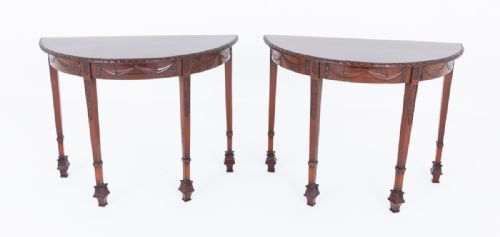
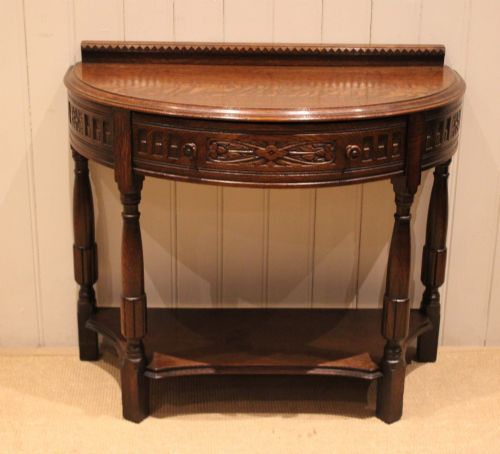
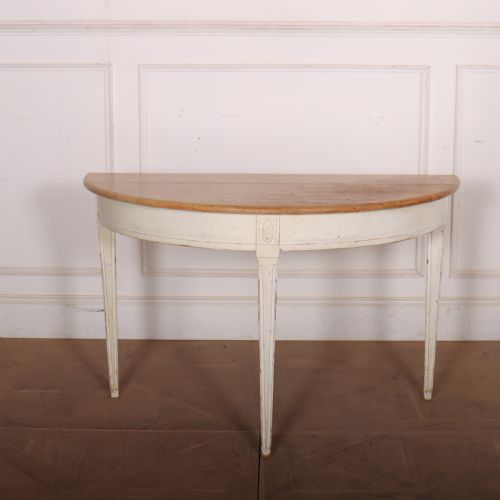


Demilune Hallway Table
A demilune hallway table brings a graceful semicircular silhouette to narrow spaces, offering a functional surface without blocking the flow of movement.
Demilune Hallway Table
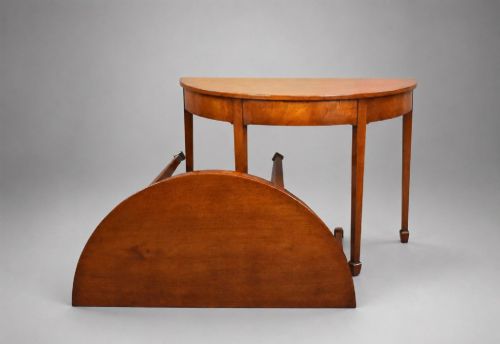
A demilune hallway table is a semicircular piece designed to sit flush against a wall, making it a practical choice for corridors and reception rooms. These items frequently appear from the Georgian, Victorian, and nineteenth-century periods, constructed primarily as console tables, side tables, or tea tables.
Buyers will encounter various stylistic interpretations on this page, ranging from plain mahogany examples to painted and gilded pieces. Many originate from English workshops, alongside continental European items from France, Sweden, and the Netherlands.
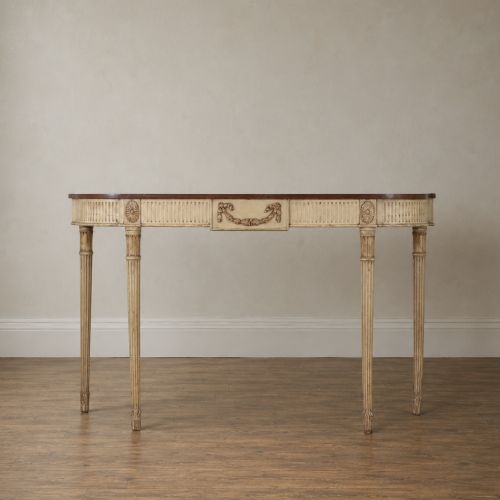
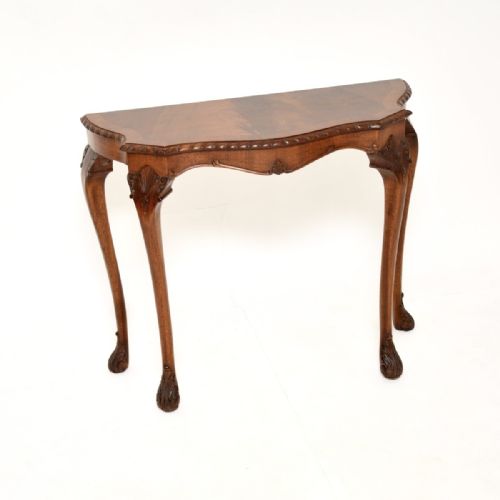
The form often includes straight tapered legs or cabriole supports, occasionally featuring inlaid decoration or marble tops. They serve as reliable surfaces for lamps, mirrors, and decorative objects in entrance halls.
How they were made
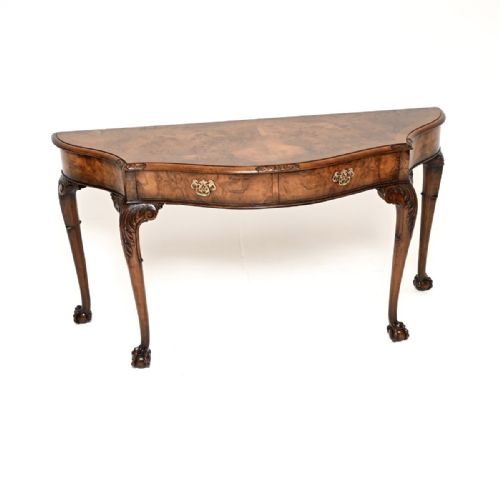
Makers relied heavily on mahogany for solid construction and veneer work, often enhancing the timber with lighter stringing and inlay. Oak also appears as a primary structural wood in several continental pieces.
Painted finishes frequently incorporate gesso and giltwood details, particularly on pieces influenced by Neoclassical, Gustavian, or later revival styles. Some tables integrate marble slabs into the top surface for durability and a formal appearance.
Current listings feature items from the eighteenth, nineteenth, and early twentieth centuries, spanning Georgian, Victorian, and revival styles in mahogany, oak, and painted wood.
What varies in quality
The standard of timber selection and the crispness of carved or inlaid detail set better examples apart from simpler utilitarian pieces. Mahogany grain figures and the precision of edge banding indicate the original maker's skill.
Original painted and gilded surfaces retain a depth and patina that distinguish them from later decorative overpainting. Structural integrity in the semicircular frame and leg joints also dictates the durability of the piece.
The Demilune Hallway Table Glossary
- Demilune
- A half-moon or semicircular shape utilised for tables designed to stand flat against a wall. This profile maximises floor space in narrow hallways.
- Console table
- A table supported by wall brackets or console legs, traditionally fixed or placed against a vertical surface. They rarely stand independently in the centre of a room.
- Giltwood
- Timber that has been coated with a thin layer of gold leaf or powder. It appears frequently on French and Neoclassical decorative frames.
- Gesso
- A plaster-like mixture applied to wood surfaces as a base for painting or gilding. It allows for crisp relief moulding before the final finish.
- Inlay
- The technique of embedding pieces of contrasting timber, brass, or shell into the primary wood surface. This creates decorative patterns along table edges and friezes.
Demilune Hallway Table: Frequently Asked Questions
Where should I place a demilune table?
These tables suit narrow entrance halls, corridors, and landings where a rectangular piece would obstruct movement. Their flat back sits securely against the wall while the curved front softens the line of the room.
They also function well beneath a wall mirror or painting in a dining room or reception area, providing a compact surface for lighting or display items.
How do I identify a Georgian demilune table?
Georgian examples often feature solid mahogany construction, precise stringing inlay, and square tapered or turned legs. The proportions are typically refined and restrained compared to later revival pieces.
Look at the timber underside and secondary woods used in the drawer construction to check for period-appropriate construction methods.
Are painted finishes original on these tables?
Many Swedish and French examples feature painted or gesso surfaces that reflect regional styles from the eighteenth and nineteenth centuries. Close examination of the paint layers reveals whether the finish is period-correct or applied during a later revival.
Original painted decoration often shows natural wear and craquelure consistent with age and use.
Can these tables be used as desks?
Most demilune tables are too shallow in depth to function comfortably as writing desks. They are primarily designed as side tables, console tables, or occasional display furniture.
Some drop-leaf or tea table variants offer a folding top, but their primary purpose remains decorative and surface-based rather than utilitarian work.