
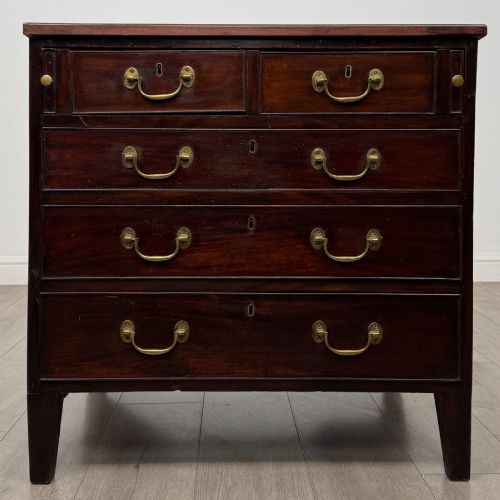


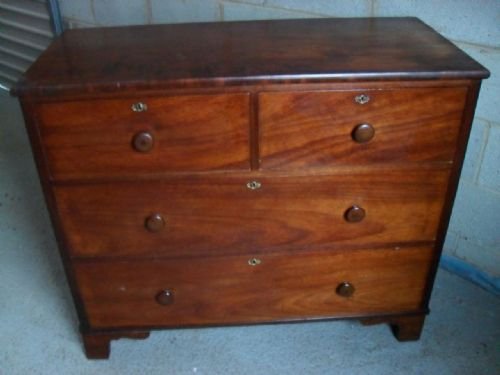
Deep Drawer Storage Chest
A deep drawer storage chest is a heavy timber piece built to hold bulky linens and clothes, and you buy one for sheer capacity and presence.
Deep Drawer Storage Chest
When you search for a deep drawer storage chest, you are looking at substantial timber furniture designed primarily for robust domestic storage. The pieces listed on this page appear predominantly in Victorian and Regency styles, alongside Edwardian examples.
The forms you are most likely to meet here include large mahogany chests of drawers, bow fronted Scotch chests, and tall pine pieces. Many feature specific configurations like two over two deep drawers, alongside narrow and large proportions suited to substantial rooms.
How they were made
These chests rely on solid timber construction using mahogany, walnut, and pine, frequently enhanced with flame mahogany veneer to create striking grain patterns on the drawer fronts. Cabinet makers shaped these woods into substantial carcases designed to withstand heavy daily use.
Metal fittings play a functional role, with brass hardware appearing on drawers that must bear the weight of contents. Wax finishes are applied to highlight the natural character of the wood surfaces.
Cot drawers lurk in this collection, proving that even nursery furniture occasionally aspires to architectural grandeur.
What varies in quality
The distinction between ordinary and superior pieces rests on the selection of timber and the handling of veneers. Flame mahogany veneer laid with precision across drawer fronts elevates a standard utility chest into a visually commanding item.
Proportion and scale dictate the visual weight of the piece, where balanced proportions in large Regency and Victorian examples demonstrate greater design harmony than heavier, less refined carcases.
The Deep Drawer Storage Chest Glossary
- Scotch chest
- A regional chest of drawers typically featuring a deep top drawer over three or more graduated lower drawers, often with distinctive pilasters or columns.
- Bow front
- A convex curved front on a chest of drawers that softens the rectangular geometry of the piece. This style gained popularity during the Regency and Victorian periods.
- Flame mahogany veneer
- A thin slice of mahogany timber cut from the point where a branch joins the main trunk, showing a flickering flame-like grain pattern. Cabinet makers used this to embellish primary display surfaces.
- Carcase
- The main structural body or frame of a chest of drawers, excluding the drawers and feet. Its construction determines the overall stability and longevity of the furniture.
Deep Drawer Storage Chest: Frequently Asked Questions
What is a deep drawer storage chest?
A deep drawer storage chest is a substantial timber cabinet built with unusually deep drawers to hold bulky items such as blankets, heavy garments, and linens. These pieces prioritize maximum internal volume while maintaining traditional furniture proportions.
They serve as focal points in bedrooms and hallways, combining practical storage utility with the rich tones of period woods like mahogany and walnut.
How do I date a Victorian chest?
Dating a Victorian chest involves examining the timber, construction methods, and hardware styling present on the piece. Mid-nineteenth-century examples often feature solid mahogany or pine carcases with hand-dovetailed drawer construction.
Later Victorian and Edwardian pieces may introduce machine-cut elements and different secondary woods while retaining traditional deep drawer configurations.
Where do I put a large chest?
A large chest of drawers requires a wall with sufficient physical clearance and visual weight to balance its proportions. Bedrooms and wide landings provide natural homes where their deep capacity can be fully utilised.
Because many period examples feature significant depth and height, measuring both floor space and ceiling clearance before placement is essential.
What is flame mahogany?
Flame mahogany is a decorative wood veneer harvested from the junction where a branch meets the tree trunk. This figure produces a dramatic, flickering pattern resembling flames across the drawer fronts.
Cabinet makers utilised this veneer selectively on primary surfaces to catch the light and add visual richness to otherwise plain chests.