




Decorative Metal Candle Holders
These decorative metal candle holders bring weight, form and steady light to a room through centuries of foundry work.
Decorative Metal Candle Holders
Decorative metal candle holders encompass a diverse range of lighting fixtures spanning the nineteenth and early twentieth centuries, from austere Regency sticks to ornate Victorian and Edwardian examples. The selection here leans heavily towards matched pairs, taking the form of candlesticks and multi-armed candelabra designed for domestic illumination and display.
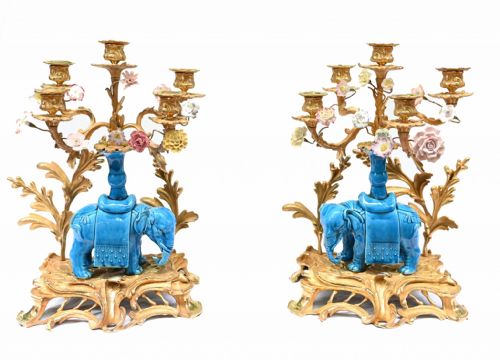
Makers drew upon an eclectic mix of historical revivals and contemporary aesthetics, producing objects influenced by French Louis XV, Venetian, Orientalist and Art Deco movements. Alongside traditional brass and bronze, the inventory includes spelter, silver plate and pewter, occasionally augmented by porcelain, marble and paint.
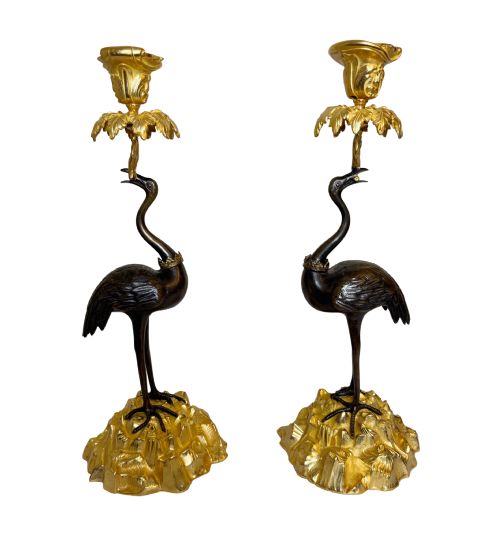
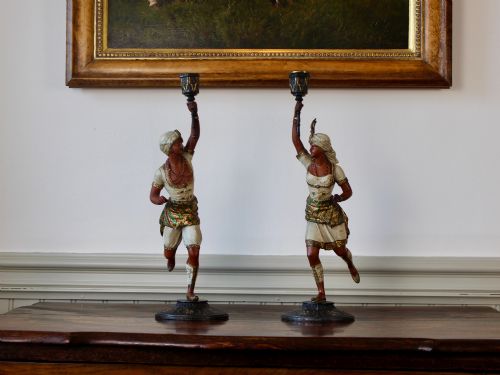
Buyers encounter functional single candlesticks alongside sculptural figural pieces depicting exotic motifs, animals and human forms. These objects bridge the gap between practical utility and mantelpiece ornament, reflecting the shifting tastes of the nineteenth century and the modernist turn of the nineteen-thirties.
Judging quality and craftsmanship
Quality in these pieces rests upon the crispness of the cast and the integrity of the chased or finished surfaces. Superior examples display sharply defined drapery, feathers or foliage without the soft, rounded edges typical of worn moulds or secondary castings.
The choice of material and finish dictates much of the visual success, where rich patinated bronze or heavy gilt ormolu outlasts simpler painted spelter. Original matching components, intact gilding and well-integrated secondary materials such as marble elevate an example above standard production.
Decorative Metal Candle Holders Retail Price Guide 2026
Typical asking prices for decorative metal candle holders among the pieces listed under this phrase on Sellingantiques today, from the lower quarter to the upper quarter. They describe what is for sale here now, not the wider market.
The Decorative Metal Candle Holders Glossary
- Ormolu
- Gilded bronze, where a layer of gold amalgam is applied to a bronze base through heat processing. This technique yields a durable, brilliant finish seen on high-end nineteenth-century candelabra.
- Spelter
- A zinc alloy used as a cheaper alternative to bronze for decorative figures and candlesticks. It is softer than bronze and typically cold painted or bronzed to simulate more costly metals.
- Candelabra
- A branched candlestick holding multiple candles on separate arms. They emerged as grand table and mantelpiece centerpieces during the Regency and Victorian eras.
- Patination
- The surface coloration and ageing acquired by metal over time or induced artificially through chemical treatments. A good patination adds depth and tactile interest to bronze and brass.
- Compote
- An ornamental bowl raised on a stem, occasionally adapted or paired with candle fittings in nineteenth-century decorative schemes. They served both fruit display and decorative utility.
Decorative Metal Candle Holders: Frequently Asked Questions
Are pairs always matching?
Nineteenth-century lighting often survives as married pairs assembled later rather than original factory matches. Close inspection of the casting seams and base weights reveals subtle discrepancies.
True matched pairs share identical foundry marks, tool marks and wear patterns. Minor variations do not diminish decorative impact but matter to strict collectors.
What is the difference between spelter and bronze?
Bronze is a heavy, durable copper alloy that takes fine chisel work and rich patination. Spelter is a zinc-based metal that feels lighter and softer to the touch.
Spelter figures often show paint flaking where bronze retains its finish. Workshops used spelter extensively for affordable decorative figures around nineteen hundred.
How do I date an antique metal candlestick?
Stylistic cues provide the primary guide, such as the neoclassical restraint of Regency designs versus the sweeping asymmetry of Art Nouveau pewter. Construction methods also change from early hand-finished brass castings to later mass-produced parts.
Weight, fixing screws and base construction help narrow down the decade of manufacture. Comparing piece proportions against documented period catalogues confirms the era.