




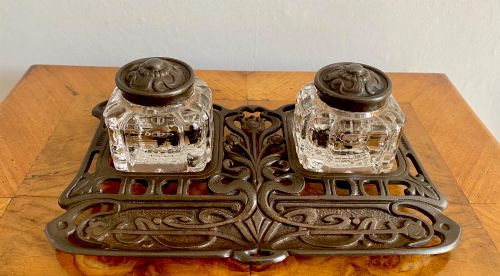


Decorative Desk Tidy
A decorative desk tidy is a compact receptacle for writing implements and correspondence, prized for bringing order to a working surface with period charm.
Decorative Desk Tidy
A decorative desk tidy encompasses various desk accessories and inkstands designed to hold writing instruments, ink bottles, and letters in domestic workspaces. Buyers pursuing this category encounter practical desk stands, stationery boxes, and inkwells dating from the Victorian era through the mid-twentieth century.
The selections frequently feature stationery cabinets and letter racks alongside specialised pieces like campaign boxes and vide poche trays. These objects reflect the changing functional requirements of writing spaces across the nineteenth and twentieth centuries.
Examples on this page draw from distinct design movements including Victorian Gothic Revival, Arts and Crafts, Art Nouveau, and Art Deco. This variety ensures that pieces range from austere campaign utility to elaborate Chinoiserie and gilded bronze.
How they were made
Craftsmen utilised dense timbers such as walnut and coromandel wood to construct the foundational bodies of stationery cabinets and desk stands. These hardwoods were frequently paired with mounted brass, copper, and ormolu to reinforce corners and provide structural ornamentation.
Metalworking techniques yielded stamped copper envelope racks, silver-plated pen holders, and cast bronze inkwells complete with original glass bottles. Specialised surface treatments included gilt covering, hand painting, and silk linings inside enclosed compartments.
Decorative Desk Tidy Retail Price Guide 2026
Typical asking prices for decorative desk tidy among the pieces listed under this phrase on Sellingantiques today, from the lower quarter to the upper quarter. They describe what is for sale here now, not the wider market.
Listings feature items spanning the Victorian era, Edwardian period, and mid-twentieth century.
What varies in quality
Quality in a decorative desk tidy rests upon the integrity of the materials and the precision of the subsidiary fittings, such as matched glass ink bottles and functioning hinges. Superior items demonstrate cohesive design where decorative brass mounts or painted gilt details complement rather than overwhelm the primary timber or metal body.
The execution of distinct stylistic elements dictates the standing of an individual piece, distinguishing standard production from exceptional studio or foundry work. Maker attribution and the retention of original components further delineate the scope of quality within these desk accessories.
Maria Pergay·Bergmann
The Decorative Desk Tidy Glossary
- Desk Stand
- A portable or stationary base fitted to hold inkwells, pens, and sometimes sanders or wafer boxes. It forms the central writing accessory of a nineteenth-century desk.
- Coromandel Wood
- A heavy, durable timber featuring dark brown grain with contrasting light stripes, utilised for luxury nineteenth-century boxes and stands. It provides an exceptionally smooth polished surface.
- Vide Poche
- French for empty pocket, this small tray or dish serves as a receptacle for loose items removed from pockets at the end of the day. They appear in silver plate and other decorative metals.
- Stationery Cabinet
- An upright wooden box with doors or a sloping front designed to store paper and envelopes vertically. These enclosed pieces protect correspondence from dust and light.
- Ormolu
- Gilded bronze ornamentation applied to furniture and desk accessories during the eighteenth and nineteenth centuries. The technique imparts a rich golden lustre to cast metal mounts.
Decorative Desk Tidy: Frequently Asked Questions
How were inkstands used?
Inkstands held liquid ink in glass bottles alongside resting channels for pens during the era of handwritten correspondence.
They sat centrally on a desk to provide immediate access to writing tools.
Where should I place a desk tidy?
These pieces function effectively on active writing desks, sideboards, or console tables in a study or living area.
Their compact footprints allow them to organise modern stationery just as they did historical correspondence.
How do I identify Art Nouveau pieces?
Art Nouveau items display organic, flowing lines inspired by natural plant forms rather than rigid geometric symmetry.
In desk accessories, this appears in sinuous copper stamp mounts and stylized floral cast bronze work.