

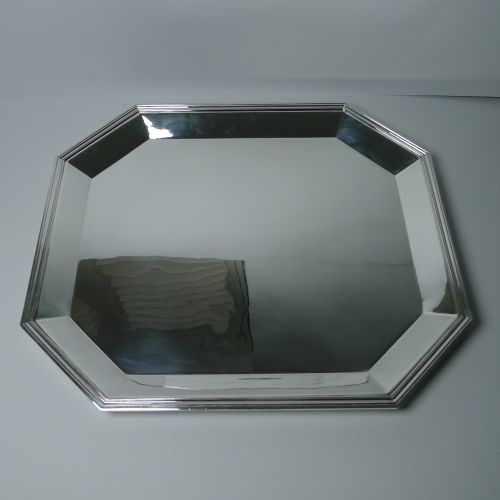
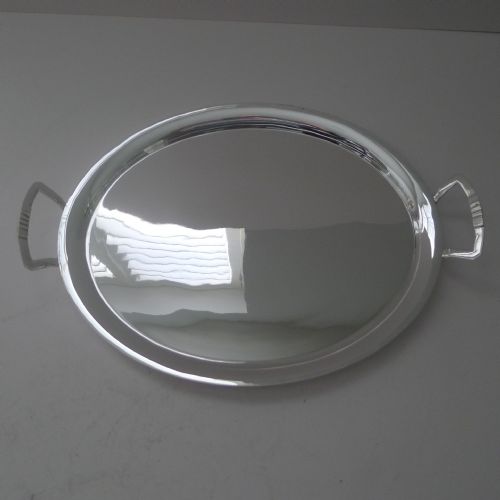
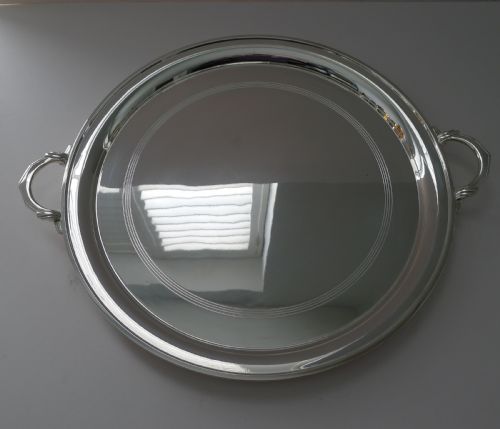
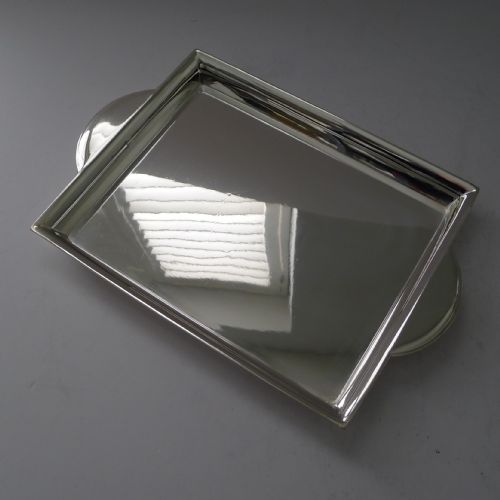
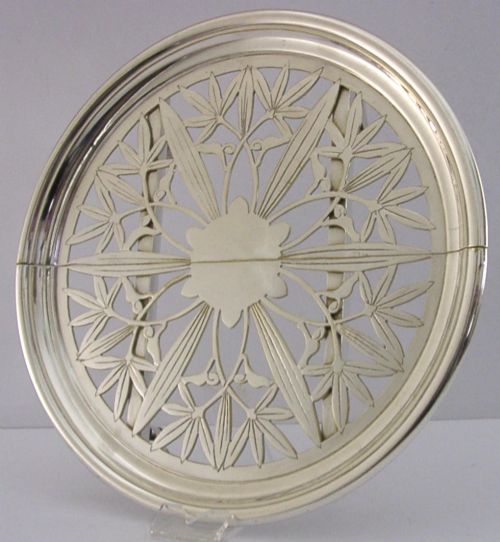
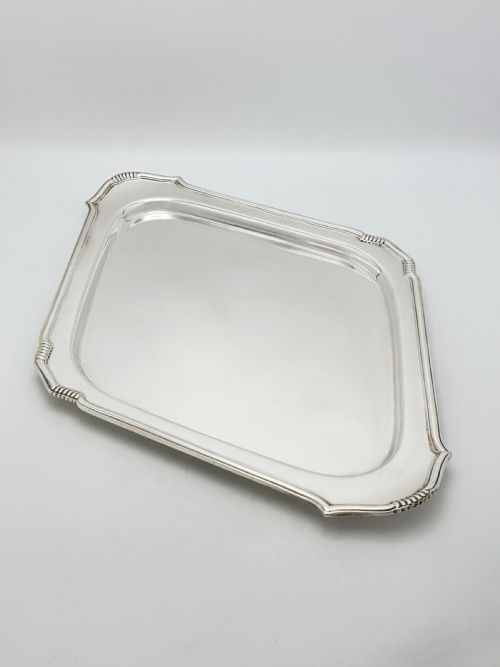
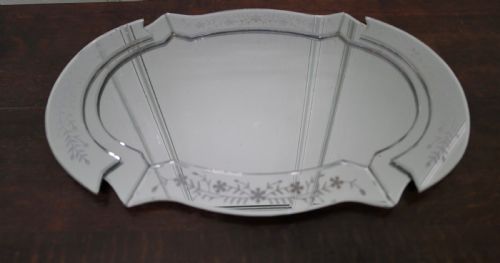


Deco Serving Platter
A deco serving platter brings geometry and shine to a table, offering a surface designed for cocktails, fruit or bread.
Deco Serving Platter
When searching for a deco serving platter, buyers encounter trays, salvers, dishes, and baskets spanning the 1900s through to the 1940s. The selection includes French and English pieces styled for the cocktail hour or formal dining.
Round, hexagonal, diamond-shaped, and rectangular silhouettes dominate the offerings. Many serve specifically as cocktail trays, drinks trays, or sandwich sets intended for hosting.
Origin points range from Parisian workshops to English silversmiths, capturing both Art Deco and French Art Deco movements. Glass and mirror bases frequently pair with metal frames to create reflective display surfaces.
Materials and construction
Silver plate, nickel silver, and standard metal form the foundational structures of these pieces, often finished with EPNS or solid sterling silver. Manufacturers applied techniques like engine turning to decorate metallic surfaces with precise geometric patterns.
Mirror glass, Venetian cut glass, cobalt blue mirror glass, and opalescent glass insert into metal frames or stand alone as heavy display plates. Wood such as Macassar appears in modernist French examples, introducing rich grain alongside metal trim.
Deco Serving Platter Retail Price Guide 2026
Typical asking prices for deco serving platter among the pieces listed under this phrase on Sellingantiques today, from the lower quarter to the upper quarter. They describe what is for sale here now, not the wider market.
Listings span the 1900s, 1920s, 1930s, and 1940s, uniting silver plate, glass, chrome, mirror, wood, and EPNS in trays, dishes, and bowls.
Distinctions in craftsmanship
Execution of decorative details separates standard production from exceptional pieces. Sharp casting on cast handles, precise etching on glass inserts, and crisp engine turning indicate superior workshops.
The reputation of the maker influences desirability, with established firms and noted designers maintaining distinct standards of weight and finish in their metalwork and glass.
Christofle Paris·Mappin And Webb·J B Chatterley And Sons·Hukin And Heath·James Dixon And Sons·Roberts And Dore·Asprey London·Elkington·Roberts And Belk·Atkin Brothers·John Collyer Birmingham·Rene Lalique
The Deco Serving Platter Glossary
- EPNS
- Electroplated Nickel Silver. This method coats a base metal base with a layer of silver.
- Engine turned
- A decorative technique that etches intricate geometric patterns into metal surfaces using a specialised lathe. It provides texture and catches the light.
- Salver
- A flat tray traditionally used for serving food or drinks. In this context, it functions interchangeably with larger serving trays.
- Opalescent glass
- Glass that displays milky, milky-blue, or fire-like colour effects under changing light. It appears in decorative plates from this era.
Deco Serving Platter: Frequently Asked Questions
What is a deco serving platter used for?
These pieces served originally for holding cocktail glassware, bottles, bread, or fruit during formal and social gatherings. They provided a stable, decorative surface for indoor entertaining.
Today, owners utilise them on sideboards, coffee tables, or drinks trolleys to display glassware or collections while retaining their original function.
How do I identify French Art Deco?
French pieces often feature bolder combinations of materials, integrating exotic woods like Macassar with metals or employing heavy glass inserts. The aesthetic leans toward dramatic proportions and modernist luxury.
Maker marks from Parisian houses like Christofle help confirm the origin, alongside distinctive styling that differs from contemporaneous English work.
Are mirrored trays original to the period?
Mirrored glass inserts were widely utilised during the 1920s and 1930s to amplify light and reflection on cocktail trays. Etched patterns or coloured glass, such as cobalt blue, indicate period manufacture.
These surfaces require careful handling to preserve the silver backing of the mirror glass over decades of use.
What materials are most common?
Silver plate and EPNS dominate the metal selections, frequently paired with clear, cut, or mirrored glass bases. Nickel silver and solid sterling silver appear in specific pieces alongside chrome and metal.
Wood elements, notably Macassar, represent the modernist French stream within the wider Art Deco movement.