



Dark Wood Office Cupboard
These dark wood office cupboard designs span Victorian pedestal desks to school storage, built for serious paperwork.
Dark Wood Office Cupboard
A dark wood office cupboard serves as a functional storage piece originating from periods like the Victorian and Edwardian eras, built to house documents, stationery, and institutional ledgers. When you search for a dark wood office cupboard, you encounter diverse forms ranging from tambour door cabinets to school cupboards and banker's pedestals.
Mahogany and oak dominate the pieces seen here, alongside walnut and pine carcasses. The construction spans British institutional designs, Edwardian styles, and Georgian influences, reflecting centuries of workplace utility.
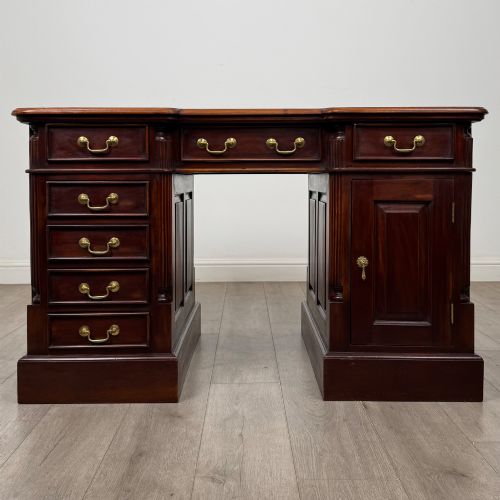
Pedestal desks, stationery cabinets, and filing cabinets make up the primary physical formats on this page. Each object carries the heavy timber construction characteristic of 19th- and early 20th-century workspace furniture.
Materials and construction
Cabinet makers utilised dense hardwoods such as mahogany and oak to construct durable frames capable of withstanding heavy daily use in offices and schools. Secondary timbers like pine often appear in internal drawer linings and carcass backs.
Metal hardware including brass handles, iron fittings, and patented locking mechanisms provide structural reinforcement and mechanical operation, notably in tambour door slats and letter file systems.
Listings here feature eight distinct periods ranging from the 18th century through to the 1930s.
Judging quality
Superior examples demonstrate refined timber selection with straight grain figures in the mahogany or oak, paired with substantial brass furniture that shows crisp casting rather than simple stamping. The weight of the timber and the rigidity of the pedestal carcass indicate the tier of the original commission.
The sophistication of the internal mechanism, whether a patented letter file system or a smooth-running tambour door track, separates standard utility furniture from pieces made by prominent cabinet makers.
Johnstone and Jeanes·Amberg
The Dark Wood Office Cupboard Glossary
- Tambour door
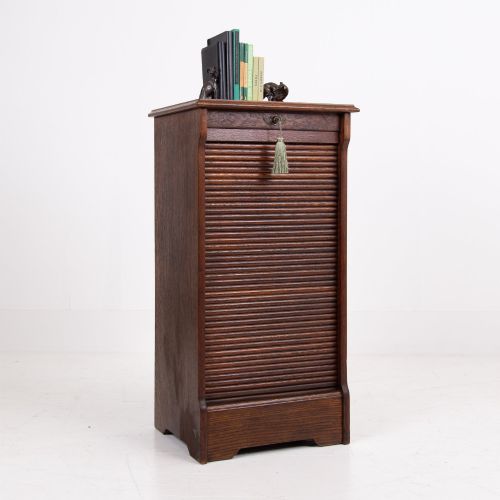
- A flexible door constructed from narrow strips of wood glued to a canvas backing, allowing it to slide smoothly around a curved track. This mechanism is typically found on office cabinets to save space.
- Pedestal desk
- A large desk supported by two banks of drawers or cupboards on either side, forming a kneehole in the centre. These pieces provide substantial filing capacity beneath the primary writing surface.
- Stationery cabinet
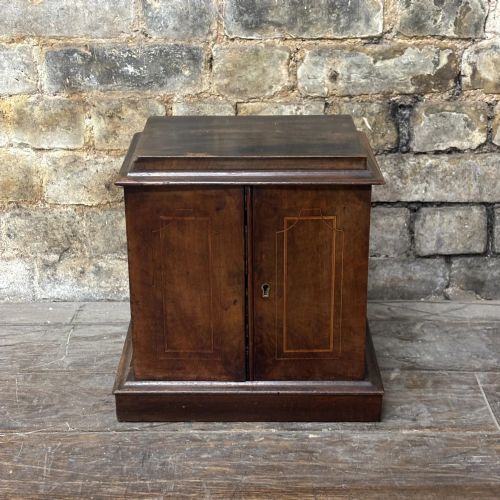
- A tabletop or freestanding cabinet fitted with pigeonholes, small drawers, and drop-front sections specifically for holding writing paper and envelopes. They often feature panelled or glazed doors.
- Kneehole desk
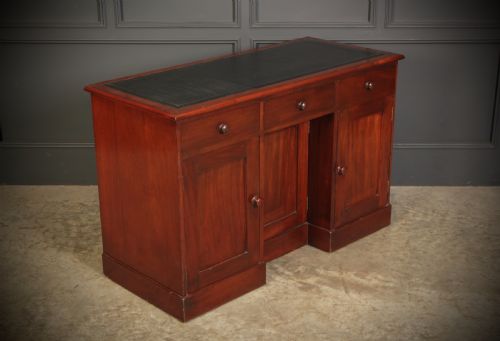
- A compact desk featuring a recessed central space for the user's legs, flanked by pedestals of drawers. Early Victorian and Georgian iterations often conceal a central drawer or small cupboard above the recess.
- Folio cabinet
- A tall storage unit designed specifically to hold large flat sheets of paper, maps, or drawings. The internal shelves or trays are spaced closely to organise loose documents.
Dark Wood Office Cupboard: Frequently Asked Questions
What periods do these cupboards date from?
The pieces span the Victorian and Edwardian periods, alongside items from the 1910s, 1920s, and 1930s.
Construction details and timber choices shift from heavy mid-nineteenth-century mahogany forms toward lighter oak institutional pieces by the early twentieth century.
How were tambour door cabinets used?
Tambour door cabinets housed active files, ledgers, and office stationery within workspaces where swinging doors would obstruct narrow walkways.
The slatted wooden curtain glided into the body of the cabinet to grant immediate access to documents.
What is a banker's pedestal?
A banker's pedestal is a heavy timber storage unit or desk base built with numerous deep drawers and secure cupboards for financial records.
These pieces were constructed to bear substantial weight and secure sensitive documents behind heavy locks.
Are these pieces made of solid wood?
The visible exteriors and structural frames utilise solid hardwoods including mahogany, oak, and walnut.
Secondary softwoods like pine appear in concealed internal areas such as drawer carcases and cabinet backs.
How do I care for polished mahogany?
Maintain polished mahogany surfaces by keeping them away from direct heat sources and strong sunlight that can fade the dark finish.
Apply traditional beeswax periodically and buff with a soft cloth to preserve the lustre of the timber.