


Dark Wood Medicine Chest
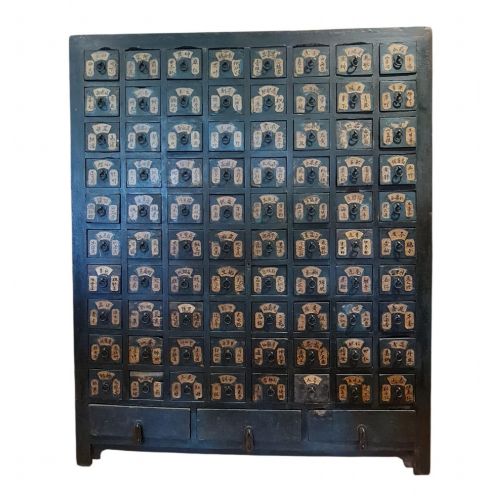
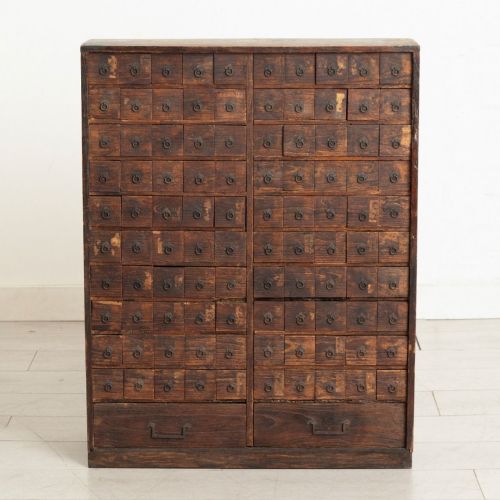
A dark wood medicine chest brings dense banks of small drawers and rich timber grain into a room, offering both quiet storage and historical depth.
Dark Wood Medicine Chest
A dark wood medicine chest typically takes the form of an apothecary cabinet, a bank of drawers, or a fitted box designed to hold remedies and dry ingredients. These pieces span the eighteenth century through to the early twentieth century, originating from British workshops as well as Chinese, Japanese and Korean makers.
The version most commonly met on this page is the multi-drawer Chinese elm apothecary chest, often featuring dozens of small compartments labelled for traditional herbs and minerals. British Victorian mahogany boxes and veterinary cabinets also appear, equipped with internal bottles and fitted compartments for travel or dispensary use.
Forms range from large floor-standing chests with eighty small drawers down to table cabinets, hanging cupboards and portable boxes. Buyers select them for their disciplined symmetry, repetitive drawer fronts, and the functional integrity of their original joinery.
How they were made
Construction relies on sturdy hardwoods such as elm and mahogany, chosen for their stability and capacity to withstand heavy daily use across decades. Cabinetmakers joined frames with traditional joinery, often leaving the dark grain visible beneath simple wax or clear finishes rather than heavy paint.
Metal fittings in brass and iron provide structural reinforcement and functional handles for numerous small drawers, hanging doors, and carrying handles on portable boxes. Inlaid details and fitted internal partitions demonstrate precise hand-tool work designed to secure fragile glass bottles and botanical specimens.
Some chests still whisper of dried roots and centuries-old remedies hidden deep within their dozens of tiny drawers.
What varies in quality
Quality separates pieces by the integrity of their original timber, the complexity of their internal drawer configurations, and the survival of original brass or iron hardware. A chest with all eighty original miniature drawers intact holds greater design coherence than one altered or rebuilt over time.
The refinement of the cabinetry defines the upper tier, seen in tightly fitted joints, well-figured mahogany or elm grain, and complete internal fittings such as original glass bottles. Simpler provincial utility pieces display coarser joinery and plainer timber surfaces, reflecting their working origins in dispensaries and storerooms.
The Dark Wood Medicine Chest Glossary
- Apothecary cabinet
- A piece of furniture fitted with numerous small drawers designed to store dried herbs, minerals, and medicinal compounds. These cabinets formed the working centre of traditional pharmacies and herbalists.
- Bank of drawers
- An arrangement of many small drawers stacked in tight vertical and horizontal grids. This format maximises storage space for diverse ingredients while keeping them sorted.
- Elm
- A tough, interlocking-grained hardwood frequently utilised in regional Chinese cabinetmaking. It accepts dark finishes well and resists splitting under heavy stress.
- Mahogany
- A durable, reddish-brown tropical hardwood favoured in British and colonial cabinetmaking from the eighteenth century onwards. It provides a stable surface for fine polished finishes and brass inlay.
- Veterinary cabinet
- A specialised storage chest equipped for animal medicine and field treatments. These pieces often include fitted bottle compartments and robust carrying handles.
Dark Wood Medicine Chest: Frequently Asked Questions
What is a dark wood medicine chest?
A dark wood medicine chest is a utilitarian cabinet or box featuring multiple small drawers, built to store medicinal ingredients, herbs, or remedies.
These pieces originate from various traditions, including British dispensary furniture and East Asian herbalist cabinets.
How were these chests used originally?
Apothecaries, doctors, and herbalists used them to organise and protect dry ingredients, powders, and bottled mixtures in daily practice.
Portable versions travelled with practitioners or veterinary surgeons, while larger floor cabinets remained fixed in shop interiors.
How do I live with a medicine chest?
Their small drawers suit the storage of modern collections, jewellery, stationery, or small dry items around the home.
Place them on tabletops, sideboards, or directly on the floor depending on the scale of the chest.
How do I tell periods apart?
Eighteenth-century examples often display simpler plank construction and regional joinery traits, while Victorian pieces lean towards polished mahogany and fitted compartments.
Twentieth-century Asian pieces maintain traditional multi-drawer formats with distinct regional timber characteristics like elm.