




Dark Walnut Pedestal Desk
A dark walnut pedestal desk offers a commanding presence and rich timber tone, drawing you straight to a practical writing surface built to last.
Dark Walnut Pedestal Desk
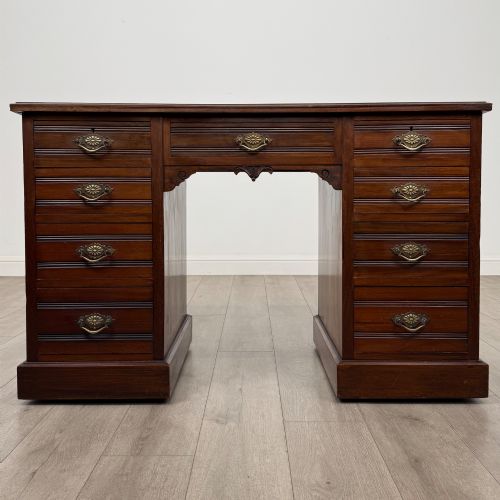
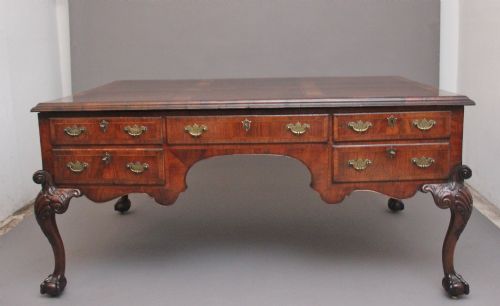
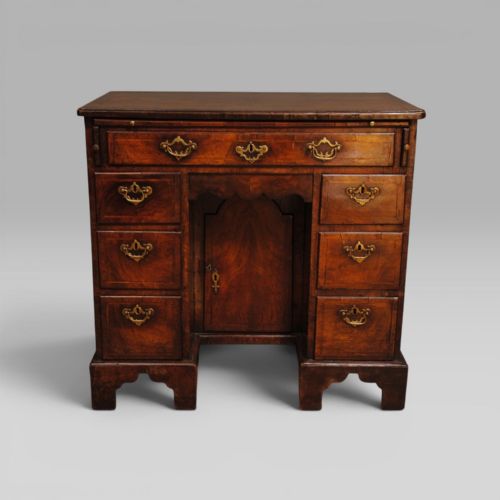
A dark walnut pedestal desk provides a sturdy double-sided or single-sided workspace supported by banks of drawers, designed for heavy daily use in a study or library. When you search for a dark walnut pedestal desk, you encounter substantial writing tables spanning the Victorian, Edwardian, and Art Deco periods, along with earlier 18th-century kneehole forms.
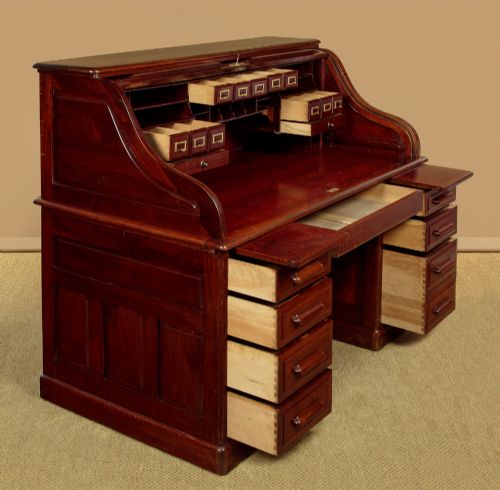
The prevailing examples on this page are Edwardian and Victorian creations fashioned from rich walnut, often featuring a fitted leather writing surface inset into the top. These pieces range from twin pedestal writing desks to roll-top variants and partner desks built to accommodate users from both sides.
Occasional incursions of 1930s modernist design, such as pieces attributed to Betty Joel or Étienne Kohlmann, demonstrate that the dark walnut pedestal desk adapts cleanly beyond traditional revivalist aesthetics. Burr walnut veneers and contrasting satinwood stringing appear frequently among the Edwardian and mid-Victorian items.
Materials and construction methods
Cabinet makers constructed these desks using solid walnut and structural oak framing, frequently applying figured walnut or burr walnut veneers to the primary display surfaces. Secondary timbers like oak reinforce the drawer linings and internal carcases, ensuring lasting stability.
Brass handles, locks, and occasional chrome accents furnish the drawers, whilst tooled Moroccan leather or standard leather hides provide the traditional writing insert on the top. Artisans shaped the timber into pedestal bases, kneeholes, and roll-top cylinders using traditional joinery appropriate to each period.
Details such as satinwood stringing and Reformed Gothic carving demonstrate the variety of decorative techniques applied across the 19th and early 20th centuries. French polishing sealed the dark walnut grain, producing a deep, reflective lustre that endures on surviving examples.
Walnut, burr walnut, and oak form the primary structural and decorative materials across these desks, complemented by brass and leather.
Distinctions in quality and execution
The calibre of a desk rests on the selection and matching of the walnut veneers, with symmetrical burr patterns and consistent grain alignment marking out superior cabinet work. Lesser examples rely on plain timber or suffer from patched veneer repairs where shrinkage has occurred over the decades.
Construction integrity manifests in the smooth operation of the pedestal drawers and the retention of original brass hardware and working locks. Desks retaining their original tooled leather top surfaces hold greater architectural and historical cohesion than those fitted with modern replacements.
Attribution to known makers like Betty Joel or Étienne Kohlmann elevates certain modernist pieces, whilst period revival desks gain distinction through refined carving and proportion rather than sheer bulk.
Betty Joel·Étienne Kohlmann
The Dark Walnut Pedestal Desk Glossary
- Pedestal desk
- A freestanding writing table supported by two vertical banks of drawers beneath the main top. This form provides substantial storage alongside a central kneehole.
- Partners desk
- A large pedestal desk designed with drawers and cupboards on both sides so two people can work facing each other simultaneously. These items generally date to the 19th century.
- Burr walnut
- A highly prized timber figure caused by tree growths, yielding intricate swirling patterns used for decorative veneer. Cabinet makers utilised it on drawer fronts and top panels to create striking visual contrast.
- Kneehole desk
- A compact form of pedestal desk featuring a central recess for the legs, flanked by narrow pedestals of drawers. Eighteenth-century examples often display restrained proportions and fine timber selection.
- Reformed Gothic
- A 19th-century design style incorporating medieval architectural motifs rendered with geometric precision and linear simplicity. Pieces in this style utilise dark woods and bold hardware.
- Stringing
- Thin inlay lines of a contrasting wood, such as satinwood, embedded into the surface of the primary timber. This technique outlines drawers and borders to frame the grain.
Dark Walnut Pedestal Desk: Frequently Asked Questions
What is a partners desk?
A partners desk is a large pedestal desk built with matching drawers and storage compartments on both the front and the back. This configuration allows two individuals to sit opposite one another and share the working surface.
Such desks were traditionally utilised in offices, banks, and large libraries where colleagues needed to collaborate or share administrative duties in a single workspace.
How do I care for a walnut desk?
Keep your walnut desk away from direct sunlight and heat sources to prevent the timber from drying out and the veneer from lifting. Clean the surface using a soft, dry cloth and apply occasional coats of appropriate furniture wax to nourish the wood.
Take care with the leather insert by avoiding moisture pooling and harsh chemical cleaners, treating the hide gently to preserve any original tooling.
Are roll top desks heavy?
Roll top desks are exceptionally heavy pieces of furniture due to the dense solid walnut timber, internal pigeonhole structures, and substantial pedestal bases. Moving them usually requires multiple people and careful dismantling of any removable drawers.
The mechanical tambour shutter adds further weight and complexity to the upper section of the desk.
How do I date a pedestal desk?
Dating a pedestal desk involves examining the construction methods of the drawer linings, the style of the brass hardware, and the choice of secondary timbers like oak. Earlier 18th-century examples display hand-cut dovetails and simpler kneehole layouts, whereas Victorian and Edwardian items often feature machine-sawn elements and heavier proportions.
Stylistic cues such as Art Deco curves or Reformed Gothic carving also help assign a piece to the 1930s or the late 19th century.