
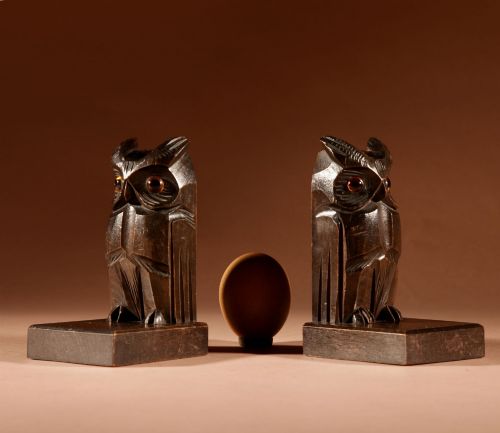


Dark Timber Bookends
Dark timber bookends bring heavy woods and disciplined carving into the home library to hold volumes steady.
Dark Timber Bookends
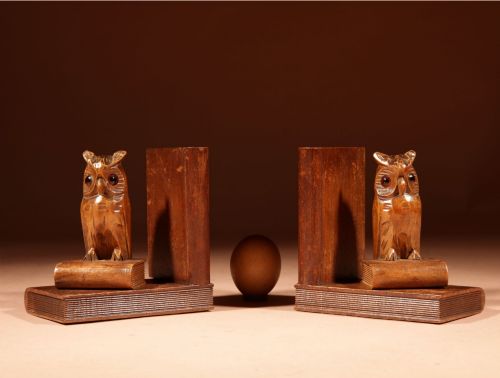
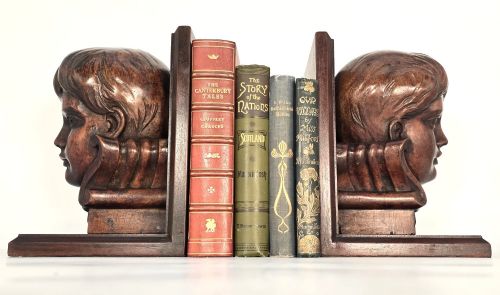
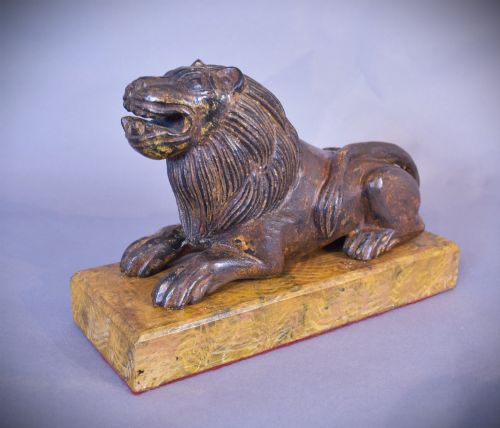
Dark timber bookends appear in forms such as carved owls, elephants, lions, and architectural library supports. These pieces emerge across periods spanning the seventeenth century through to the early twentieth century, reflecting varied regional tastes and domestic habits.
The buyer frequently encounters Black Forest animal carvings featuring owls alongside Victorian ecclesiastical mahogany designs and Anglo-Indian beech or coromandel examples. Solid yew wood and hardwood elephant pairs also populate this selection.
Origins stretch from European workshops to English libraries and Asian carvers, offering domestic utility combined with decorative sculpture. Each pair anchors shelves while displaying the distinct character of its native timber and period.
Materials and construction methods
Carpenters and carvers utilise dense timbers such as mahogany, hardwood, linden wood, coromandel, and yew wood to provide the necessary weight for holding books upright. These woods are selected for their grain and structural stability.
Makers apply hand-carving techniques, shaping biological subjects like lions and elephants or architectural motifs directly from the solid block. Surface finishes rely on natural polish or paint highlights to accentuate the underlying timber.
Listings feature wood and hardwood alongside bone and glass elements, spanning Victorian and seventeenth-century periods.
Assessing quality in dark timber pieces
Quality rests upon the crispness of the carving and the fidelity of the anatomical or architectural proportions. Stronger pieces display confident tool work that defines feather, mane, or timber grain without hesitation.
The integrity of the timber and the balance of the heavy plinth dictate the functional success of the object. Superior examples maintain structural harmony between the sculptural subject and the supporting base.
The Dark Timber Bookends Glossary
- Black Forest
- A style of wood carving originating from the European mountain region, renowned for detailed animal studies and figurative groups. These pieces typically utilise linden wood.
- Anglo-Indian
- Descriptive of furniture and decorative objects produced in India under British influence, often combining indigenous motifs with European forms. Such items frequently employ exotic hardwoods.
- Coromandel
- A dense, heavily grained tropical timber prized for its dark colour and durability. It appears in nineteenth-century decorative objects.
- Gothic Revival
- An architectural and decorative style drawing inspiration from medieval design. This aesthetic manifests in ecclesiastical library furnishings.
Dark Timber Bookends: Frequently Asked Questions
How heavy are these bookends?
These pieces use dense woods like mahogany, coromandel, and hardwood to provide sufficient mass. The solid timber weight naturally anchors heavy volumes on open shelves.
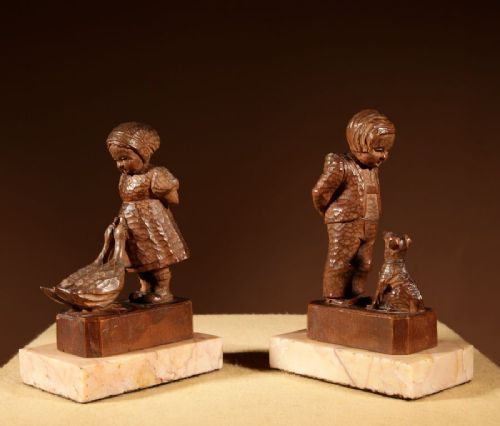
Heavier pairs often incorporate substantial plinths or stone elements to increase stability. This ensures the support remains firm under pressure from large collections.
Where were they originally used?
Makers designed these objects for Victorian libraries, studies, and domestic reading rooms. They served both a practical role and a decorative function among private collections.
Examples also appeared on desks and side tables for organising active reading materials. Their presence added refined craftsmanship to everyday domestic spaces.
Are these pairs original?
Many listings present matching pairs created together in workshops during the nineteenth and early twentieth centuries. Carving styles and timber grain help confirm their shared origin.
Individual sculptures adapted later into bookends also appear within the wider selection. Careful inspection of the base and wear patterns reveals these modifications.