



Dark Oak Weather Glass
These dark oak weather glass instruments combine domestic utility with robust Victorian and Edwardian craftsmanship to grace your wall.
Dark Oak Weather Glass
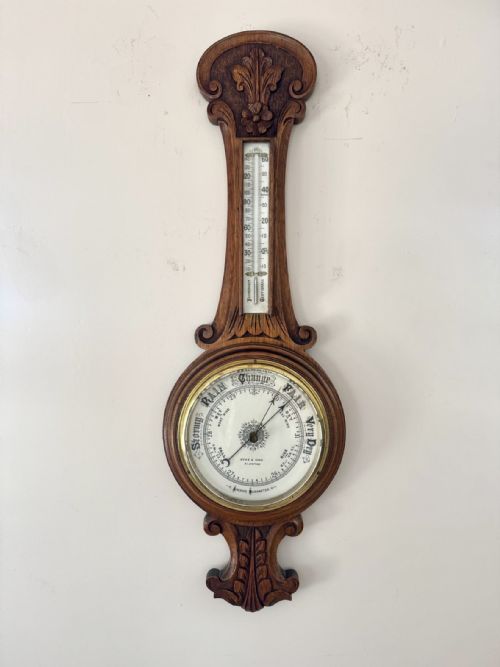
A dark oak weather glass is a functional meteorological instrument housed in timber, most commonly seen here in Victorian and Edwardian wall-hanging formats from the nineteenth and early twentieth centuries. These pieces record atmospheric pressure and temperature using either mercury columns or aneroid dials.
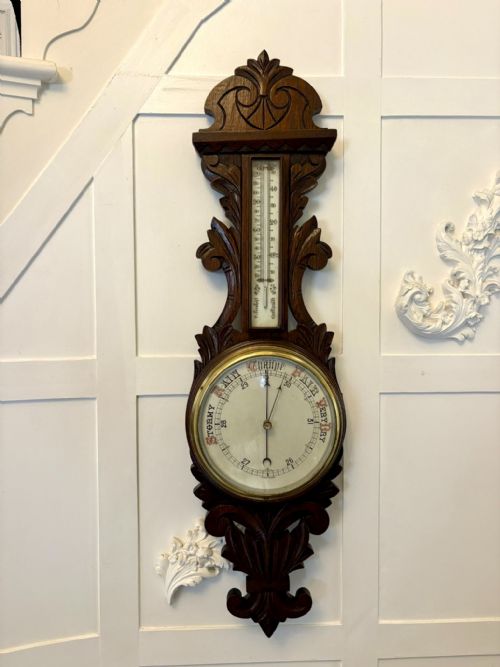
The selections range from simple circular aneroid wall barometers to elaborate carved banjo barometers and oak-cased barographs with chart drawers. Examples span the decades from the mid-nineteenth century through to the nineteen-twenties, often incorporating ceramic dials and brass bezels.
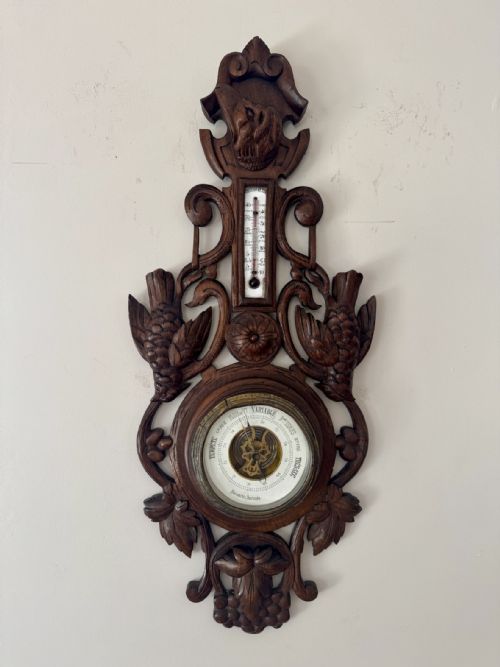
Makers such as Negretti & Zambra and James Pitkin appear among these timber-framed pieces, alongside ornate Black Forest carvings depicting birds and botanical motifs. Buyers encounter both mercury stick barometers and Admiral Fitzroy storm barometers mounted in dark oak.
Materials and construction
The primary structural material in these instruments is dark oak, frequently shaped through deep hand-carving or turned into circular wall bezels. Lindenwood and other timbers also appear in more sculptural Black Forest frames.
Internal mechanisms rely on brass fittings, glass viewing tubes, and occasionally porcelain or ceramic dials marked with barometric pressure scales. Mercury fills the columns of stick barometers, whilst aneroid models utilise internal metal bellows connected to pointers.
Listings for dark oak weather glasses span the period from eighteen-fifty to nineteen-twenty, featuring both aneroid dials and mercury-filled tubes.
Judging quality in barometer cases and dials
Quality rests in the crispness of the oak carving and the legibility of the dial, whether ceramic, porcelain, or silvered brass. Cabinets with bevelled glass and intact maker signatures command greater attention from collectors.
The sophistication of the movement, from standard aneroid dials to recording barographs with chart drawers and subsidiary thermometers, distinguishes standard domestic pieces from workshop-signed scientific instruments.
Negretti & Zambra·James Pitkin London·Hyde & Sons Sleaford·J Hicks of London
The Dark Oak Weather Glass Glossary
- Aneroid barometer
- A barometer that measures air pressure via the expansion and contraction of a flexible metal box, operating without liquid mercury. This design became popular in domestic wall instruments during the Victorian era.
- Stick barometer
- A tall wall instrument containing a vertical glass tube filled with mercury over a cistern. These provide direct readings of atmospheric pressure.
- Barograph
- A self-recording meteorological instrument that plots barometric pressure onto a rotating paper chart over a week. These are typically housed in oak cases with glass panels.
- Admiral Fitzroy storm barometer
- A specialised weather glass designed following nineteenth-century maritime guidelines to predict impending gales. They frequently incorporate chemical storm tubes alongside standard barometric scales.
- Bevelled glass
- Glass with an angled edge set into the brass bezel of the instrument. This detail adds depth and catches the light.
Dark Oak Weather Glass: Frequently Asked Questions
How do I hang a heavy oak barometer safely?
Secure your barometer directly into wall studs or utilise heavy-duty wall anchors rated for timber-cased instruments. The weight of the dense oak frame and internal brass mechanisms requires robust support.
Ensure the mounting hook grips the recessed bracket firmly at the rear of the case so the instrument hangs completely vertical for accurate mechanical function.
Are these mercury barometers safe for the home?
Enclosed mercury stick barometers present minimal risk during normal domestic use because the liquid metal remains sealed within the thick glass tube. Avoid tilting or inverting the instrument during cleaning.
If moving the barometer to a new room, tilt it gently at a forty-five-degree angle to allow the mercury to rise to the top of the tube without trapping air pockets.
How do I read an aneroid dial?
Tap the glass lightly with your fingertip to settle any friction in the mechanical linkage before taking a reading. The pointer indicates the current barometric pressure.
Set the movable brass indicator needle directly over the primary pointer so you can observe whether pressure rises or falls over the following hours.
How do I tell Victorian pieces from Edwardian ones?
Victorian dark oak barometers often feature heavy, deep-relief carving with naturalistic motifs like birds and foliage. Cases from this era tend to be bold and substantial in scale.
Edwardian examples frequently show cleaner lines, simpler circular bezels, and lighter oak tones while retaining traditional aneroid or thermometer combinations.