


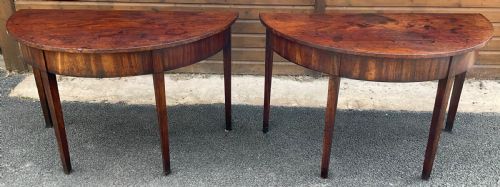


D End Hall Tables
These d end hall tables offer practical surfaces for narrow spaces, shaped by centuries of cabinetmaking tradition.
D End Hall Tables
D end hall tables are narrow, flat-backed furnishings designed to sit against a wall in a passage or reception area. When you search for d end hall tables, you encounter versatile formats built to save space while providing a functional top surface. The pieces appearing here span from the 17th century through the Georgian, Victorian, and Edwardian periods, reflecting shifting domestic needs over generations.
Oak tables from the Edwardian era and the 1920s appear frequently in this selection, often taking the form of side tables or console variants. Alongside these domestic oak pieces, mahogany and walnut examples from the Georgian and Victorian eras offer richer grain patterns and darker tones. The archive evidence demonstrates that matched pairs designed to sit together form an established part of this furniture tradition.
Materials and Construction
Makers utilised native and imported hardwoods, relying heavily on solid oak, mahogany, and walnut for structural stability and visual depth. Cabinetmakers selected figured walnut, satinwood, and paint finishes to enhance specific surfaces, whilst brass fittings provided functional accents. Construction methods combined traditional joinery with turned supports such as bobbin-turning and barley-twist legs.
The physical form of these tables required precise shaping of the curved D ends to ensure the edge profile met the wall cleanly. Carving and inlay work appear across various examples, particularly within Jacobean Revival and Arts and Crafts pieces. The transition from heavy oak benches with shaped trestle ends to lighter occasional tables illustrates the varied demands placed on woodworkers.
Some tables double as secret dining companions, splitting apart to reveal hidden leaves tucked away for unexpected guests.
Assessing Quality and Execution
Quality in these tables rests upon the selection of timber and the precision of the joinery rather than ornamentation alone. Finer examples display carefully matched grain patterns across the top surface, particularly in figured walnut and mahogany pieces. The integrity of the structural frame, from the tightness of the leg joints to the stability of the D shaped ends, determines the durability of the piece.
The refinement of carved details and the execution of turned elements separate standard utility pieces from more ambitious cabinetwork. Tables featuring secondary woods chosen with care or subtle inlay work demonstrate a higher level of workshop practice. Conversely, simpler oak designs rely entirely on honest proportions and solid construction for their enduring appeal.
Hindley and Sons
The D End Hall Tables Glossary
- Demi Lune
- A half-moon shape used for table ends and consoles. This profile allows the furniture to sit flat against a wall with minimal projection.
- Console Table
- A table fixed to a wall or designed to stand against one, often supported by legs at the front. These pieces serve narrow entrance spaces where floor area is restricted.
- Bobbin-Turning
- A lathe-working technique producing a series of rounded, spool-like shapes along a wooden leg or stretcher. It appears frequently on 17th-century furniture.
- Satinwood
- A durable, yellowish timber prized for its lustrous grain. Cabinetmakers utilised it for fine veneering and contrasting inlay work during the 18th and 19th centuries.
- Side Table
- A small utility table designed to stand against a wall. These versatile items served various domestic functions in hallways, bedrooms, and reception rooms.
D End Hall Tables: Frequently Asked Questions
What is a d end hall table?
A d end hall table is a narrow piece of furniture with one curved, semi-circular end or two D-shaped ends designed to stand against a corridor wall. These tables provide a surface for lamps, post, or decorative objects without obstructing narrow walkways.
Historically, many were modular dining tables that could be separated into console sections when not in use. Today, they function primarily as permanent hallway or reception furniture.
How do I date an oak side table?
Dating an oak side table involves examining the construction methods, fastener types, and wood patination. Earlier pieces from the 17th century often feature hand-split timber, peg joinery, and turned legs like bobbin or barley-twist styles.
Later Edwardian or 1920s oak tables generally display machine-cut elements, lighter finishes, and revival styles such as Jacobean or Arts and Crafts motifs. Comparing the hardware and grain appearance to known period examples confirms the era.
Where should I place a console table?
Console tables fit naturally in entrance halls, narrow corridors, or behind sofas where floor space is limited. Their shallow depth allows them to anchor a wall space beneath a mirror or artwork without crowding the room.
Placing one in a reception area creates a convenient drop zone for daily essentials. Matched pairs can also frame a doorway or focal point in larger living spaces.
What is the difference between mahogany and walnut?
Mahogany and walnut are distinct hardwoods favoured in different periods of British cabinetmaking. Mahogany, common in Georgian pieces, offers a reddish-brown tone and high structural stability.
Walnut, often seen in earlier periods and Victorian burr variations, presents a rich, figured grain pattern with warmer brown shades. Both timbers take polishes well but age with visibly different surface textures.