



Curved Painted Chest Drawers
A curved painted chest drawers brings soft contour and decorative surface to a room, offering practical storage with distinct eighteenth-century and later character.
Curved Painted Chest Drawers
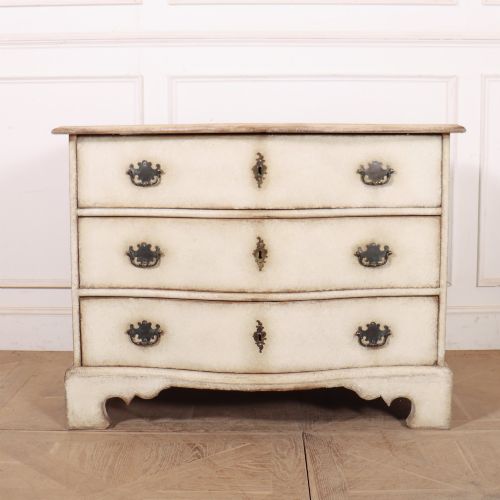
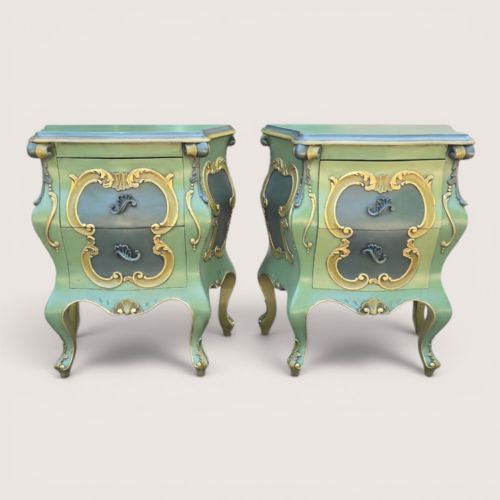
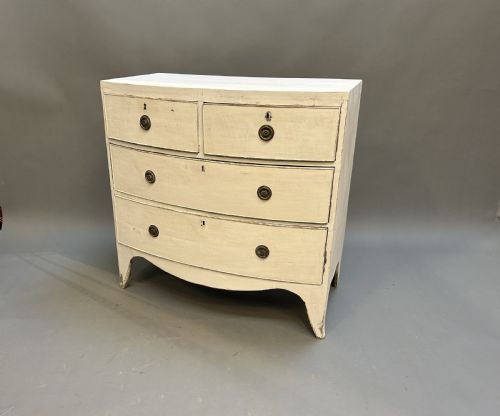
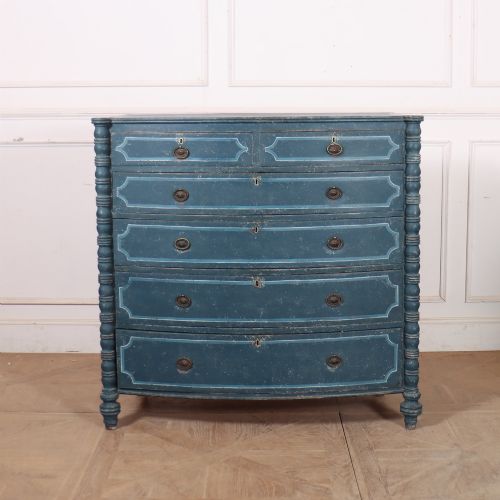
When you search for a curved painted chest drawers, you are looking at serpentine, bowfront, and commode forms shaped in wood and finished with paint. These pieces range from substantial eighteenth-century Provincial French and German commodes to smaller nineteenth-century English bowfronts and twentieth-century bedside chests.
The most common versions met on this page are bowfront and serpentine chests of drawers, often finished in painted surfaces alongside burr walnut or gilt moulding. They appear across Georgian, Regency, Louis XV Revival, and French Provincial styles, showing how makers adapted curved silhouettes to different regional tastes.
How they were made
Surfaces received layers of paint, sometimes accented with gilt moulding or metal hardware such as brass handles and escutcheons. The combination of structural woodwork and decorative paintwork defined the production across both English country workshops and continental ateliers.
Curved Painted Chest Drawers Retail Price Guide 2026
Typical asking prices for curved painted chest drawers among the pieces listed under this phrase on Sellingantiques today, from the lower quarter to the upper quarter. They describe what is for sale here now, not the wider market.
Listings show pieces spanning the eighteenth century, the nineteenth century, Regency, and the 1920s to 1930s.
What varies in quality
Quality rests in the precision of the curved silhouette and the handling of the painted surface. Finer examples display harmonious proportions in their serpentine or bowfront profiles, where the drawers fit flush against the contoured frame.
The sophistication of the painted finish and the integration of decorative details like gilt moulding or burr walnut distinguish standard pieces from superior works. Finer execution in the woodwork ensures the drawers operate smoothly despite the natural movement of curved timber over centuries.
The Curved Painted Chest Drawers Glossary
- Serpentine
- A front or side profile that curves inward centrally and outward at the ends in a gentle wave. This undulating shape requires advanced cabinetmaking skill to execute properly.
- Bowfront
- A convex, outward-curving front facade popular in Georgian and Regency furniture. It softens the boxy angles of a standard rectangular chest.
- Commode
- A low chest of drawers or cabinet, typically of French or continental origin. The term often describes decorative pieces with pronounced curves and painted or polished surfaces.
- Gilt Moulding
- Thin decorative strips coated in gold leaf or a metallic substitute applied to frame panels or edges. It highlights the structural lines of the furniture.
- Burr Walnut
- Wood veneer taken from the wart-like growths on walnut trees, prized for its swirling, highly figured grain patterns. It provides rich visual texture on select drawer fronts.
Curved Painted Chest Drawers: Frequently Asked Questions
How do I style a painted chest?
A painted chest works well as a focal point in a bedroom, hallway, or living area, offering surface space for lamps or mirrors. The painted finish allows the piece to introduce colour and softness to an interior scheme.
Pair it with neutral walls to let the curved lines and decorative surface draw the eye.
What is the difference between a commode and a chest of drawers?
A commode is traditionally a low continental chest of drawers, often associated with French or German styling and pronounced curved fronts. An English chest of drawers typically follows regional forms like the bowfront or straight front.
Both serve the same primary storage function but carry distinct regional design histories.
How do I identify a Georgian chest?
A Georgian chest often displays proportioned drawer arrangements, quality timber selection, and restrained decorative details such as bowfront contours. These pieces reflect the classical design influences of the eighteenth and early nineteenth centuries.
Examining the construction methods and hardware helps confirm the period of origin.