





Crystal Drop Candle Holders
These crystal drop candle holders bring candlelight and glass refraction together, offering a traditional way to illuminate a room.
Crystal Drop Candle Holders
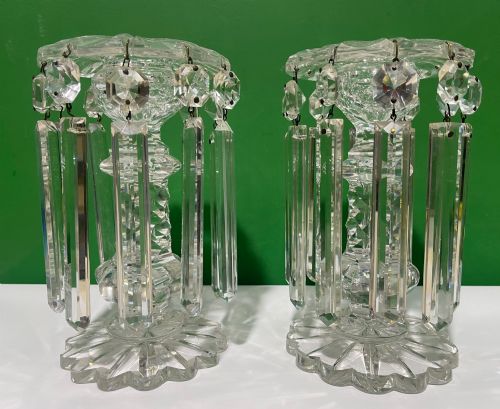
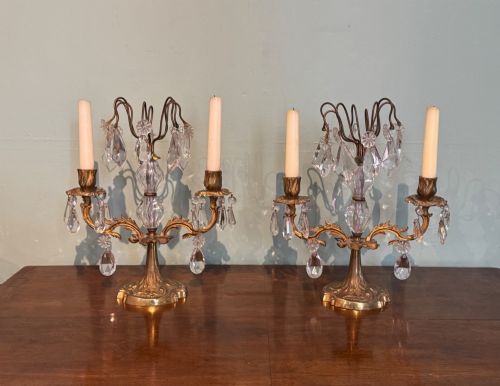
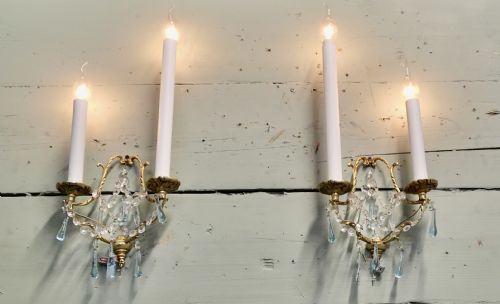
Crystal drop candle holders encompass forms such as candelabras, candlesticks, wall sconces, and mantel lustres found across the nineteenth century and into the twentieth century. When exploring crystal drop candle holders, buyers encounter varied configurations from single candlesticks to multi-armed candelabras hung with glass drops.
The objects originate from English, French, Italian, and Bohemian workshops, reflecting styles spanning Regency, Victorian, Louis XVI, and Rococo Revival. These lighting pieces function as tabletop centrepieces or wall fittings designed to catch and multiply the light from flames.
Materials and construction
Makers shaped glass, crystal, and cut glass alongside metal components such as brass, gilt brass, gilt bronze, ormolu, and silvered metal. Cutting and polishing techniques defined the glass bodies and hanging pendants, while metal arms and bases provided structural support.
Additional decorative elements include enamel work, coloured flash glass in ruby and green tones, and mirrored backplates on wall sconces. Hanging crystal drops are attached via wire loops to catch the illumination.
Crystal Drop Candle Holders Retail Price Guide 2026
Typical asking prices for crystal drop candle holders among the pieces listed under this phrase on Sellingantiques today, from the lower quarter to the upper quarter. They describe what is for sale here now, not the wider market.
The listings span the nineteenth century, including Regency and Victorian periods, alongside early twentieth-century examples up to the 1930s.
Assessing quality and craftsmanship
Quality rests in the precision of the glass cutting, the clarity of the crystal, and the weight of the metal mounts. Finer examples feature deep, sharp facets on the glass drops and substantial bronze, brass, or ormolu frames rather than lighter stamped metals.
The integrity of the ensemble depends on matching components, complete sets of hanging drops, and harmonious proportions between the candle nozzles, standard, and base.
The Crystal Drop Candle Holders Glossary
- Lustre
- A decorative tabletop piece fitted with hanging glass pendants, designed to reflect candle flame rather than primarily function as a light source. These often feature coloured glass bodies.
- Candelabra
- A branched candlestick holding multiple candles across several arms. They range from twin-light versions to large multi-armed fixtures.
- Ormolu
- Gilded bronze used for mounts and decorative fixtures on nineteenth-century pieces. The technique involves applying a gold amalgam to a bronze base.
- Flash glass
- Glass formed by fusing a thin layer of coloured glass over a clear glass body, often cut away to create patterns. Ruby and green versions appear frequently in Victorian pieces.
Crystal Drop Candle Holders: Frequently Asked Questions
How do I clean crystal drop candle holders?
Remove hanging drops individually and wash them in warm soapy water using a mild detergent. Dry each piece thoroughly with a soft cloth before rehanging them.
Clean the metal frames carefully with a dry or slightly damp cloth to preserve original patination, avoiding harsh chemical polishes.
Can I burn real candles in these holders?
Real candles can be used provided they fit securely in the nozzles and are monitored while lit. Drips should be cleaned promptly from glass and metal surfaces.
Ensure drafts are minimised to prevent uneven burning and potential wax damage to hanging drops.
What is the difference between a lustre and a candelabra?
A lustre is primarily ornamental, featuring glass drops intended to catch and refract light from a central candle or oil burner. Lustres often incorporate coloured glass and elaborate pendant arrangements.
A candelabra provides functional illumination through multiple branched arms designed to hold several candles simultaneously.
How do I date an antique crystal holder?
Dating relies on stylistic clues, mounting techniques, and glass-cutting methods. Regency and Victorian pieces exhibit distinct proportions and metalworking signatures.
Examine the construction of the joints, the composition of the metal, and the hand-finished details on the glass components.