




Crystal Candle Sconces
Crystal candle sconces bring candlelight and glass refraction to panelled walls, catching every flicker across French and Italian rooms.
Crystal Candle Sconces
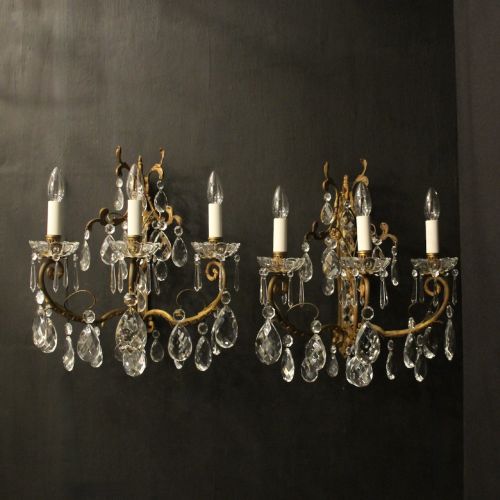
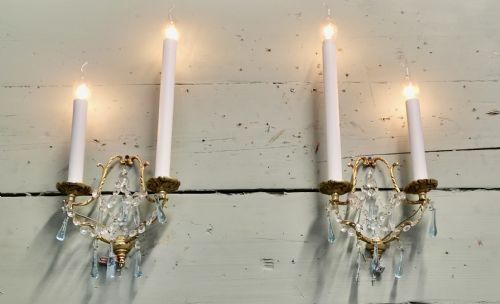
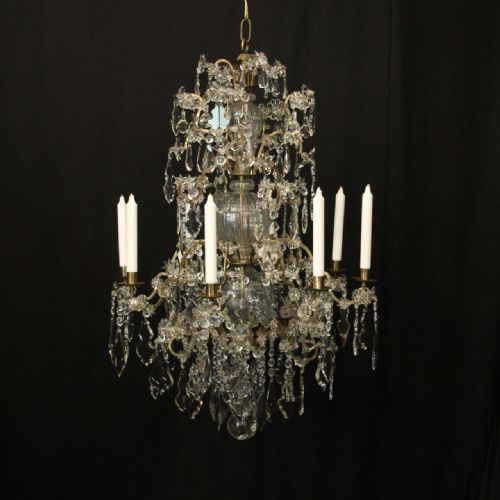
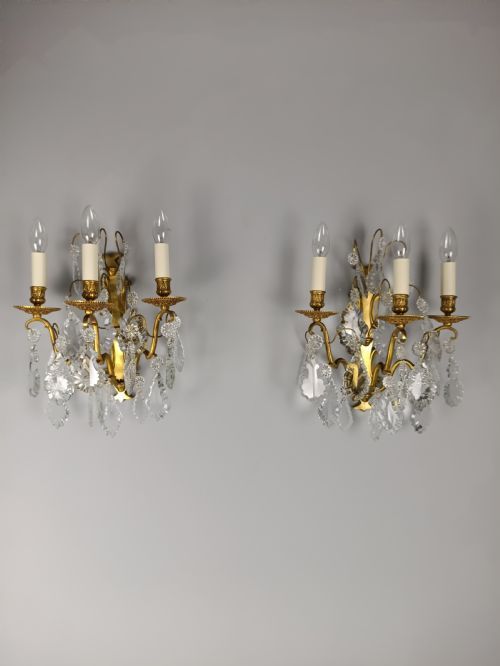
Crystal candle sconces are wall-mounted lighting fixtures designed to hold tapers while reflecting illumination through glass drops and pendants. When searching for crystal candle sconces, buyers encounter various forms including double and triple arm wall lights, girandoles, and wall-mounted chandeliers.
Most examples originate from the nineteenth century and the early twentieth century, spanning periods from eighteen fifty up to nineteen thirty. French designs dominate the selection, often rendered in the Rococo, Neoclassical, or Chateau styles.
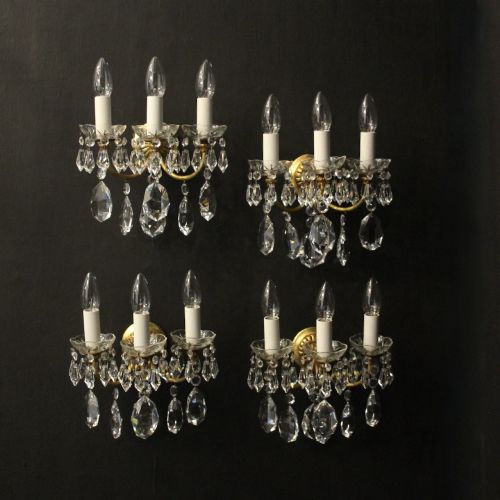
Italian Florentine workshops and Swedish makers also contribute significantly to the available styles. Pieces range from simple twin branch pairings to large sets of four featuring intricate metalwork.
Materials and construction
The framework of these wall lights relies on cast and gilt metals, including brass, bronze, ormolu, and gilt metal, which provide a sturdy armature for the branching arms. Artisans secured glass and cut crystal pendants to these frames using wire pins, allowing the drops to move and catch the light freely.
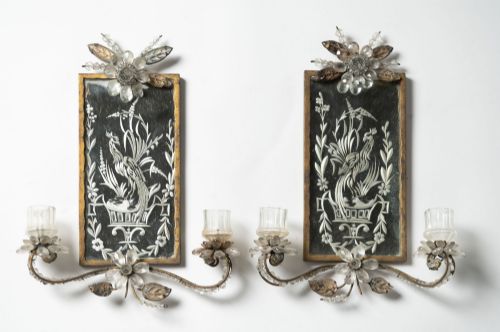
Glass components include moulded crystal drops, cut glass prisms, and mirrored backplates that amplify the illumination of the candles. Certain models incorporate carved giltwood or toleware alongside the primary metal structures to achieve specific decorative effects.
Reflective mirrored backplates were originally designed to double the flicker of a single tallow dip, creating maximum illumination from minimal resource.
Assessing craftsmanship
Quality rests in the crispness of the metal casting and the depth of the gilding on the bronze or brass framework. Superior examples display carefully faceted cut glass or crystal drops that refract light cleanly without internal cloudiness.
The complexity of the arm configuration and the integration of matching crystal drops determine the refinement of the piece. Matching sets of four demonstrate a higher level of original commissioning than assembled pairs.
Maison Baguès·F. & C. Osler·Baccarat
The Crystal Candle Sconces Glossary
- Girandole
- A decorative wall-mounted bracket or sconce fitted with candle branches and reflective elements such as mirrors or crystal drops. These fixtures were designed to multiply the ambient light in a room.
- Ormolu
- Gilded bronze produced by applying a mercury and gold amalgam to a bronze base and firing it to leave a rich finish. This technique gives metalwork a warm, enduring lustre.
- Lustre
- A glass or crystal pendant, drop, or prism hung from a lighting fixture to refract candlelight. Lustres are characteristic of nineteenth-century chandeliers and wall lights.
- Gustavian
- The Swedish interpretation of French neoclassical design, characterised by restrained ornamentation and lighter metallic or painted finishes. This style appears frequently in Scandinavian wall lighting.
Crystal Candle Sconces: Frequently Asked Questions
How do I mount crystal candle sconces safely?
These wall lights require secure anchoring to wall studs or the use of appropriate heavy-duty cavity fixings due to the combined weight of the metal armature and glass drops. Professional installation ensures the bracket bears the load without straining the plaster.
Once secured, ensure the candle holders sit level so that tapers burn evenly and wax does not run down the glass pendants.
Can these sconces be converted for electricity?
Many surviving examples have already been adapted for modern wiring, whilst others retain their original configuration for wax tapers. Conversion typically involves running discreet wiring through the central bracket and arms.
Buyers preferring traditional usage can continue burning wax candles, though electric conversions offer a practical alternative for daily illumination.
How should I clean crystal drops?
Pendants and prisms benefit from gentle hand cleaning with warm water and a mild solution rather than harsh chemical sprays. Removing the drops individually allows for thorough drying and prevents residue build-up on the metal armature.
Careful handling protects the historical wire pins that secure each piece of crystal to the main frame.
What distinguishes French styles from Italian ones?
French designs lean towards symmetrical Rococo curves, Neoclassical restraint, and gilt bronze or brass framing. These pieces often feature elaborate casting and numerous cascading crystal drops.
Italian Florentine variants frequently incorporate carved giltwood elements, leaf motifs, and beaded arrangements that create a distinctively organic silhouette on the wall.