
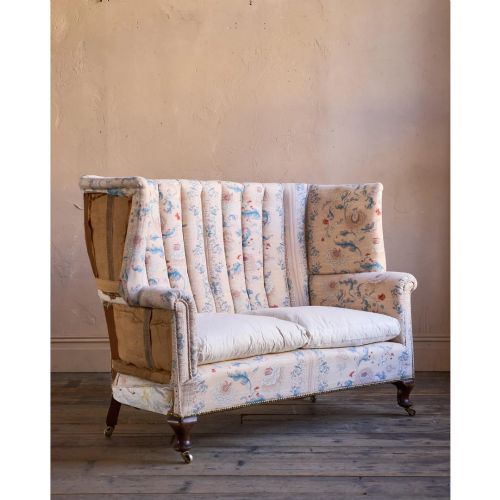
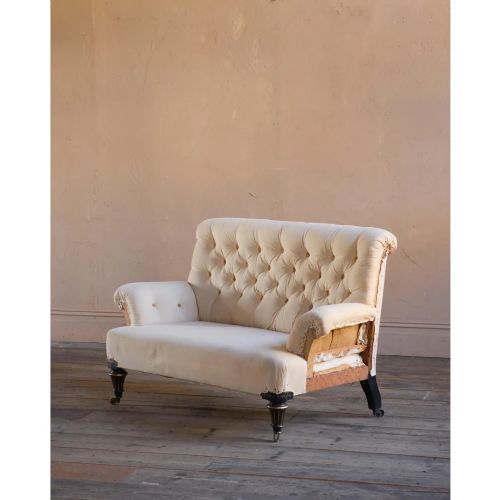
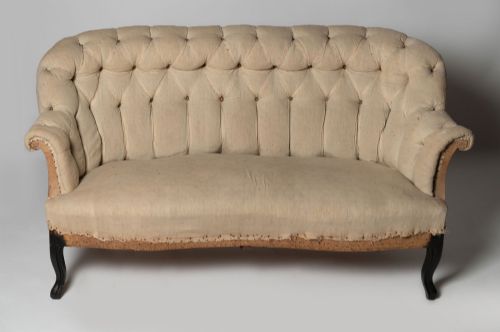
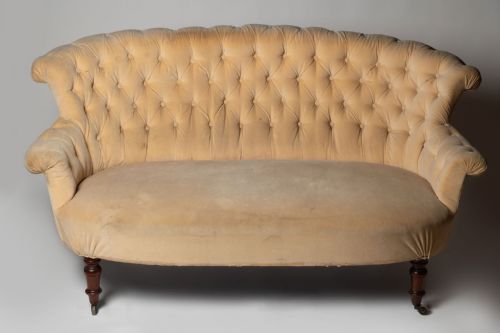


Cream Tufted Settee
These cream tufted settee examples bring nineteenth-century comfort and deep buttoning to a room.
Cream Tufted Settee
A cream tufted settee encompasses nineteenth-century seating forms such as Chesterfields, chaise longues, and salon sofas. These pieces provide deep buttoning and upholstered frames designed for formal drawing rooms and parlours. Victorian and French styles dominate the selections.
Buyers frequently encounter nineteenth-century walnut, mahogany, and rosewood frames alongside pieces intended for custom upholstery in calico or raw leather. Variations range from compact salon seating to expansive open-arm sofas and double-end settees.
How they were made
Frames rely on dense hardwoods such as mahogany, walnut, and rosewood, carved and joined by hand. Visible wood elements frequently feature gilded or painted highlights, particularly on French Rococo and Louis XVI models.
Upholstery techniques employ traditional coil springing and deep buttoning secured through heavy fabric, leather, or calico. Makers often mounted these padded frames on turned wooden legs fitted with brass castors.
Listings feature nineteenth-century periods spanning from 1850 to 1910, utilising wood, brass, leather, velvet, and calico.
What varies in quality
The distinction between standard production and fine workshop execution lies in the depth of frame carving and the integrity of the underlying timber. Finer examples display crisp botanical or scroll motifs carved directly into solid walnut or mahogany rather than applied mouldings.
Upholstery execution dictates the visual weight of the piece, where precise button placement and disciplined pleating create a balanced silhouette. The integration of maker-stamped elements or documented cabinet work elevates the standing of a settee.
Jackson and Graham·Jas Shoolbred·Howard and Sons
The Cream Tufted Settee Glossary
- Chesterfield
- A large upholstered sofa characterised by arms and back of the same height with deep button tufting. This form frequently appears in leather or heavy fabric.
- Chaise Longue
- An elongated upholstered chair designed for reclining, combining the backrest of a sofa with a seat long enough to support the legs. Nineteenth-century versions often feature a single scroll end.
- Buttoned
- An upholstery technique where indentations are created across the surface by pulling strings or twine through the padding and securing them with buttons. This method maintains the shape of the filling over decades of use.
- Salon Suite
- A matched set of seating furniture comprising a sofa and matching chairs intended for formal entertaining. These groupings share identical wood framing and textile upholstery.
Cream Tufted Settee: Frequently Asked Questions
How do I style a cream tufted settee?
Position the settee away from direct sunlight to protect delicate fabrics and leather finishes from fading over time. Pair the piece with neutral walls and polished wood furniture to complement the nineteenth-century aesthetic.
Ensure adequate clearance around larger forms like Chesterfields or chaise longues to allow the carved wooden frames and buttoned upholstery to remain visually prominent.
What is a nineteenth-century settee made of?
Frames are constructed primarily from solid hardwoods including mahogany, walnut, and rosewood. Structural support relies on internal webbing and traditional coil springs.
Surface materials span leather, velvet, calico, and various patterned fabrics. Brass castors frequently finish the feet of these frames.
Are these settees comfortable for daily use?
Nineteenth-century settees utilise deep padding and sprung seats designed for upright or reclining posture. The presence of button tufting creates a firmer sit compared to modern loose-cushion sofas.
Restored examples often feature renewed internal webbing and padding that restores the original support level of the piece.
How do I identify Victorian styles?
Victorian seating is characterised by dark hardwood frames, elaborate carved scrollwork, and prominent button tufting. Forms range from double-end settees to open-arm salon sofas.
French influences from the same era introduce lighter painted and gilded finishes alongside cabriole legs.