



Cream Ground Persian Carpet
A cream ground persian carpet offers a luminous field that anchors a room, bringing intricate medallion and floral designs into a lighter interior scheme.
Cream Ground Persian Carpet
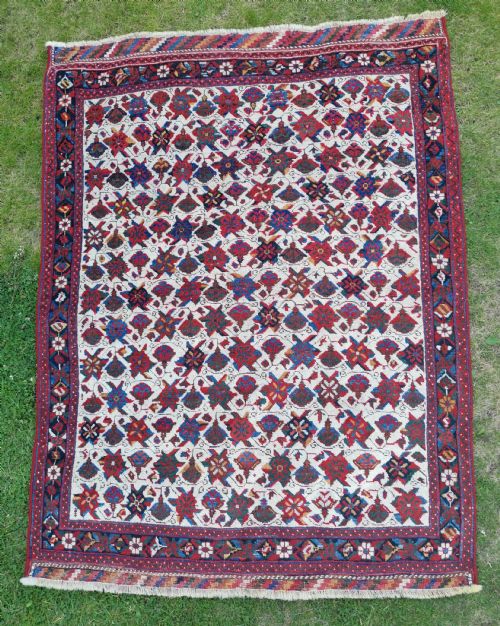
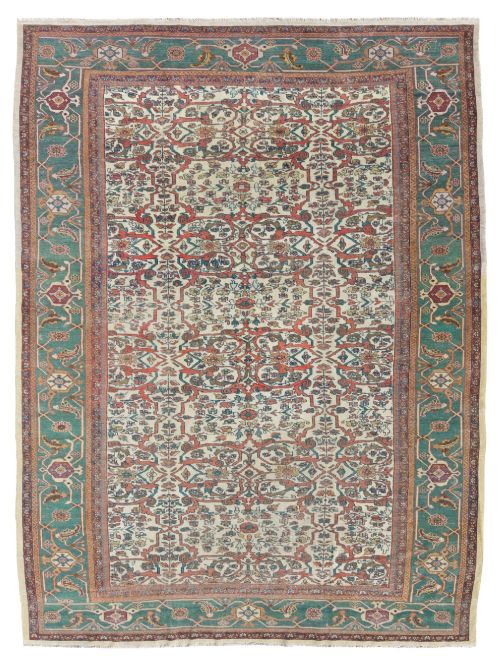
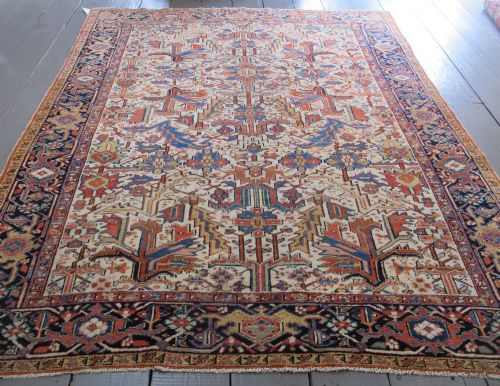
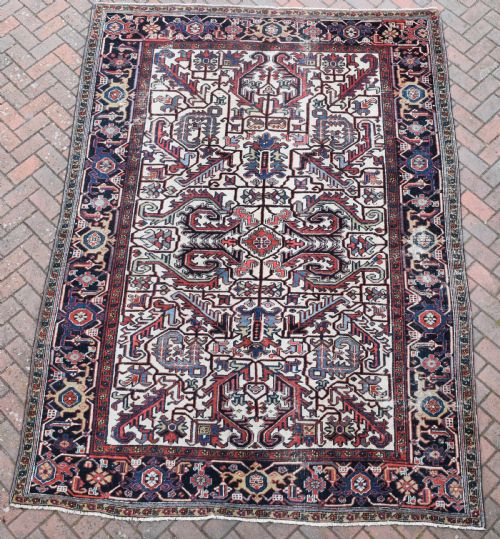
A cream ground persian carpet brings together regional hand-knotting traditions from centres such as Heriz, Sultanabad, Mahal, Malayer, and Tabriz, alongside tribal work from Afshar and Bakhtiari weavers. These large rugs and carpets feature pale, ivory, or cream fields that contrast with richer tones in the borders and motifs.
The pieces on this page span the decades from 1880 to 1930, capturing late nineteenth-century village and workshop production through to early twentieth-century examples. Buyers encounter formats ranging from room-sized carpets down to smaller area rugs and runners.
Designs on these pale grounds include traditional vase patterns, dragon and phoenix motifs, butterflies, boteh, and geometric tribal layouts. The lighter background shifts the visual weight of the weaving, allowing complex border arrangements to stand clear without overwhelming a modern floor space.
Materials and Construction
Every cream ground persian carpet recorded here relies on a foundation of cotton for the warp and weft threads, providing stable structure and firm edges. Wool forms the pile, knotted by hand to create dense surfaces capable of withstanding generations of foot traffic.
Dyers utilised natural materials to achieve the soft colour palettes seen across Malayer, Afshar, and Ziegler pieces, balancing the ivory fields with varied vegetable dyes in the surrounding ornamentation.
Several nineteenth-century village weavers included unexpected butterflies alongside traditional dragon and phoenix motifs on their ivory fields.
Assessing Quality and Execution
Knot density and the precision of the drawing dictate the distinction between standard village production and finer workshop carpets like those from Sultanabad or Tabriz. A tighter knotting structure allows intricate curves in floral and medallion layouts to remain crisp.
The handling of the cream or ivory field itself establishes visual success, where even dye saturation across large open areas creates a calm expanse that lets the secondary colours in the borders and central motifs sing.
The Cream Ground Persian Carpet Glossary
- Boteh
- A stylised almond or pear-shaped motif of Persian origin, frequently appearing in rows or scattered across the field of antique runners and rugs.
- Warp
- The vertical threads stretched tightly on the loom before knotting begins, forming the foundational fringe structure at both ends of the carpet.
- Weft
- The horizontal threads passed between rows of knots to bind the structure together and secure the wool pile in place.
- Medallion
- A symmetrical central ornament placed in the middle of the carpet field, often echoed in the corner spandrels.
- Spandrel
- The triangular corner areas of a carpet field, enclosed by the main border and often filled with secondary ornamentation.
Cream Ground Persian Carpet: Frequently Asked Questions
How do I clean a antique carpet?
Gentle surface brushing and professional specialist washing preserve the wool pile and cotton foundation without disturbing natural dyes.
Avoid immersion washing or harsh chemical treatments unless handled by an established textile conservator.
Where were these carpets made?
Production spans specific Persian weaving towns, tribal regions, and larger commercial workshops including Heriz, Sultanabad, Mahal, Malayer, Tabriz, and Afshar.
Each centre developed distinct drawing styles, structural weights, and palette preferences.
Can I place these rugs in heavy traffic areas?
The sturdy wool pile and cotton foundations of these nineteenth and early twentieth-century pieces handle normal domestic foot traffic well.
Adding a suitable underlay prevents slip and reduces internal friction between the fibres.
How do I tell an Afshar rug from a Heriz carpet?
Afshar pieces often display tribal geometry, dragon motifs, or vase designs associated with southern nomadic weaving traditions.
Heriz carpets feature bolder, larger-scale geometric medallions and stronger structural lines characteristic of north-west Persian workshops.