
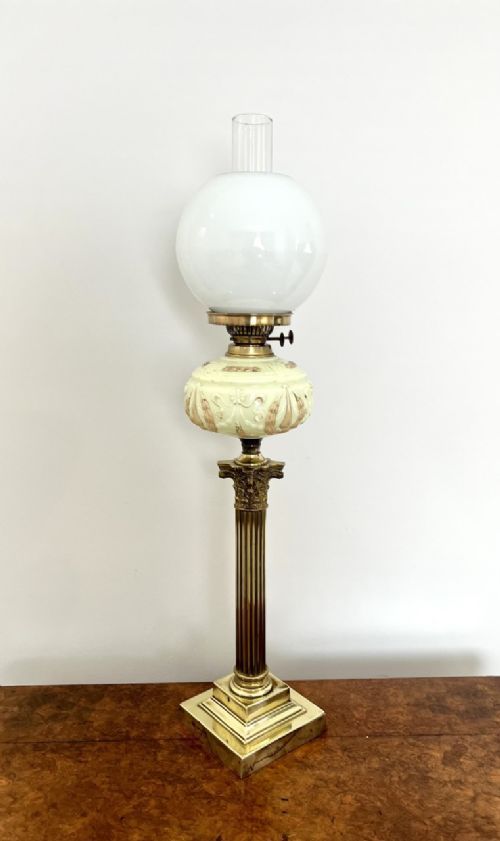

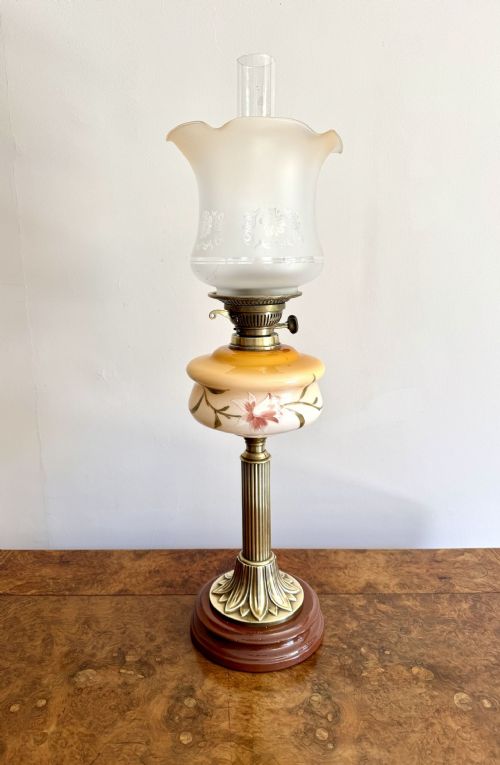


Cream Glass Table Lamp
These cream glass table lamps bring a soft, diffused glow and sculptural presence to a room, exactly what collectors want for layered lighting.
Cream Glass Table Lamp
A cream glass table lamp is a decorative lighting piece combining glass bodies with materials such as brass, bronze, marble, or ormolu. These lamps trace their lineage back through Victorian, Edwardian, and Art Deco periods, encompassing both electric table lamps and converted oil lamps.
The versions most commonly encountered on this page span the late nineteenth century into the nineteen-thirties, ranging from ornate French Neoclassical and Napoleon III designs to geometric Art Deco creations. Forms include standard table lamps, spirit dispensing barrel lamps, and night lights mounted on marble bases.
How they were made
Maker workshops utilised moulded and blown glass, often in opaline or crystal varieties, shaped into bodies and fonts. These glass elements were paired with cast metals such as brass, bronze, and ormolu, sometimes incorporating faience and ceramic components.
Metalwork involved casting, chasing, and mounting, securing glass reservoirs or shades onto heavy marble or brass bases. Later twentieth-century pieces introduced early plastics like Catalin and phenolic bakelite alongside traditional glass and metal.
The listings span Victorian, Edwardian, and Art Deco periods, uniting glass, brass, bronze, marble, and ormolu materials.
What varies in quality
The distinction between ordinary and exceptional pieces lies in the crispness of the metal casting and the weight of the materials used. Finer examples display detailed chasing on ormolu and bronze, substantial marble plinths, and heavier, unblemished glass bodies.
Stylistic cohesion also dictates quality, where period-specific details remain authentic and integrated rather than assembled from mismatched components. The articulation of decorative figures, such as bronze greyhounds, separates standard production items from superior artistic works.
The Cream Glass Table Lamp Glossary
- Opaline glass
- A type of semi-translucent glass that is typically milky white or pale cream in appearance. It diffuses light softly and was widely favored in nineteenth-century lighting design.
- Ormolu
- Gilt bronze created by applying a finely ground high-carat gold-mercury amalgam to a bronze object. It provides a rich, warm metallic finish seen on French neoclassical pieces.
- Catalin
- A cast phenolic formaldehyde resin developed in the nineteen-thirties that retained vibrant colours and translucency. It appears frequently in modernist and Art Deco lighting components.
- Faience
- Tin-glazed earthenware decorated with opaque colours before firing. It provides a ceramic body and rich surface pattern within nineteenth-century lamp bases.
- Spirit dispensing barrel lamp
- A specialised nineteenth-century lighting form incorporating a barrel-shaped vessel, often constructed from glass, originally designed to hold or dispense spirits while functioning as a lamp.
Cream Glass Table Lamp: Frequently Asked Questions
Are these lamps converted from oil?
Many older examples originating from the nineteenth and early twentieth centuries began life as burning oil lamps before later conversion to electricity. This evolution is standard for period lighting and preserves the decorative metal and glass reservoirs.
Collectors appreciate these conversions for retaining their original burner mechanisms and heavy brass or bronze mountings while accommodating modern wiring for domestic use.
How do I date a glass table lamp?
Dating relies on stylistic markers, material combinations, and manufacturing techniques visible in the glass and metal components. Victorian and Edwardian pieces often feature heavy brass castings and opaline glass, whereas nineteen-thirties pieces introduce bakelite, catalin, and streamlined geometric forms.
Examining the construction methods of the base, such as the use of bronze versus plated metals, further narrows the period of manufacture.
What is French neoclassical style in lamps?
This style draws on classical Greek and Roman motifs, translating them into decorative lighting through symmetry, restraint, and classical proportions. Ormolu mounts, cast bronze details, and crystal elements are typical hallmarks of this aesthetic.
Such lamps project an air of formal elegance suited to traditional interiors.
Where should I place a cream glass lamp?
Cream glass lamps suit surfaces where diffused, gentle illumination is desirable, such as sideboards, entrance consoles, or bedside tables. Their neutral tones complement both dark wood antique furniture and modernist interiors.
Pairing them with appropriate fabric shades balances the proportions of the heavy glass and metal bases.