
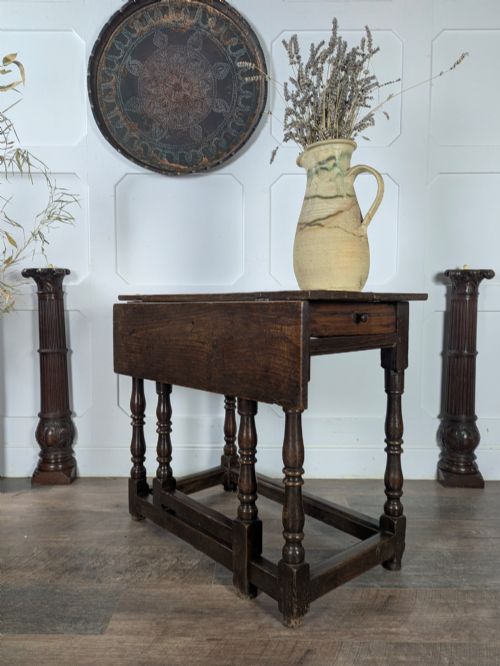
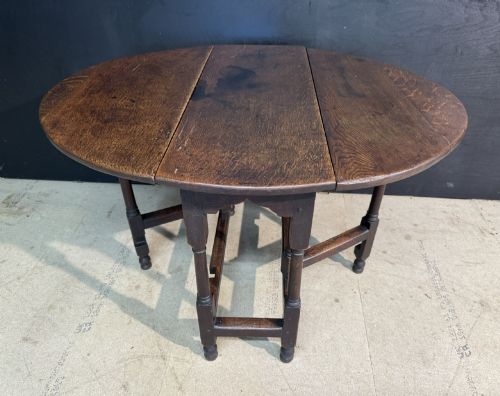
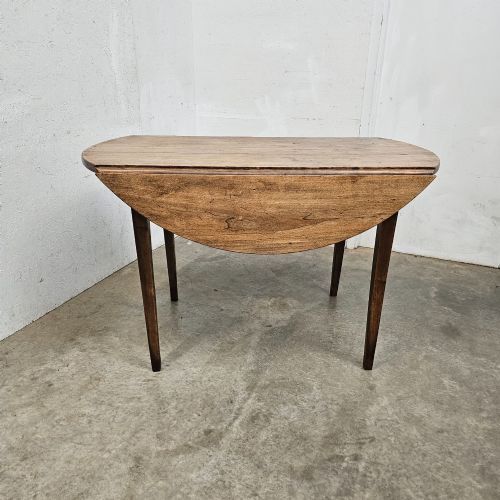


Country Oak Flap Table
A country oak flap table is a practical antique dining or side surface designed with folding leaves, offering sturdy timber construction and centuries of domestic utility.
Country Oak Flap Table
A country oak flap table is a utilitarian form designed for flexible domestic space, featuring hinged leaves that drop down when not required for dining or work. The pieces on this page span several centuries, with the eighteenth century strongly represented alongside seventeenth-century and later examples.
Buyers most frequently encounter gateleg tables within this search phrase, where hinged legs swing out to support the raised flaps. Alongside these are Pembroke and drop-leaf formats, constructed in solid oak often accompanied by secondary timbers such as elm and fruitwood.
The geographical origins stretch across English and French country traditions, displaying regional vernacular traits rather than rigid court designs. These tables functioned as central pieces in farmhouses and provincial homes, built to endure daily family life.
Assessing Quality and Character
Quality rests in the integrity of the timber selection and the retention of original surface characteristics like historical patina. Tables displaying sound structural joinery without excessive timber replacement stand apart from heavily altered examples.
The elegance of the turned leg supports and the proportion of the drop leaves relative to the fixed centre frame dictate the visual balance of the piece. Subtle details in the turning of baluster posts and the weight of the solid oak top distinguish superior workshop output.
The Country Oak Flap Table Glossary
- Gateleg table
- A table with hinged leaves supported by legs that swing outward from the frame like a gate. This form provides maximum surface area when open and folds compactly when closed.
- Drop-leaf table
- A table featuring a fixed central section and one or two hinged flaps that lower at the sides. These leaves are supported by folding brackets or swinging legs.
- Baluster post
- A moulded or turned vertical timber support resembling a classical baluster. These frequently form the structural legs on seventeenth and eighteenth-century tables.
- Patina
- The surface sheen and colour developed on wood over decades of handling, polishing and exposure to light. Original patina indicates an untouched historical finish.
- Fruitwood
- Dense timber harvested from fruit-bearing trees such as pear or cherry, used occasionally in country furniture for turning or secondary parts.
Country Oak Flap Table: Frequently Asked Questions
What is a country oak flap table?
A country oak flap table is a functional antique dining or occasional table featuring hinged leaves that lower to save space. They were built in regional workshops to serve practical domestic needs.
These tables utilise solid timber construction and often incorporate swing-out gatelegs to support the extended flaps during meals or work.
How do I date an antique oak flap table?
Dating relies on examining the construction methods, nail types, hinge styles and turning details of the legs. Seventeenth-century examples often feature heavy baluster posts and pegged joinery.
Later eighteenth and nineteenth-century pieces display lighter proportions, different hinge mechanisms, and variations in timber secondary woods like elm or fruitwood.
Where were these tables made?
These tables originated in provincial workshops across England and France, reflecting local vernacular furniture traditions rather than urban court styles. Regional makers utilised locally available timber.
English country pieces frequently show West Country or general provincial characteristics, while French examples exhibit distinct continental framing techniques and proportions.
Can I use an antique flap table daily?
These tables were originally built for heavy daily use in farmhouses and country homes, making them structurally suited for modern dining. Solid oak construction provides substantial durability.
Care should be taken to protect the historical surface from moisture and heat using appropriate mats, while ensuring the swing legs support weight evenly.