

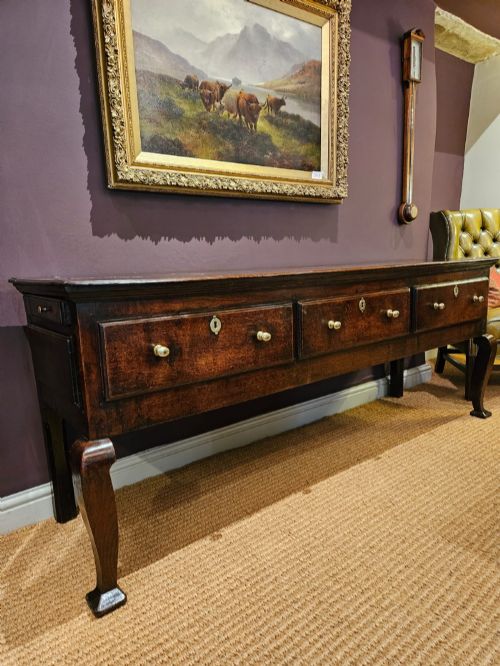


Country House Lowboy
A country house lowboy is a sturdy, low-slung table for daily utility, offering simple drawers and honest timber construction.
Country House Lowboy
The versions most commonly met on this page span the eighteenth and nineteenth centuries, including Georgian and later country house styles. They arrive in timber forms such as oak, mahogany, cherrywood, yew, and painted pine.
Makers built these low storage tables for practical tasks, resulting in straightforward proportions and minimal ornamentation. Their presence brings a quiet, utilitarian character to hallways, bedrooms, and reception rooms alike.
How they were made
Joiners constructed these lowboys primarily using solid timbers like oak, mahogany, cherrywood, and yew, supplemented by painted pine and walnut. Surfaces often display the natural grain of the wood or bear layers of early paint.
Hardware typically consists of brass handles and escutcheons fitted to drawer fronts. Construction methods rely on traditional joinery techniques suited to hard-wearing domestic furniture.
Country House Lowboy Retail Price Guide 2026
Typical asking prices for country house lowboy among the pieces listed under this phrase on Sellingantiques today, from the lower quarter to the upper quarter. They describe what is for sale here now, not the wider market.
Many an antique lowboy secretly harbours ink stains inside its top drawer from centuries of household accounts and correspondence.
What varies in quality
The distinction between standard examples and finer pieces lies in the choice of timber and the restraint of the design. Dense hardwoods like mahogany or cherrywood command attention through their natural figuring, while simpler pine relies on the character of old painted surfaces.
Proportion and integrity of the timber dictate the overall appeal of each piece. Tables that retain their original brass drawer furniture and unaltered structural joins demonstrate superior historical survival.
The Country House Lowboy Glossary
- Lowboy
- A small table with one or more drawers, originating in the late seventeenth century and frequently used as a dressing table or side table.
- Georgian
- Pertaining to the reigns of the first four Georges, spanning the eighteenth century and the early decades of the nineteenth. This era is known for balanced proportions and classical influence.
- Escutcheon
- A protective brass plate surrounding a keyhole on a drawer or door. It prevents the wood from splitting around the lock.
- Dresser base
- The lower section of a kitchen or dining room dresser, featuring drawers and cupboards without the upper plate rack. These sturdy pieces double as sideboards.
Country House Lowboy: Frequently Asked Questions
What is a country house lowboy used for?
These low tables served various domestic purposes throughout the eighteenth and nineteenth centuries, often functioning as dressing tables or compact storage surfaces.
Today, they fit easily into entrance halls or living spaces as decorative side tables with convenient drawer storage.
How do I date an antique lowboy?
Dating relies on examining the timber species, construction methods, and secondary woods used in the drawers. Eighteenth-century pieces commonly employ oak or walnut before mahogany and cherrywood gained widespread popularity.
Changes in hardware styles and fixing methods also provide clear indicators of the period in which the item was constructed.
Are these tables made of solid wood?
Most country house lowboys and related side tables feature solid timber construction throughout their frames and drawer linings. Craftsmen utilised locally available woods such as oak, pine, and yew alongside imported hardwoods like mahogany.
This solid construction contributes to the heavy weight and enduring durability of these antique furnishings.
Where should I place a lowboy at home?
The compact proportions of a lowboy make it suitable for narrow hallways, landings, or as a slim desk in a study. Their low height also allows them to sit comfortably beneath mirrors or paintings.
Pairing the table with a simple chair or leaving the surface clear highlights its historical form.