
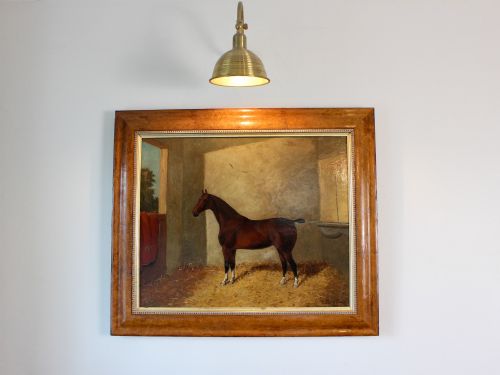


Country House Equestrian Picture
A country house equestrian picture brings the raw energy of the hunting field and the quiet dignity of the stable straight to your wall.
Country House Equestrian Picture
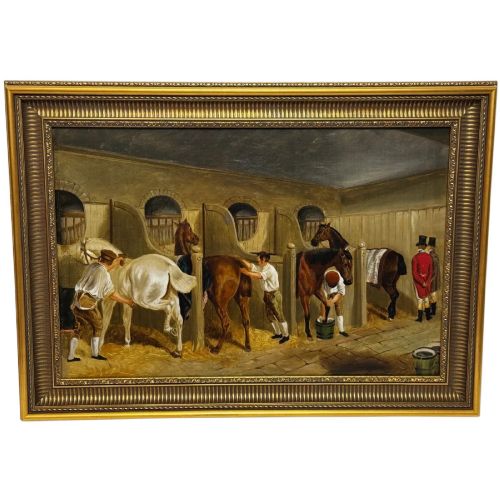
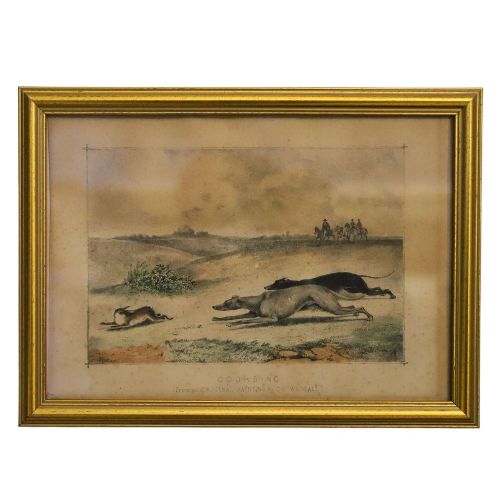
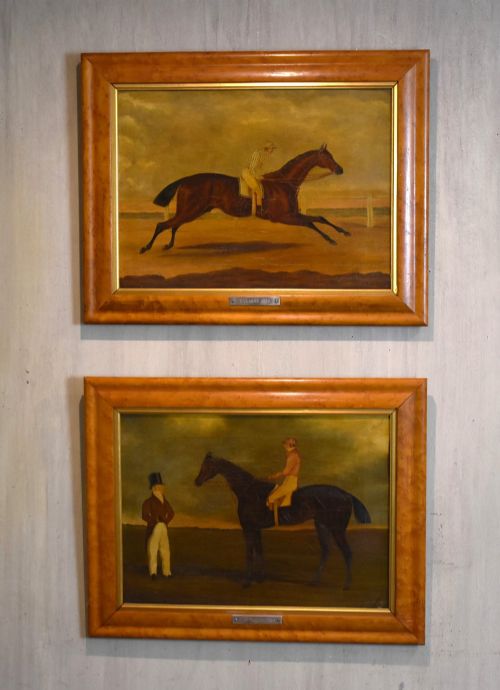
A country house equestrian picture captures horses, hounds, huntsmen and rural coaching scenes across oil paintings, watercolours and framed prints. These works reflect the sporting life of country estates, celebrating prized hunters, racehorses and working farm animals in traditional settings.
You will encounter works spanning the Victorian era through the mid-twentieth century, dominated by nineteenth-century oil paintings and early twentieth-century prints. The subjects range from individual portraits of bay and chestnut horses to sweeping fox hunting meets and bustling racecourse views.
The compositions vary from intimate stable studies to large narrative hunting scenes populated by riders and hounds. Whether rendered in rich oil paint on canvas or delicate hand-coloured engraving on paper, each piece preserves a distinct chapter of rural heritage.
Assessing quality in equestrian art
Quality rests primarily upon the artist's anatomical mastery of the horse and the convincing depiction of movement in the field. Superior works render muscle structure, tension and equine posture with precise accuracy, whereas lesser pieces flatten the animal form into stiff, lifeless silhouettes.
The integrity of the medium further distinguishes the tier of a piece, separating spontaneous brushwork in original oils from mass-produced later reproductions. Original prints pulled from steel or copper plates retain crisp lines that weaker impressions lose entirely.
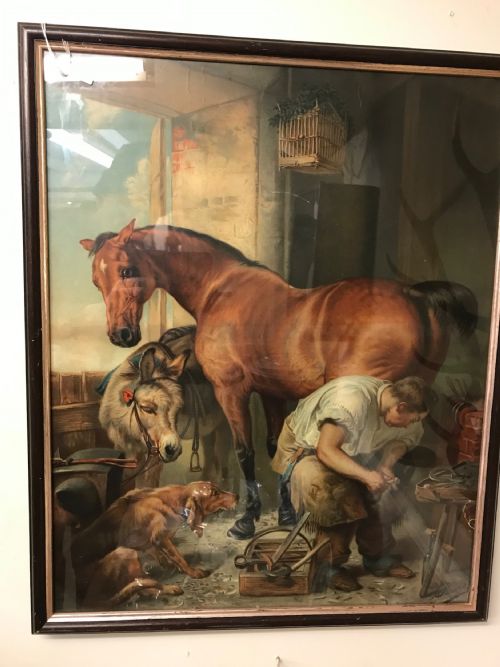
Jack Russell terriers keep watchful guard over caged rats right alongside the horses.
C. H. Weigall·Edwin Henry Landseer·John Frederick Herring Snr·John Arthur Lomax·John Frederick Herring Jnr·Alfred Duke·John Atkinson·Guillaume Urban Régamey·Charles Hunt·Francis Calcroft Turner·Sam. Howitt·Benedict Angell Hyland·Wilfred Bailey
The Country House Equestrian Picture Glossary
- Lithography
- A planographic printing method using a stone or metal plate to yield fine graphic lines. This technique allowed nineteenth-century publishers to distribute popular sporting scenes widely.
- Gouache
- An opaque water-based paint that provides solid colour and sharp highlights in works on paper. It is frequently combined with transparent watercolour in detailed equestrian studies.
- Engraving
- A printmaking process where an artist cuts lines directly into a metal plate with a burin. The resulting impressions capture microscopic detail in hunting coats and hound fur.
- Bay
- A horse coat colour characterised by a reddish-brown body with black points on the mane, tail and lower legs. It remains the most frequently encountered horse colour in these pastoral paintings.
- Gilt wood
- Timber carved and coated with a thin layer of gold leaf or metallic paint to create a reflective frame. These frames add architectural weight to large nineteenth-century oil canvases.
Country House Equestrian Picture: Frequently Asked Questions
What subjects appear in these pictures?
The subjects focus on horses, working farm animals, fox hunting meets, and coaching scenes set across rural landscapes. You will see individual portraits of bay and chestnut horses alongside dynamic action scenes of hounds and riders.
Many works also depict racecourses, stable interiors, and quiet pastoral moments involving terriers and farmyard livestock.
How do I date a piece?
Dating relies on stylistic clues, framing methods, and the recorded working periods of the artists or printmakers. Victorian and Edwardian pieces often carry specific period framing, signature styles, or written inscriptions on the reverse.
Examining the paper type, canvas weave, and printing technique further helps narrow down the production era.
Are these works original or prints?
The selection includes both original hand-painted oils and watercolours alongside historical engravings, lithographs, and vintage prints. Original paintings feature visible brush texture and unique hand application, whereas prints display fine dot patterns or inked plate lines.
Each listing specifies whether the item is a direct painted work or a period print reproduction.
How should I hang them?
Equestrian art suits traditional study spaces, dining rooms, and hallways where wooden furniture and neutral walls complement the palette. Ensure pieces on paper are kept away from direct sunlight to protect the watercolours and hand-tinted engravings.
Secure heavy oil paintings in gilt frames using appropriate wall fixings suited to the substantial weight of the timber.