

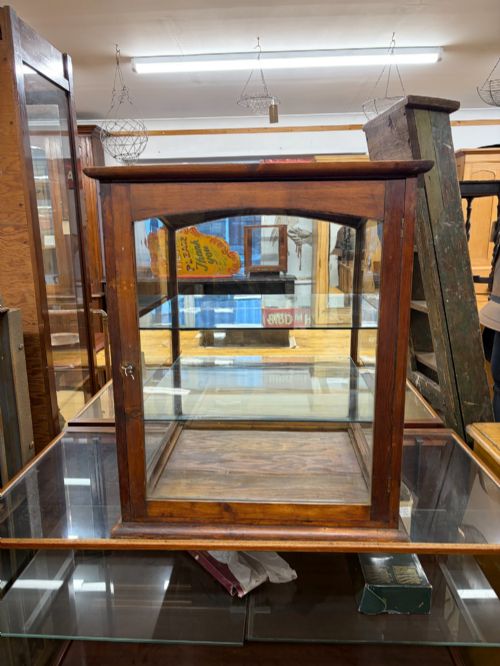
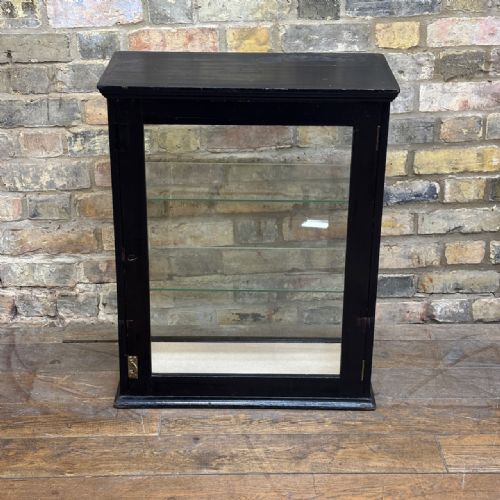



Countertop Collector Cabinet
These countertop collector cabinet examples place small treasures under glass within easy reach.
Countertop Collector Cabinet
A countertop collector cabinet provides glazed tabletop storage for small items, originating from commercial shop interiors and domestic display uses. When searching for a countertop collector cabinet, buyers encounter tabletop display cases and shop display cabinets spanning the nineteenth and twentieth centuries.
The selection ranges from Victorian mahogany and oak designs to Edwardian oak pieces and later 1920s commercial and Art Deco forms. These compact enclosures sit directly upon counters or tables, protecting contents while offering clear all-round visibility through glass panels.
Examples include specialised utility such as an apothecary's countertop display cabinet or a watchmaker's cabinet by Manoah Rhodes & Sons Ltd. Construction typically incorporates timber frames fitted with hinged or sliding doors and internal shelving or drawers.
How they were made
Maker construction relies heavily on traditional timber framing using oak and mahogany, alongside ebonised wood surfaces. Structural integrity comes from sturdy joints designed to support glass panes and frequent daily handling in retail or domestic settings.
Glazing forms the primary viewing surface, held securely within wooden rebates alongside brass hardware for handles, hinges, and drawer pulls. Interiors often feature surfaces lined in felt to cushion delicate objects placed inside.
Countertop Collector Cabinet Retail Price Guide 2026
Typical asking prices for countertop collector cabinet among the pieces listed under this phrase on Sellingantiques today, from the lower quarter to the upper quarter. They describe what is for sale here now, not the wider market.
Listings feature oak and mahogany construction paired with glass panels across Victorian, Edwardian, and 1920s periods.
What varies in quality
Quality differences emerge through the selection of cabinet timbers, such as figured mahogany or quarter-sawn oak, matched with precise joinery and refined moulding details. Superior examples exhibit clean timber finishing and well-fitted glass panes that maintain tight closures.
Hardware choice also distinguishes pieces, with heavy brass fittings and specialised maker plaques indicating higher workshop standards. The incorporation of functional additions like fitted drawers enhances the overall utility and structural refinement of the cabinet.
Manoah Rhodes & Sons Ltd
The Countertop Collector Cabinet Glossary
- Glazed
- Fitted with glass panels. This allows objects inside the cabinet to be viewed while protected from dust.
- Ebonised
- Wood treated to resemble ebony. This dark finish gives the timber a formal, uniform appearance.
- Apothecary
- Relating to the preparation and sale of medicines. Cabinets from this context often feature specialised compartment layouts.
- Rebate
- A recess or groove cut into the edge of a piece of timber. This cut holds the glass panels securely in place.
Countertop Collector Cabinet: Frequently Asked Questions
What fits inside a countertop collector cabinet?
Small collectibles, pocket watches, and specimens fit comfortably behind the glass panels.
Interior space is typically optimized for compact display rather than bulky items.
Where were these cabinets originally placed?
Shopkeepers positioned them on counters to showcase merchandise to customers.
Domestic settings also utilised them on tabletops to display private collections.
How do I date an oak display cabinet?
Dating relies on architectural styles, hardware types, and construction methods.
Victorian and Edwardian versions display distinct timber mouldings and joinery compared to 1920s commercial pieces.
Are the interiors lined?
Many examples feature felt-lined bases to protect delicate items from scratching.
This soft lining cushions the objects placed directly on the display surface.