

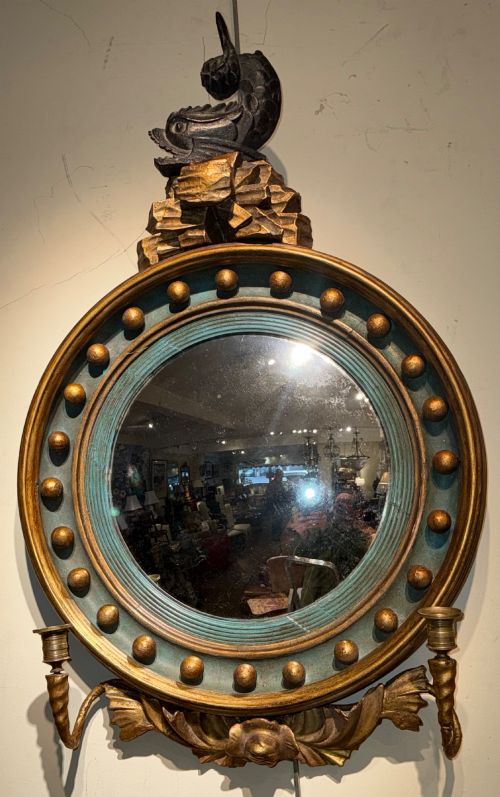


Convex Mirror Girandoles
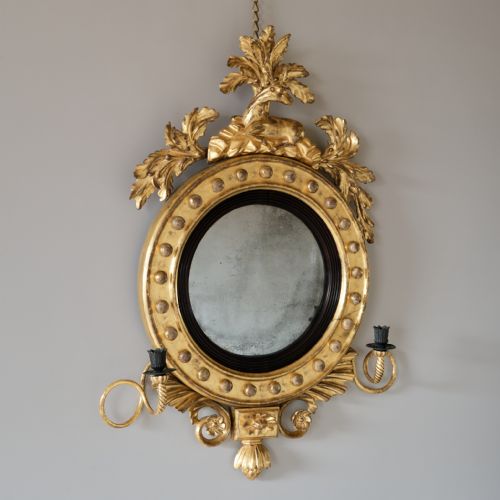
Convex mirror girandoles distort the room into a single curved globe, capturing light through a deep circular frame.
Convex Mirror Girandoles
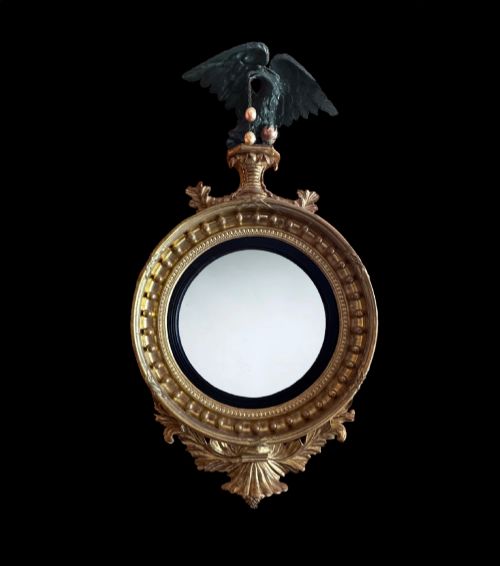
Convex mirror girandoles are wall-hanging objects primarily encountered from the Regency period, alongside Victorian and 1920s examples.
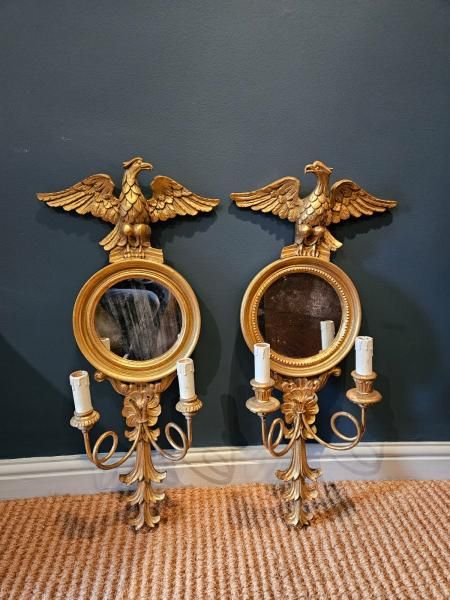
These pieces appear in various forms, including wall mirrors, wall sconces, and carved giltwood frames incorporating candle arms.
Most examples date to the nineteenth century, with specific pieces originating around eighteen-twenty.
Materials and construction
Makers formed the frames using giltwood, gesso, and ebonised wood, occasionally employing brass, painted wood, and other metals.
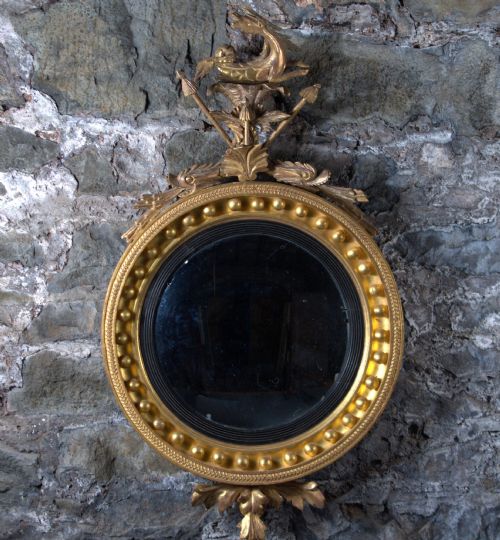
Curved mirror glass sits within deep circular mouldings, sometimes topped with carved eagles or dragon motifs.
A dragon peers out from the frame, guarding your miniature upside-down reflection.
Distinguishing quality
Quality rests in the crispness of the carved wood and gesso ornamentation, particularly around eagles, dragons, and candle branches.
The depth of the gilding and the integrity of the curved mirror plate dictate the visual weight of the piece.
The Convex Mirror Girandoles Glossary
- Giltwood
- Wood that has been coated with gold leaf or a gold-coloured finish. This surface treatment defines the appearance of most traditional frames.
- Girandole
- A branched wall-light or sconce equipped with candles, attached to a reflective mirror back. These fixtures distribute candlelight across a room.
- Gesso
- A plaster-like mixture applied to wood frames to create a smooth surface for gilding and carving. It allows for intricate relief details.
- Ebonised
- Wood treated to imitate ebony, producing a dark, black finish. This technique creates a strong contrast against gilded highlights.
- Convex glass
- Curved mirror glass that bulges outward to reflect a wide, panoramic view of the interior space. It creates a miniature spherical perspective.
Convex Mirror Girandoles: Frequently Asked Questions
How do I hang a convex mirror?
These mirrors carry substantial weight due to their dense wooden frames and heavy glass plates. Secure fixings directly into solid wall studs or use appropriate heavy-duty wall anchors.
Position the piece at eye level where it can reflect the main light sources and focal points of the room.
What is the difference between a mirror and a girandole?
A standard wall mirror functions purely to reflect light and space within an interior. A girandole specifically incorporates attached candle arms or sconces onto the frame.
Candlelight multiplies when reflected in the curved glass plate of a girandole.
How do I date a convex mirror?
Examine the construction methods of the wooden frame, the composition of the gesso, and the characteristics of the mirror plate. Regency examples often feature distinct carved crests like eagles.
Nineteenth-century and later twentieth-century pieces display variations in timber preparation and moulding techniques.
Where should I place a convex mirror?
Place these mirrors opposite a window or light source to maximise the panoramic reflection of the room. Their optical distortion works effectively in hallways and principal reception rooms.
Keep them away from direct moisture and extreme temperature fluctuations to protect the gilt surface.