


Continental Painted Drawers
Continental painted drawers bring regional European character to a room through varied provincial finishes on wood.
Continental Painted Drawers
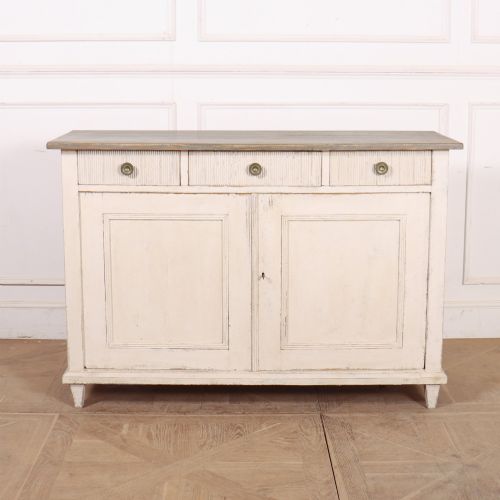
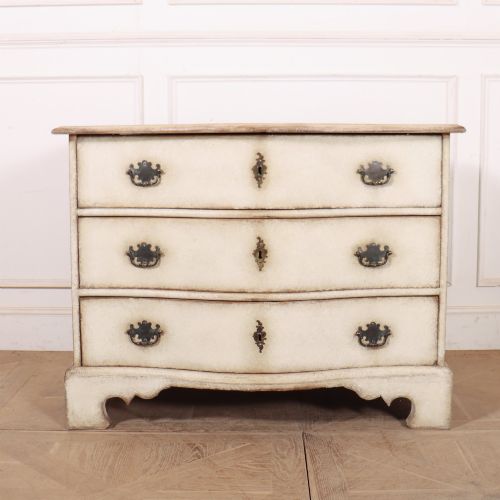
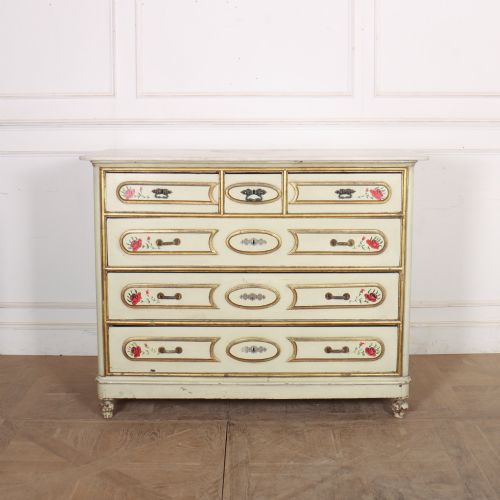
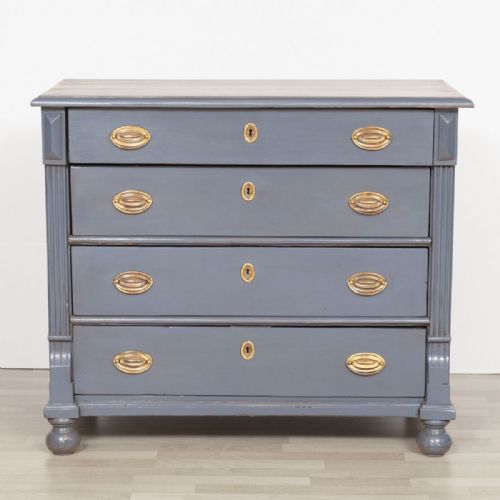
Continental painted drawers encompass items built across Europe, taking the form of commodes, chests of drawers, and bureaux. These pieces frequently emerge from periods such as the eighteenth and nineteenth centuries, displaying regional styles including Dutch Rococo, Scandinavian Country, and Italian Neoclassical. Buyers seeking these items encounter forms ranging from serpentine fronts and bombe profiles to straightforward pine chests.
The pieces on this page span diverse European origins, featuring work from Italy, Germany, Denmark, Spain, Austria, Portugal, and the Netherlands. Alongside standard chests of drawers, listings include sideboards, buffets, and cupboards fitted with drawers, demonstrating the broad utility of painted case furniture across the continent.
Assessing quality in painted furniture
Quality rests in the integrity of the original surface and the sophistication of the regional woodwork. Pieces retaining their original paint schemes display a harmony between the decorative pigment and the underlying wood structure that later repainting lacks. The execution of carved details, such as serpentine fronts and bombe contours, distinguishes ambitious workshop production from simpler provincial items.
Proportion and the handling of regional details, whether Dutch, Italian, or German, dictate the standing of a commode or chest. Refined hardware integration and stable construction complete the measure of a superior piece.
One German chest pairs massive bombe curves with carved mask motifs, ensuring your socks live behind shouting wooden faces.
The Continental Painted Drawers Glossary
- Bombe
- A bulging, convex swelling shape on the front and sides of a chest of drawers or commode. This flamboyant profile is particularly characteristic of eighteenth-century Dutch and German case furniture.
- Commode
- A low chest of drawers or cabinet originating in France but used widely across Europe. These pieces often feature decorative painted surfaces and distinct serpentine or bombe fronts.
- Serpentine
- A furniture front or top shaped with a double-curved line, curving outward in the centre and inward at the sides. This contour requires skilled carpentry and adds visual movement to painted commodes.
- Gesso
- A plaster-like mixture applied to wood as a base for paint or gilding. It provides a smooth surface for detailed decorative work on continental furniture.
- Bureau
- A desk fitted with sloping lids and internal drawers for writing. Continental examples often combine this function with painted exterior decoration.
Continental Painted Drawers: Frequently Asked Questions
How do I clean painted drawers?
Dust surfaces gently with a soft, dry cloth to prevent accumulation of grit.
Avoid commercial liquid polishes and abrasive cleaners, as moisture and harsh chemicals can damage historic paint layers.
Are these drawers original paint?
Many pieces retain their original regional paint finishes applied during the eighteenth or nineteenth centuries.
Some listings explicitly note later painted surfaces where a previous owner refreshed the exterior of the pine or softwood carcase.
Where were these pieces made?
These items originate from various European countries including Italy, Germany, the Netherlands, Denmark, Spain, Austria, and Portugal.
Each region developed distinct aesthetic preferences, resulting in styles ranging from Italian Neoclassical to Scandinavian Country and Dutch Rococo.
What wood is underneath the paint?
Pine and oak serve as the primary woods for the construction of these provincial and formal continental chests.
Selected pieces also incorporate walnut bodies beneath specific regional finishes or bleached treatments.