


Collie Dog Oil Painting
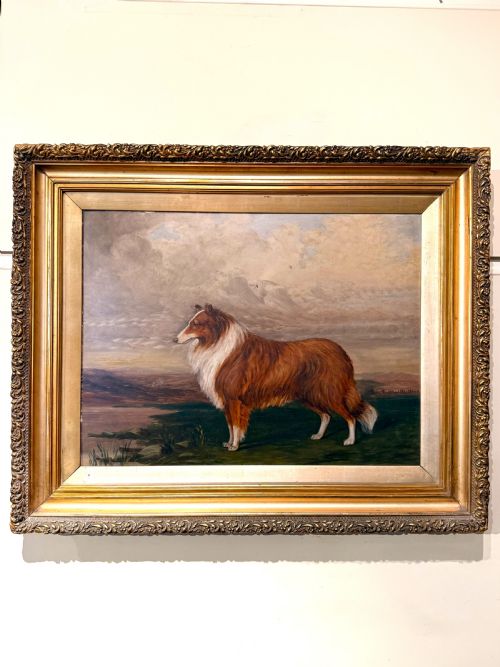
A collie dog oil painting captures the intelligence and loyalty of the breed through the rich medium of oils on canvas or board.
Collie Dog Oil Painting
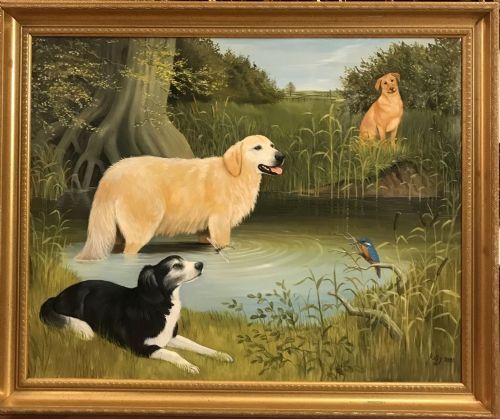
When you search for a collie dog oil painting, you encounter works celebrating the working dog, often depicted in landscapes or detailed portraiture.
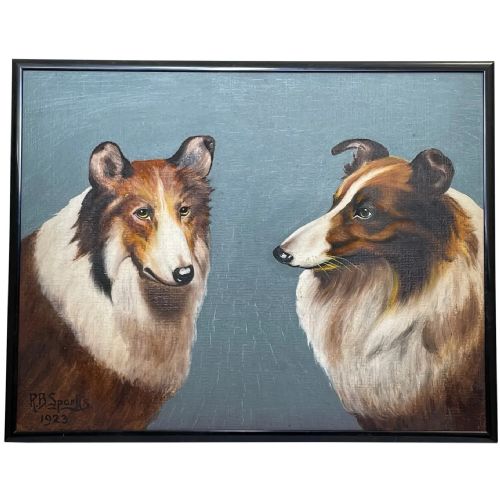
The examples recorded here span the Victorian era, the nineteenth century, and early twentieth century, showing rough collies and border collies.
You meet various expressions of the breed, from the academic precision of traditional realism and Victorian naturalism to the charm of the English naive school.
How they were made
These works are executed in oil paint applied to stretched canvas or wooden board, utilising the rich opacity of the medium to render the texture of the thick coat.
Framing often involves wood and giltwood, sometimes accented with gold leaf to complement the warm tones of the painted subjects.
Several paintings record individual dogs by name, preserving the specific identity of a Victorian pet.
What varies in quality
Quality rests in the anatomical precision of the dog and the subtlety with which the artist captures the alert expression characteristic of the breed.
Works by named artists or recognised schools demonstrate superior handling of light within the surrounding landscape and depth in the rendering of fur.
John Emms·John Trivett Nettleship·Daniel Pasmore·GW Horlor·George Earl·Benedict Angell Hyland·Colin Graeme Roe·Madeline Graham Barker
The Collie Dog Oil Painting Glossary
- Oil on canvas
- Pigment suspended in a drying oil applied to a woven fabric support. This combination allows for rich blending and textured brushwork.
- Giltwood
- Wood carved and coated with gold leaf or metallic gilt. It provides a reflective and decorative border that frames the artwork.
- Naive school
- Art produced by painters without formal academic training, often characterised by a charming directness and simplified perspective.
- Victorian naturalism
- An artistic movement focusing on the accurate depiction of the natural world and animals without idealisation.
Collie Dog Oil Painting: Frequently Asked Questions
How do I identify a Victorian collie painting?
Victorian works frequently feature detailed brushwork on canvas or board, often depicting rough collies in naturalistic or pastoral settings.
Examining the stretcher frames, canvas type, and any inscriptions on the reverse helps determine the period.
What is the difference between a rough collie and a border collie in art?
Rough collies typically display longer coats and a more pronounced facial structure, which artists emphasised through layered oil paint.
Border collies often appear in working contexts, reflecting their heritage as sheep dogs in rural landscapes.
Where should I hang an oil painting of a dog?
These works suit traditional living spaces, libraries, or studies where their warm colour palettes and subject matter complement classic interiors.
Keep them away from direct sunlight and excessive moisture to protect the oil paint and giltwood frames.
What does English naive school mean for these paintings?
English naive school paintings offer a direct, unpretentious perspective on the subject, focusing on character rather than strict academic rules.
Such works have a distinct, appealing simplicity that sets them apart from formal Victorian portraiture.