

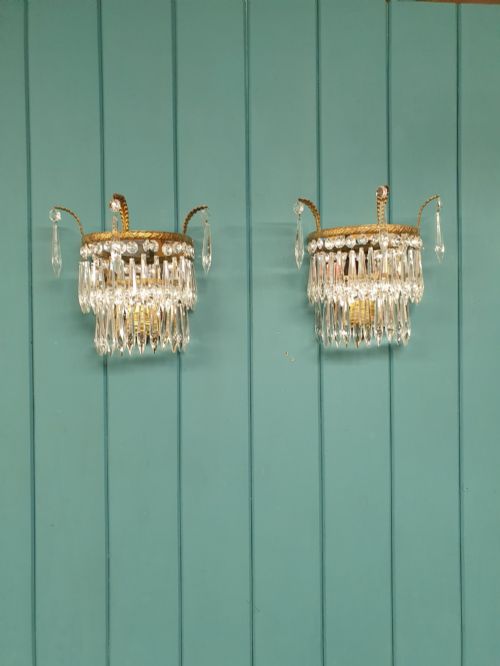


Clear Crystal Wall Lights
Clear crystal wall lights bring a bright, reflective warmth to a room through cut glass, brass, and gilt metal.
Clear Crystal Wall Lights
Clear crystal wall lights are decorative wall-mounted light fittings designed to bounce illumination around a space using glass drops and pendants. When you search for clear crystal wall lights, you encounter wall sconces, wall chandeliers, and branch lights dating from the nineteenth century through the 1930s. The selection on this page leans heavily towards Edwardian and 1920s examples, alongside late nineteenth-century pieces.
Most examples appear as pairs, whether configured as simple spike designs, prison bag lights, tent forms, or multi-armed fixtures. Origins span English, French, Italian, and Scandinavian workshops, incorporating mirror backs, cherub motifs, and beaded details. These pieces function both as auxiliary lighting and as decorative wall ornaments in their own right.
Forms range from compact twin-branch assemblies to large triple-arm French fixtures and Swedish glass lustres. The construction consistently relies on wall mounting plates that support arms, backplates, or frames dressed in glass and crystal. Dating relies on the specific combination of mounting style, metalwork finish, and the cut of the crystal.
Materials and construction
The physical structure of these wall lights depends on metal frames cast or fabricated from brass, bronze, gilt metal, and general metalwork. These metal armatures hold the weight of the glass components and secure the fixture firmly to the wall. Mirror backs frequently sit behind the arms to amplify the light output.
Glass and crystal elements are shaped through cutting, moulding, and bead-stringing to create lustres, drops, tent sections, and bag structures. Cut crystal and cut glass refract the bulb illumination, while specialist elements like the Baccarat production demonstrate precise factory standards. Metal components are often patinated or gilded to complement the brilliance of the crystal.
Clear Crystal Wall Lights Retail Price Guide 2026
Typical asking prices for clear crystal wall lights among the pieces listed under this phrase on Sellingantiques today, from the lower quarter to the upper quarter. They describe what is for sale here now, not the wider market.
Listings span the nineteenth century, Edwardian period, 1910, 1920, and 1930, utilising brass, bronze, glass, crystal, and gilt metal.
Distinguishing quality in construction and material
Quality separates fixtures by the clarity and depth of the crystal cutting, alongside the weight and detail of the supporting metalwork. Heavier bronze and brass castings with chased or gilded surfaces indicate superior manufacture compared to simpler stamped metal frames.
The complexity of the glass dressing dictates the tier of the piece, moving from basic spike or bag forms to intricate French tent arrangements, multi-branched configurations, and signed factory production. Intact original lustres, beads, and matching components preserve the integrity of the design.
Baccarat
The Clear Crystal Wall Lights Glossary
- Bag light
- A wall light featuring a flattened, bag-like cascade of crystals tapering towards the bottom. This form was popular during the Edwardian period.
- Lustre
- A pendant drop of cut glass or crystal hung from a lighting fixture to refract light. Lustres swing slightly to catch illumination from the bulbs.
- Tent and bag
- A lighting configuration where a conical canopy of glass strands sits above a gathered bag of crystals. This style reflects French Neoclassical and Regency influences.
- Spike wall light
- A fixture featuring prominent upright crystal spikes or spears projecting from the central body. These project forward from a secure wall plate.
- Twin branch
- A lighting arm configuration holding two distinct bulb sockets or candle holders. Such branches extend outward from a central backplate.
Clear Crystal Wall Lights: Frequently Asked Questions
What periods do these wall lights cover?
The pieces span from the late nineteenth century through the Edwardian era, the 1910s, 1920s, and into the 1930s. Styles reflect French Regency, Italian Regency, and English domestic design.
Earlier examples often feature heavy brass or bronze casting, while later 1930s fixtures incorporate streamlined neoclassical or factory-produced elements.
How were these wall lights used?
They served as decorative and practical illumination in principal rooms, drawing rooms, and hallways of period homes. The reflective qualities of the crystal and mirror backs maximised the impact of candle or early electric light.
Pairs were typically positioned flanking mirrors, fireplaces, or architectural doorways to create symmetrical balance.
How do I install antique wall lights?
Installation requires secure mounting to wall studs or appropriate masonry anchors to support the combined weight of the metal frame and glass crystals. Professional electrical wiring is necessary to integrate vintage fixtures with modern household circuits.
Pendants and lustres are generally hung after the main metal armature is securely fixed to the wall.
How do I clean crystal wall lights?
Cleaning involves careful dusting of the metal frame and individual removal of glass drops for washing in warm soapy water. A soft cloth prevents scratching the cut crystal and delicate gilt or bronze surfaces.
Leaving the fixture wired while cleaning is avoided to ensure safety during maintenance.