


Clear Crystal Stemware Pair
These clear crystal stemware pair selections bring together matched drinking vessels spanning the Georgian, Victorian, and Edwardian eras.
Clear Crystal Stemware Pair
When you search for a clear crystal stemware pair, you encounter matched drinking vessels created across multiple historic periods including Georgian, Victorian, and Edwardian eras. These objects comprise specific functional forms such as wine glasses, champagne flutes, champagne coupes, beer and ale glasses, and decorative vases.
The versions you are most likely to meet on this page span from eighteenth century Georgian pieces to nineteenth century Victorian bowls and early twentieth century Edwardian examples. Each pairing demonstrates the prevailing drinking customs and table requirements of its specific period.
Makers and origins reflected in the evidence range from English workshops to continental European manufacturers such as Stevens & Williams, Theresienthal, and Moser. These pairings represent diverse design movements including Jugendstil and Vienna Secession alongside traditional British cut glass.
Materials and methods
The pieces recorded in the evidence utilise lead crystal, flint glass, and cranberry glass. These high clarity materials provide the structural foundation necessary for deep faceting and thin blown walls.
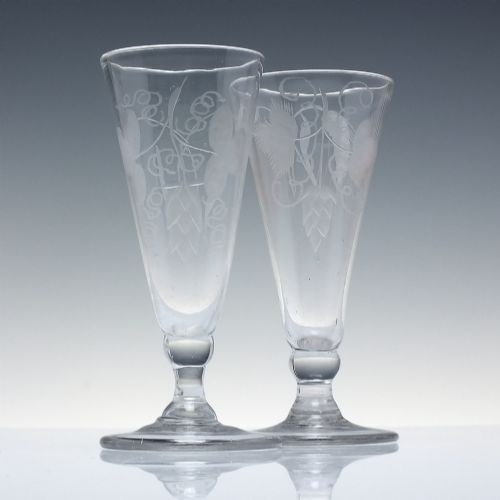
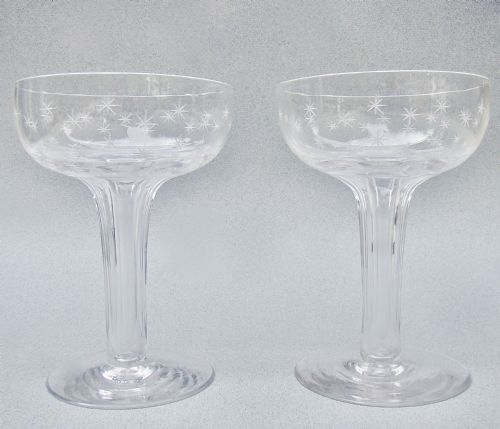
Makers employed complex surface techniques including wheel cutting, star-etching, acid cutting, and direct engraving with motifs such as convolvulus. Enamel decoration and cameo casing further distinguish the continental European examples.
Jacobite sympathy glasses carried hidden political toasts in their engraving, ready to be raised secretly over the water jug.
Judging quality in matching pairs
Quality rests upon the precision of the matching between the two items in the pair, ensuring consistent weight, height, and wall thickness. Superior examples display crisp faceting and deeply incised engraving that remains sharp to the touch.
The choice of material and the complexity of the decorative technique dictate the sophistication of the vessel. Pieces featuring multi-layered cased glass, detailed enamel work, or specialised designer output from firms like Moser represent the upper tier of the range.
Stevens and Williams·Theresienthal·Moser·Otto Prutscher
The Clear Crystal Stemware Pair Glossary
- Lead Crystal
- Glass containing a significant proportion of lead oxide, which increases weight, brilliance, and refractive index.
- Flint Glass
- An historical term for clear, high-purity glass used in fine drinking vessels.
- Champagne Coupe
- A shallow, broad-bowled stemmed glass traditionally used for sparkling wines.
- Facet Cut
- A decorative surface treatment consisting of multiple flat, polished planes ground into the glass.
- Cranberry Glass
- Transparent pinkish-red glass produced by adding gold chloride to the molten batch.
Clear Crystal Stemware Pair: Frequently Asked Questions
What periods do these stemware pairs cover?
The selection covers pieces originating from the Georgian period through the Victorian era and into Edwardian times. Specific dates span from the late eighteenth century up to the early twentieth century.
This broad chronological range incorporates traditional British glassmaking alongside continental European works from German and Austrian design movements.
How were these pairs used historically?
These vessels functioned primarily as dining table service items for serving wine, beer, ale, and champagne during formal meals and social gatherings. Certain forms, such as champagne coupes and hock glasses, fulfilled specific roles for particular beverages.
Over time, some pairs also served decorative functions as small display vases or cabinet pieces rather than functional tableware.
How do I care for antique crystal stemware?
These delicate pieces require careful hand washing in warm water using mild detergent, avoiding sudden temperature changes that can stress the historic glass. Storing them upright on stable surfaces prevents rim damage.
Due to their age and material composition, mechanical dishwashers must be strictly avoided to protect the surface polish and engraved details.
How do I identify a matched pair?
A matched pair shares consistent dimensions in height, bowl diameter, and foot width, along with identical decorative motifs and glass coloration. Slight variations in hand-blown and hand-cut items are normal but the overall form remains balanced.
Examining the pontil marks, weight distribution, and cutting style helps confirm that both items originated from the same workshop and production period.