


Classical Urn Flower Painting
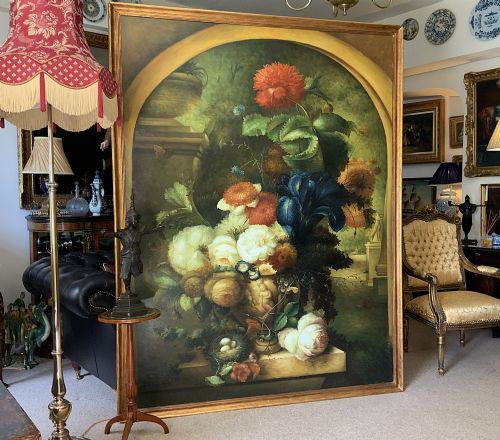
A classical urn flower painting brings Dutch Golden Age and Flemish revival botanical mastery into your interior.
Classical Urn Flower Painting
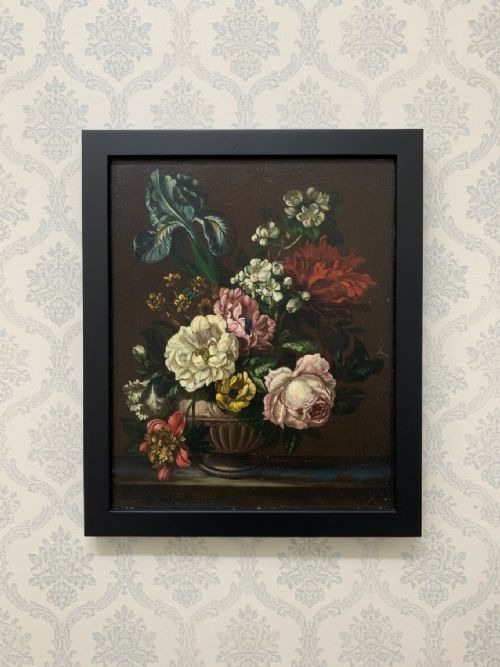
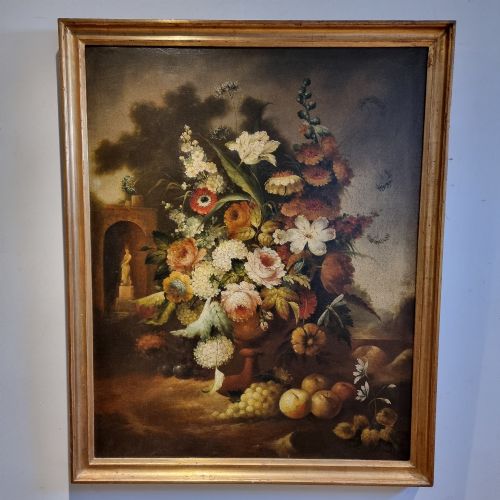
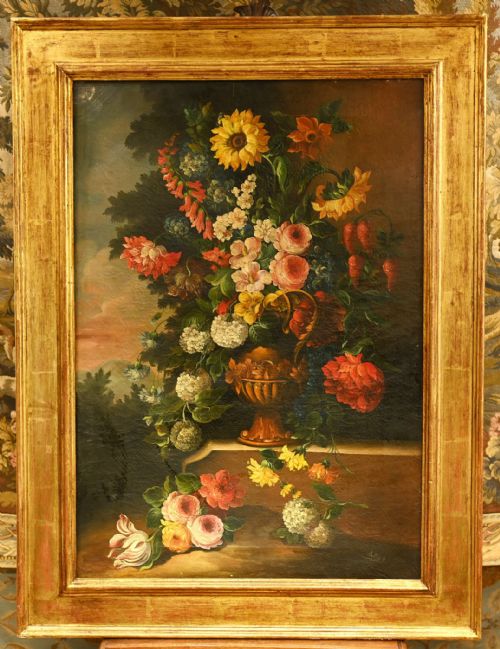
A classical urn flower painting centres on botanical arrangements housed within classical vessels, spanning periods from the eighteenth century to the mid-twentieth century. These artworks reflect historical revivals, notably Dutch Golden Age and Flemish revival traditions, capturing floral abundance alongside symbolic elements like fruit or pigeons.
Most examples found here take the form of oil paintings on canvas or wood panels, encompassing both eighteenth-century works and later nineteenth-century and twentieth-century interpretations. The compositions range from Italian school board paintings to trompe l'oeil still lifes set in the classical style.
How they were made
These works rely on oil paint applied to prepared supports such as canvas or wood panel, utilising traditional layering techniques to build depth and luminosity. Artists worked with rich pigments to render intricate petals, foliage, and the reflective surfaces of vases.
Frames frequently complement the artwork through gilded wood, giltwood, or gold leaf finishes, enhancing the visual weight of the paintings. Structural support is provided by sturdy wooden frames or panels, ensuring the longevity of the oil medium.
Listings feature oil paint on canvas and wood panel across periods from the 18th century to 1940.
What varies in quality
The sophistication of the brushwork and the naturalistic rendering of petals and urns dictate the visual hierarchy of these pieces. Finer examples display meticulous attention to light and shadow, characteristic of skilled practitioners within the Dutch and Italian traditions.
The condition and quality of the supporting substrate, whether canvas, board, or wood panel, together with the integrity of any associated gilded wood or gold leaf framing, influence the overall character of the piece.
The Classical Urn Flower Painting Glossary
- Oil paint
- A slow-drying medium consisting of pigments suspended in a drying oil, typically linseed, allowing for smooth blending and rich colour depth.
- Wood panel
- A rigid flat surface made of timber used as a support for painting, frequently utilised in earlier and revival panel works.
- Giltwood
- Wood that has been treated with gold leaf or a gold-coloured finish, often elaborately carved to frame traditional artwork.
- Trompe l'oeil
- An art technique involving extremely realistic imagery in order to create the optical illusion that the depicted objects exist in three dimensions.
Classical Urn Flower Painting: Frequently Asked Questions
What is a classical urn flower painting?
It is an oil painting depicting floral arrangements inside classical urns or vases, often following Dutch Golden Age or Flemish revival traditions.
These artworks span the eighteenth, nineteenth, and twentieth centuries, capturing botanical subjects with varied stylistic influences.
Which periods do these paintings come from?
The available pieces date from the eighteenth century through to the mid-twentieth century, including revival works.
Evolving interpretations reflect distinct historical periods such as the Victorian era and the 18th century revival.
What materials were used for these artworks?
Artists employed oil paint on supports such as canvas, wood panels, and boards to create these floral compositions.
Frames are frequently constructed from gilded wood, giltwood, or finished with gold leaf.
How do I style a still life painting?
These works suit traditional interiors, often hung as focal points above furniture or paired with complementary decorative objects.
Their rich oil colours and classical motifs integrate well into rooms featuring period architectural details.