



Classical Mahogany Chest
A classical mahogany chest brings architectural proportion and deep timber tones into a room, offering enduring storage grounded in Georgian, Regency, and Victorian craftsmanship.
Classical Mahogany Chest
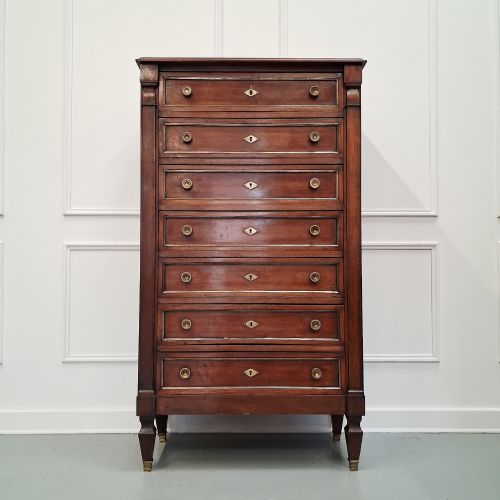
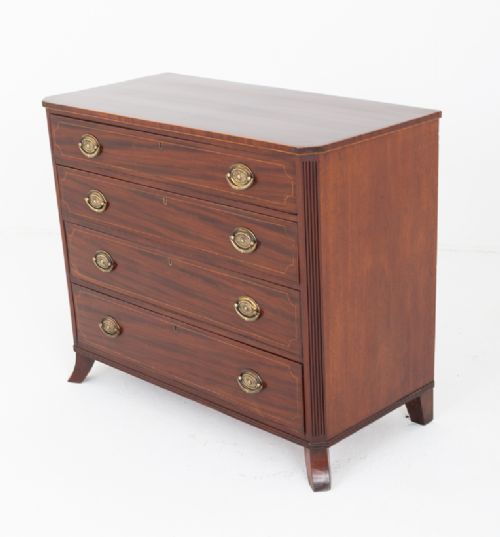
A classical mahogany chest encompasses case pieces built during the Georgian, Regency, and Victorian periods, alongside continental pieces executed in French classical styles. These forms range from traditional chests of drawers and serpentine fronts to commodes, semainiers, and specialised cabinets.
The versions most commonly met on this page span British and French influences, often featuring figured grain, inlaid satinwood, or contrasting marble tops. Alongside standard drawer configurations, the selection includes cellarettes, music cabinets, and desks that share the same vocabulary of classical design.
Makers and workshops recorded in this tradition include notable names such as Edwards & Roberts and Keeble of London, as well as pieces produced in the manner of Jean-Henri Riesener. Their work illustrates the breadth of cabinet-making that collectors encounter when seeking a classical mahogany chest.
Materials and construction
Cabinet-makers relied on solid mahogany and flame mahogany veneer applied to secondary timbers such as oak, creating stability and rich surface pattern. Selected boards were chosen for their deep grain movement and arranged to highlight the natural warmth of the timber.
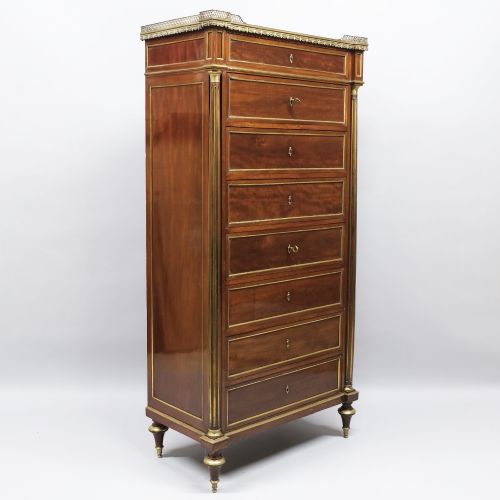
Surface enrichment frequently involved contrasting satinwood inlay, marquetry motifs, and gilt bronze or ormolu mounts. On continental and high-status pieces, grey marble tops provided a durable and weighty contrast to the timber frames.
Classical Mahogany Chest Retail Price Guide 2026
Typical asking prices for classical mahogany chest among the pieces listed under this phrase on Sellingantiques today, from the lower quarter to the upper quarter. They describe what is for sale here now, not the wider market.
Materials appearing across the collection range from solid mahogany and flame veneer to grey marble and gilt bronze mounts.
Judging quality in classical case pieces
Quality rests upon the selection of timber veneers and the precision with which decorative inlays and brass or ormolu mounts are integrated into the carcase. Superior examples display continuous grain alignment across drawer fronts and crisp carving that remains sharp over centuries.
The internal construction of the drawers, including the fineness of the dovetail joints and the choice of secondary woods like oak, indicates the standard of the workshop. Refined proportions and well-balanced hardware elevate a piece from utilitarian storage to high cabinet-making.
Edwards & Roberts·Keeble London·Jean Henri Riesener
The Classical Mahogany Chest Glossary
- Flame mahogany veneer
- A thin slice of timber cut from the fork of the tree where branches meet, producing a distinct flickering flame pattern on the drawer fronts.
- Ormolu
- Gilded bronze mounts applied to furniture edges, feet, and key escutcheons, common in French classical and Empire designs.
- Semainier
- A tall, narrow chest traditionally fitted with seven drawers, one for each day of the week, originating in France.
- Cellarette
- A freestanding container designed to hold wine bottles, often fitted with internal partitions and standing on short legs or feet.
- Marquetry
- The art of applying decorative pieces of veneer to a structure to form intricate pictorial or geometric patterns.
Classical Mahogany Chest: Frequently Asked Questions
How do I identify a Georgian chest?
Georgian pieces generally rely on proportion, clean lines, and architectural bracket feet or straight legs, avoiding excessive ornamentation. The timber used in this era is often richly grained solid mahogany rather than heavy veneered surfaces.
Drawer linings on these pieces are typically constructed from oak or pine with hand-cut dovetails. Looking at the backboards and interior construction helps confirm the period of manufacture.
What is a French semainier?
A semainier is a tall, slender chest of drawers designed to hold a week's worth of linen or personal items. These pieces often feature a marble top and restrained classical columns or pilasters.
Originating in France, they suit smaller spaces where floor area is limited but vertical storage is required. Their proportion sets them apart from wider English chest designs.
How should I care for mahogany?
Mahogany responds best to a stable environment away from direct heat sources and strong sunlight, which can fade the timber. Regular dusting with a soft, dry cloth maintains the finish without building up heavy wax residues.
Applying a traditional beeswax polish occasionally helps nourish the wood and preserve its deep colour. Avoid silicone-based sprays, as they can penetrate the grain and alter the surface.
What distinguishes Regency pieces?
Regency furniture draws inspiration from classical antiquity, featuring bolder brass inlay, lion paw feet, and dark mahogany tones. The hardware is often more pronounced, with gilt brass ring pulls and escutcheons.
These pieces reflect early nineteenth-century tastes for heavier, monumental forms. They contrast with the lighter, more linear style of the preceding Georgian period.